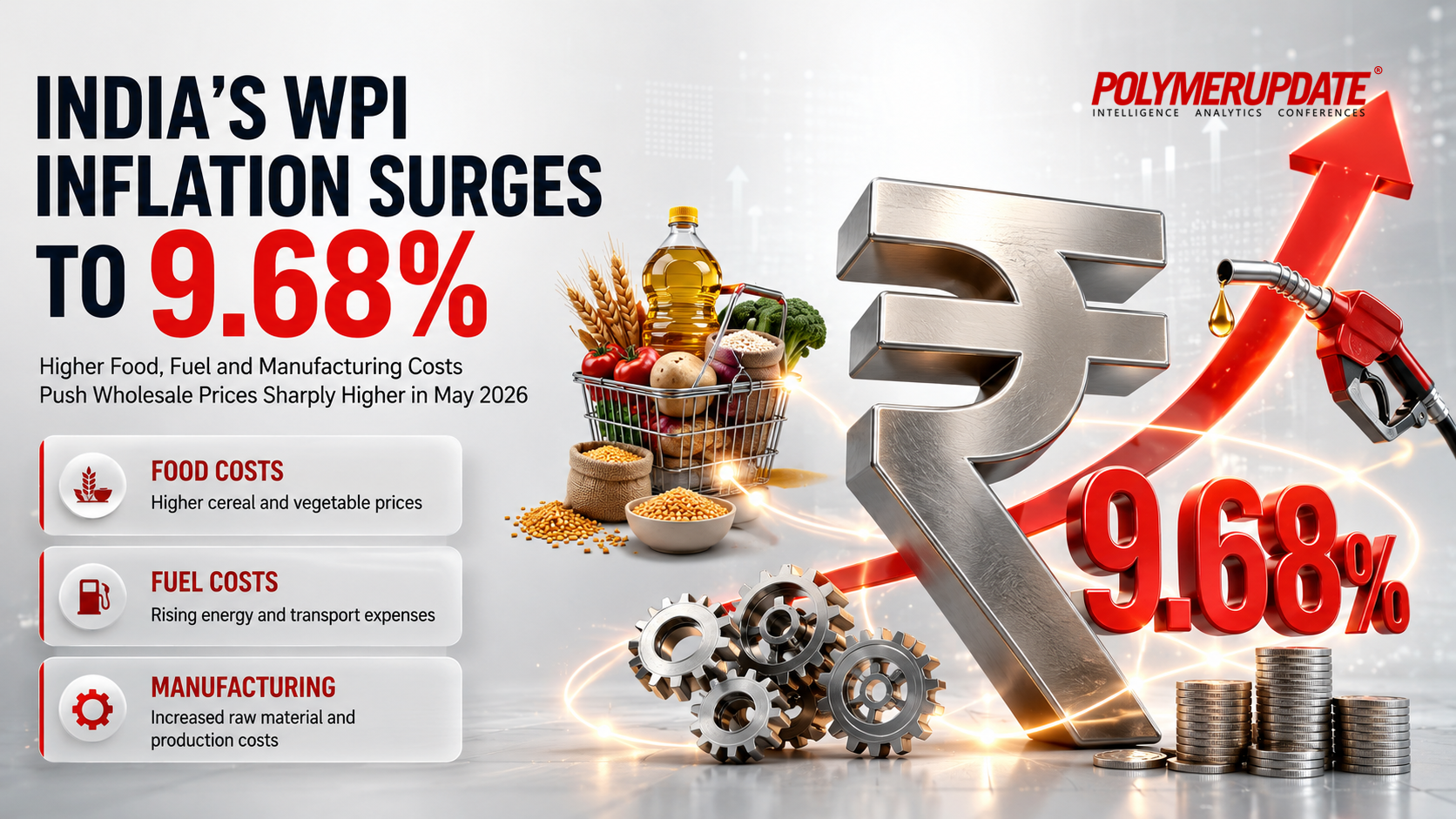
India’s wholesale inflation, measured by the Wholesale Price Index (WPI), climbed to a peak of 9.68 percent year-on-year (yoy) in May, driven by elevated prices of food, energy, and manufactured products, following the recently settled West Asia crisis that boosted overall market sentiment. This was the first WPI reading based on the new 2022-23 base year series, which represents a modest revision from the previous 2011-12 series and is intended to better reflect prevailing producer-price trends. The government announced the new WPI series earlier this month.
The May producer-price reading marked a sharp increase from the 8.26 percent rise recorded in April 2026 under the old series. In comparison, producer-price inflation stood at just 1.72 percent in May 2025, down from 2.55 percent in April 2025. Although the WPI does not directly influence government policymaking or interest-rate decisions by the Reserve Bank of India (RBI), it remains an important indicator because of its potential impact on retail prices and Consumer Price Index (CPI)-based inflation with a lag of several weeks.
A statement from the Ministry of Commerce & Industry said, “All India Wholesale Price Index (WPI) inflation for May 2026 stood at 9.68 percent on a yoy basis, compared to 8.26 percent in April 2026. The index for all commodities stood at 109.9 in May 2026, compared with 108.8 in April 2026. Across major groups, yoy inflation for primary articles, fuel and power, and manufactured products was 4.99 percent, 30.33 percent, and 7.48 percent, respectively, in May 2026, compared with 3.78 percent, 24.89 percent, and 6.68 percent, respectively, in April 2026.”
India’s retail inflation, measured by the Consumer Price Index (CPI), edged up to 3.93 percent year-on-year in May, marking the fifth consecutive monthly increase. The rise was driven by a substantial increase in food prices, including key items such as tomatoes, while energy costs remained elevated. The latest reading was the highest so far this year, with retail inflation having risen steadily from 2.74 percent in January.
Madan Sabnavis, Chief Economist at Bank of Baroda, commented, “WPI inflation for May 2026 under the new series with a base year of 2022-23 stands at 9.7 percent. The new index carries different weights for the three broad categories, though the changes are not very significant. The weight of primary articles has increased from 22.6 percent to 22.8 percent, while the weight of manufacturing has declined to 63.1 percent and that of fuel and power has risen from 13.2 percent to 14.1 percent. The mineral oil category has also been shifted from the primary articles group to the fuel and power category.”
 High food inflation
The ministry’s data showed that inflation in food articles accelerated to 3.60 percent in May from 2.43 percent in April, reflecting a notable increase in prices across key agricultural commodities. The rise was primarily driven by higher prices of oilseeds and spices, which contributed significantly to the overall increase in food inflation. The trend highlights persistent supply-side pressures in certain crop segments despite seasonal improvements in the availability of other food items.
Inflation in manufactured products also accelerated, rising to 7.48 percent in May from 6.68 percent in April. The increase suggests that input-cost pressures continue to be passed through the production chain, adding to broader inflationary concerns. The simultaneous rise in food and manufactured-product inflation indicates that price pressures are becoming more widespread across the economy, warranting close monitoring by policymakers and market participants.
Fuel inflationWholesale Price Index (WPI)-based inflation in the fuel and power category surged to 30.33 percent in May from 24.89 percent in April, reflecting a sharp increase in energy-related price pressures. Within the category, inflation in crude petroleum rose to 61.51 percent in May, compared with 56.31 percent in the previous month. The increase underscores the significant impact of elevated global crude oil prices and higher import costs on domestic wholesale inflation.
The acceleration in fuel and power inflation was primarily driven by the recalibration of domestic prices in response to rising import costs. The pass-through effect was evident across a range of petroleum products, including liquefied petroleum gas (LPG), petrol, diesel, naphtha, and kerosene, among others. Persistently high energy costs are likely to keep input prices elevated for manufacturers and transport operators, potentially exerting broader inflationary pressures on the economy in the coming months.
The uptrendThe rate of WPI inflation had been rising even before the war and has now reached 9.7 percent in May. This trend has been evident across all three major categories, with the sharpest increase recorded in the fuel and power segment due to higher crude oil prices. If oil prices decline significantly, as witnessed today, WPI inflation could moderate in the coming months on account of lower energy costs.
Manufactured products, which include the ‘core’ component of inflation, recorded an increase of 7.5 percent. Significant price increases of more than 10 percent were observed in categories such as base metals, chemicals, textiles, and electrical equipment. This is noteworthy because these cost pressures are not necessarily linked to crude oil prices. Moreover, once prices rise in products such as leather goods, apparel, and rubber products, they may not decline even if crude oil prices moderate in the global market.
Sanjay Kumar, CEO & MD of Rassense Pvt Ltd, commented, “The continued high level of inflation for end-consumers may result in a more cautious spending environment, with an increasing share of disposable income being allocated to essential goods. This could have a significant impact on consumption-driven sectors of the economy, while also raising costs for food service establishments, manufacturers, and retailers. Food prices are likely to remain volatile in the near term, particularly in view of El Niño conditions.”
He further added, “As we continue to grapple with inflationary pressures, there is a need to adopt a multi-dimensional approach to address challenges related to strengthening agricultural supply chains, reducing post-harvest losses, investing in food storage infrastructure, and improving market linkages. At the same time, the adoption of a sustainable and technology-enabled food supply chain ecosystem is vital to enhance productivity, build resilience, and achieve long-term food security.”
OutlookInflation in the coming months is likely to remain in the range of 8-9 percent, provided global crude oil prices remain stable. The major risk lies in a potential rainfall shortfall in the coming months, which could push food prices higher. Commodities such as pulses and oilseeds are likely to be particularly vulnerable to such supply-side disruptions. Another critical factor will be whether manufacturers roll back prices if their input costs decline due to easing crude oil prices. This will be especially important in industries such as chemicals, glass, ceramics, and textiles, where production costs are closely linked to energy and petroleum-based inputs.
DILIP KUMAR JHA
Editor
dilip.jha@polymerupdate.com



