India’s trade deficit widened in May despite record exports, as surging imports of raw materials for the domestic manufacturing sector and the impact of geopolitical tensions in West Asia weighed on the external balance. A widening trade gap is generally viewed as an adverse sign for the Indian economy, as it can lead to a depletion of foreign exchange (forex) reserves, put downward pressure on the rupee against the U.S. dollar, reduce the Reserve Bank of India’s (RBI) room for intervention to stabilize the currency, and increase dependence on imports, thereby making the economy more vulnerable to external developments.
Data compiled by the Ministry of Commerce & Industry showed that India’s overall trade deficit stood at US$ 10.51 billion in May, up from US$ 6.79 billion in the corresponding month last year. In April, the overall trade deficit had narrowed to US$ 7.81 billion from US$ 11.16 billion a year earlier. The Federation of Indian Export Organisations (FIEO) welcomed India’s strong foreign trade performance during April–May 2026–27, citing the resilience and growing global competitiveness of Indian exporters amid evolving international economic conditions, particularly following the U.S.-Israel-Iran peace agreement.
Commenting on the trade data, Madan Sabnavis, Chief Economist at Bank of Baroda, said, “Indian exports showed a good degree of resilience, reaching US$ 45.2 billion despite the pressures arising from the war, registering growth of 18 percent. Imports stood at US$ 73.41 billion, up around 20.6 percent, resulting in a trade deficit of US$ 28.2 billion. This was broadly similar to the level recorded in April. It appears that exporters have adjusted to the current global economic environment and have managed to maintain their position three months into the conflict. Imports trended higher due to elevated crude oil prices, which kept the trade deficit at a higher level.”
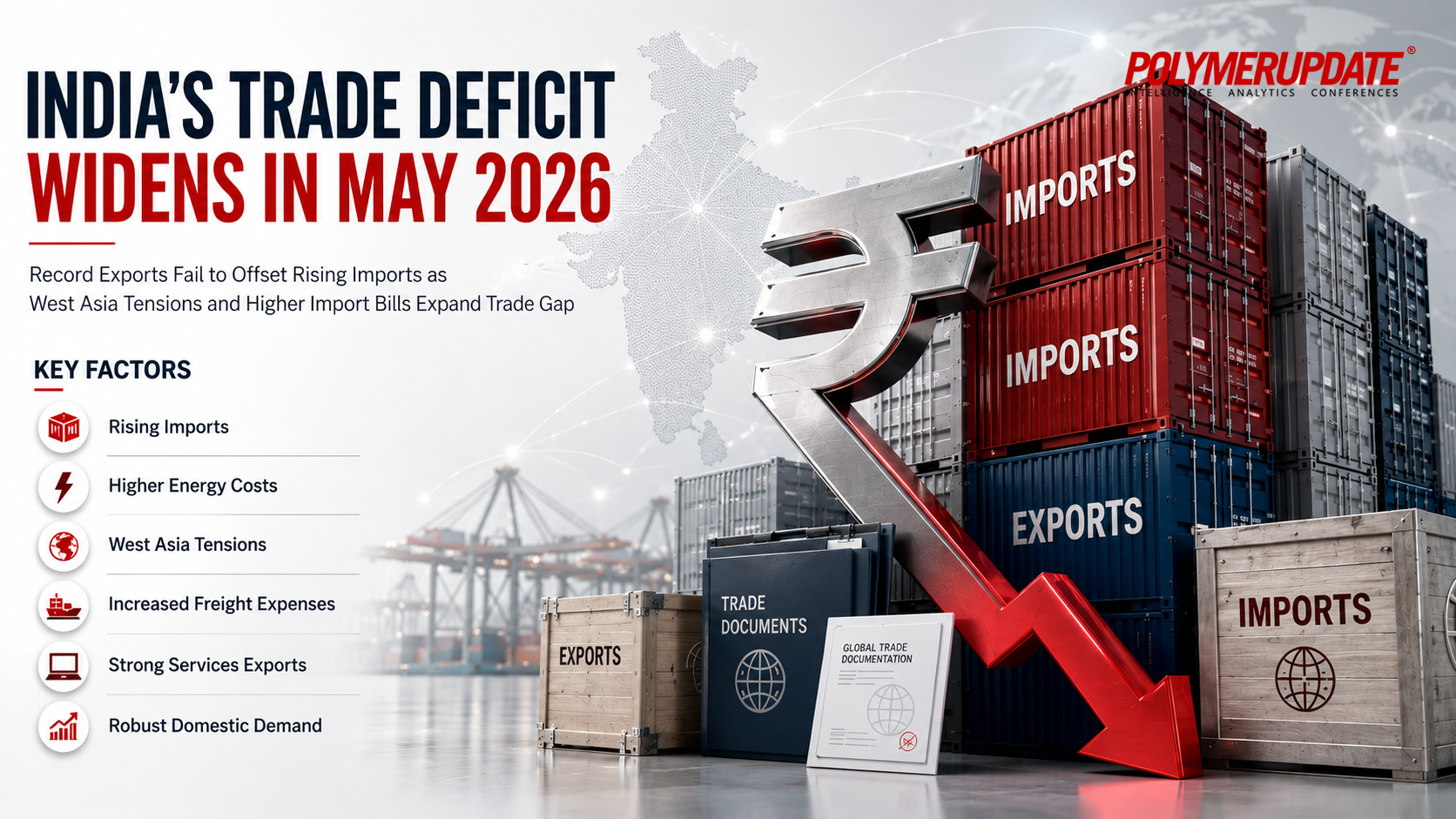 Merchandise trade
India’s merchandise exports surged to a record monthly high of US$ 45.20 billion in May 2026, up from US$ 38.30 billion in the corresponding month last year, reflecting strong external demand and improved performance across key export sectors. The Ministry of Commerce described the figure as the highest-ever monthly merchandise export value, underscoring the resilience of India’s export sector despite persistent global economic uncertainties and trade-related challenges.
However, this robust export performance was overshadowed by a sharp increase in merchandise imports, which rose to US$ 73.41 billion in May 2026 from US$ 60.86 billion a year earlier. The higher import bill, driven by increased purchases of crude oil, industrial raw materials, and other essential commodities, remained the primary factor behind the widening trade deficit. As a result, the gap between exports and imports widened significantly, highlighting the continued dependence of India’s trade balance on import trends despite record export earnings.
Service sector performanceIndia’s services trade remained a key pillar of the country’s external sector performance in May 2026, generating a surplus of US$ 17.7 billion. Services exports rose to an estimated US$ 36.76 billion from US$ 32.46 billion in the same month last year, reflecting continued strength in sectors such as information technology, business services, financial services, and professional consulting. At the same time, services imports also increased, reaching US$ 19.06 billion compared with US$ 16.70 billion a year earlier, indicating steady domestic demand for overseas services.
Despite the rise in imports, the services sector continued to generate a substantial trade surplus, providing an important cushion against the large merchandise trade deficit. The strong surplus helped reduce the overall imbalance in India’s external trade account and highlighted the growing importance of the services sector in supporting foreign exchange earnings. However, the gains from services trade were insufficient to fully offset the widening merchandise trade gap, resulting in a broader overall trade deficit during the month.
Bi-monthly trade dataAccording to the latest trade data, India’s overall exports (merchandise and services combined) during April–May 2026–27 reached US$ 162.69 billion, registering a healthy growth of 14.66 percent over the corresponding period of the previous year. Merchandise exports during April–May 2026–27 stood at US$ 88.91 billion, recording robust growth of 16.09 percent, while merchandise exports in May 2026 alone reached US$ 45.20 billion, reflecting an impressive growth of 18.01 percent.
India’s overall imports (merchandise and services combined) during April–May 2026–27 stood at US$ 182.83 billion, showing growth of 14.38 percent. Merchandise imports during the period reached US$ 145.35 billion, registering growth of 15.14 percent, while merchandise imports in May 2026 stood at US$ 73.42 billion, reflecting a growth of 20.62 percent.
S. C. Ralhan, President of FIEO, stated, “The strong growth in exports during the first two months of FY 2026–27 is a highly encouraging sign for India’s external sector. Achieving over 16 percent growth in merchandise exports and nearly 15 percent growth in overall exports despite global uncertainties demonstrates the resilience, adaptability, and competitiveness of Indian exporters.”
“This performance reflects the positive impact of policy reforms, enhanced market access initiatives, growing manufacturing capabilities, and the sustained efforts of exporters across sectors. The recent diplomatic breakthrough in West Asia, involving the emerging peace framework among the United States, Iran, and other regional stakeholders, is a positive development for global trade, shipping, and supply chains, he added”
The reported reopening of the Strait of Hormuz and the de-escalation of geopolitical tensions are expected to improve the movement of goods, stabilize freight and insurance costs, and enhance predictability in international trade flows. These developments are also likely to benefit Indian exporters and provide a further boost to exports in the coming months, given that the Gulf Cooperation Council (GCC) region remains one of India’s key export markets. Engineering goods, petroleum products, electronic goods, drugs and pharmaceuticals, chemicals, gems and jewellery, textiles, rice, cotton products, and plastics continued to drive India’s export growth during the period.
Market diversificationIndia's leading export destinations during April–May 2026–27 included the United States of America (USA), the United Arab Emirates (UAE), Singapore, China, the Netherlands, the United Kingdom, Bangladesh, Tanzania, Germany, and Saudi Arabia. Continued strong demand from both traditional and emerging markets reflects growing global confidence in Indian products and services. The expanding presence of Indian exporters across diverse geographies is helping strengthen India's position in global trade while reducing dependence on a limited number of markets.
On the import side, India's major sourcing partners during the period were China, Russia, the USA, the UAE, Saudi Arabia, South Korea, Singapore, Japan, Germany, and Oman. Key imported commodities included petroleum products, electronic goods, machinery, gold, transport equipment, non-ferrous metals, coal, chemicals, plastics, and vegetable oils. The increase in imports of capital goods, machinery, electronics, and industrial inputs indicates sustained economic activity, strong investment demand, and continued growth in the manufacturing sector.
Ralhan further emphasized that as India advances toward its aspiration of becoming a developed economy and a global manufacturing hub, exports will continue to play a critical role in driving economic growth, generating employment, and boosting foreign exchange earnings. The encouraging trade figures at the start of the fiscal year reinforce confidence in achieving stronger export growth during 2026–27.
FIEO expressed confidence that ongoing infrastructure improvements, PM Gati Shakti initiatives, digital trade facilitation measures, Free Trade Agreements (FTAs), Production-Linked Incentive (PLI) schemes, and proactive export promotion efforts by Indian Missions abroad will further enhance India's export competitiveness. FIEO reiterated its commitment to working closely with the Government, industry stakeholders, and exporters to help achieve India's long-term export ambitions and contribute significantly to the vision of Viksit Bharat.
OutlookIndia’s trade deficit is likely to narrow after the signing of the U.S.-Iran peace agreement, scheduled for June 19, as lower crude oil prices and easing geopolitical tensions in West Asia are expected to reduce import costs and improve trade flows.
DILIP KUMAR JHA
Editor
dilip.jha@polymerupdate.com



