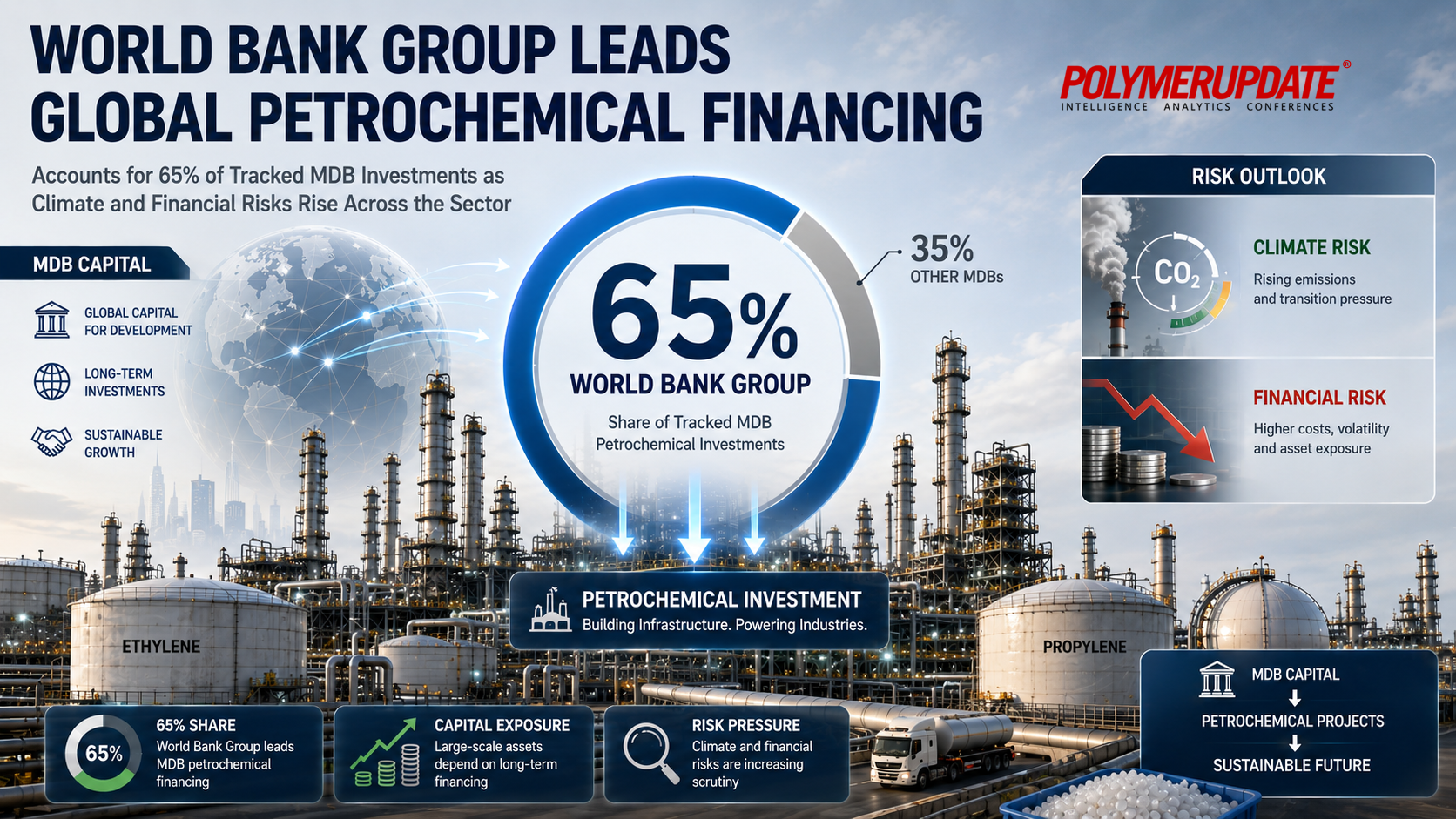
The World Bank Group has emerged as the dominant multilateral financier of the global petrochemical industry, accounting for nearly two-thirds of all tracked investments, according to a new database released by the Institute of Energy Economics and Financial Analysis (IEEFA) and the International Accountability Project (IAP). The Global MDB Investment in Petrochemicals Tracker, launched last week, maps investments made by 16 multilateral development banks (MDBs) across 92 petrochemical projects worth a combined US$ 10.04 billion.
The interactive database, built using the Early Warning System (EWS), offers one of the most comprehensive assessments of how development finance institutions are supporting petrochemical expansion, infrastructure and decarbonisation initiatives worldwide. The findings show that institutions within the World Bank Group collectively account for 65 percent of the total investment value, highlighting their pivotal role in financing one of the world’s most carbon-intensive industrial sectors.
 IFC emerges as the largest investor
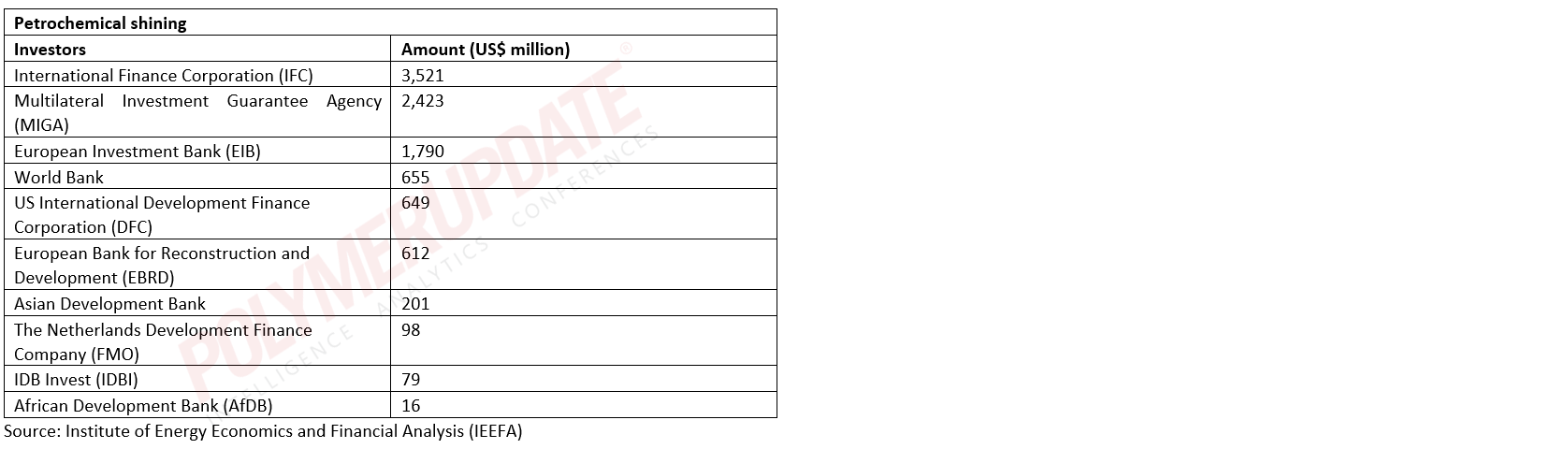
The International Finance Corporation (IFC), the private-sector lending arm of the World Bank Group, is the single largest investor, contributing 35 percent of the total funding tracked. It is followed by the Multilateral Investment Guarantee Agency (MIGA) with a 24 percent share, while the World Bank itself accounts for 7 percent. Among other multilateral lenders, the European Investment Bank (EIB) contributes 18 percent, the European Bank for Reconstruction and Development (EBRD) accounts for 6 percent, and the Asian Development Bank (ADB) represents 2 percent of the total investment value.
The concentration of financing within a handful of institutions underscores the significant influence MDBs continue to exert over the direction of global petrochemical development despite increasingly ambitious climate commitments.
 Agrochemicals attract the highest funding
The tracker reveals that agrochemicals remain the largest investment destination within the petrochemical value chain. Projects involving fertilisers, ammonia and urea account for US$ 3.23 billion, representing 32 percent of all investments tracked. Polymers and plastics-related projects follow closely with US$ 3.03 billion, while petrochemical infrastructure—including storage, logistics and industrial facilities—accounts for another US$ 2 billion.
Looking ahead, approved projects indicate an even stronger tilt towards agrochemicals. Fertiliser, ammonia and urea projects are expected to receive around US$861 million, making them the single largest category of future MDB-supported petrochemical investments. Within the IFC’s own petrochemical portfolio, agrochemical projects dominate even more decisively. Investments in urea, fertilisers, ammonia and related chemicals constitute 51 percent of IFC’s petrochemical financing. Plastic and polymer manufacturing—including naphtha, ethylene derivatives, polyethylene, PET, polystyrene and plastic packaging—accounts for 19 percent, while integrated oil refineries represent 14 percent.
Greenfield projects dominate investment pipelineThe analysis shows that MDB financing remains largely focused on expanding production capacity. Expansion and greenfield developments together account for 57 percent of total investments, reflecting continued support for new petrochemical facilities and capacity additions. By comparison, decarbonisation projects receive 14 percent of funding. These include initiatives such as integrating renewable energy into existing petrochemical plants, developing hydrogen production facilities and implementing emission-reduction technologies across industrial operations.
Research and development accounts for another 10 percent of investments, including projects exploring alternative feedstocks and toxic-free polymer technologies. The database also distinguishes projects by their implementation stage. Approximately 40 percent of tracked investments are already completed, while 38 percent are either approved or proposed. Active or ongoing projects account for 16 percent, indicating a substantial pipeline of future petrochemical investments.
West Asia and Africa dominate regional allocationGeographically, petrochemical financing is heavily concentrated in resource-rich regions. The Southwest Asia and North Africa (SWANA) region attracts the largest share at 39 percent, followed by sub-Saharan Africa with 22 percent. Europe accounts for 20 percent, while Asia, excluding West Asia, receives 12 percent of the total investment value. North and South America each account for about 3 percent.
Among individual countries, Oman leads investment inflows in the Southwest Asian and North Africa (SWANA) region, while Nigeria is the largest recipient in Africa. In Europe, Belgium and Germany dominate petrochemical financing, whereas India, followed by China and Indonesia, are the principal destinations in Asia. Mexico and Argentina receive the largest shares across the Americas. The regional concentration reflects the industry’s continued reliance on hydrocarbon-producing economies and rapidly industrialising markets where demand for fertilisers, plastics and petrochemical feedstocks remains robust.
Climate concerns over continued financingWhile the tracker primarily documents investment flows, IEEFA researchers argue that the findings raise important questions about the compatibility of MDB financing with global climate goals. Swathi Seshadri, Energy Specialist for Petrochemicals at IEEFA South Asia, said the organisation’s research over the past three years has consistently pointed to oversupply, weakening profitability and growing financial risks within the petrochemical industry.
She noted that petrochemicals remain one of the most difficult industrial sectors to decarbonise and warned that recent geopolitical tensions in West Asia have further exposed the sector’s vulnerability to supply-chain disruptions. According to Seshadri, continued MDB support for petrochemical expansion therefore represents significant financial as well as climate-related risk.
The International Accountability Project said the new database addresses a long-standing transparency gap by providing standardised information on petrochemical investments that had previously been difficult to trace across multiple institutions. Alessandro Ramazzotti, Researcher at IAP, said the tracker offers policymakers, researchers and affected communities an evidence-based tool to evaluate whether multilateral development banks are aligning their investment decisions with stated climate commitments.
Avoiding scrutinyVaishnavi Varadarajan, Program Coordinator for Asia Pacific at IAP, argued that petrochemical projects often avoid the level of scrutiny applied to other carbon-intensive investments. She said MDBs should apply identical environmental safeguards and accountability standards to petrochemical financing, given its long-term implications for emissions, communities and climate.
The tracker arrives at a time when global petrochemical markets are grappling with persistent overcapacity, volatile margins and mounting pressure on development finance institutions to balance industrial growth with decarbonisation objectives. With US$10 billion already committed and a significant pipeline of approved projects, the database suggests that multilateral lenders will continue to play a defining role in shaping the future of the global petrochemical industry.
DILIP KUMAR JHA
Editor
dilip.jha@polymerupdate.com



