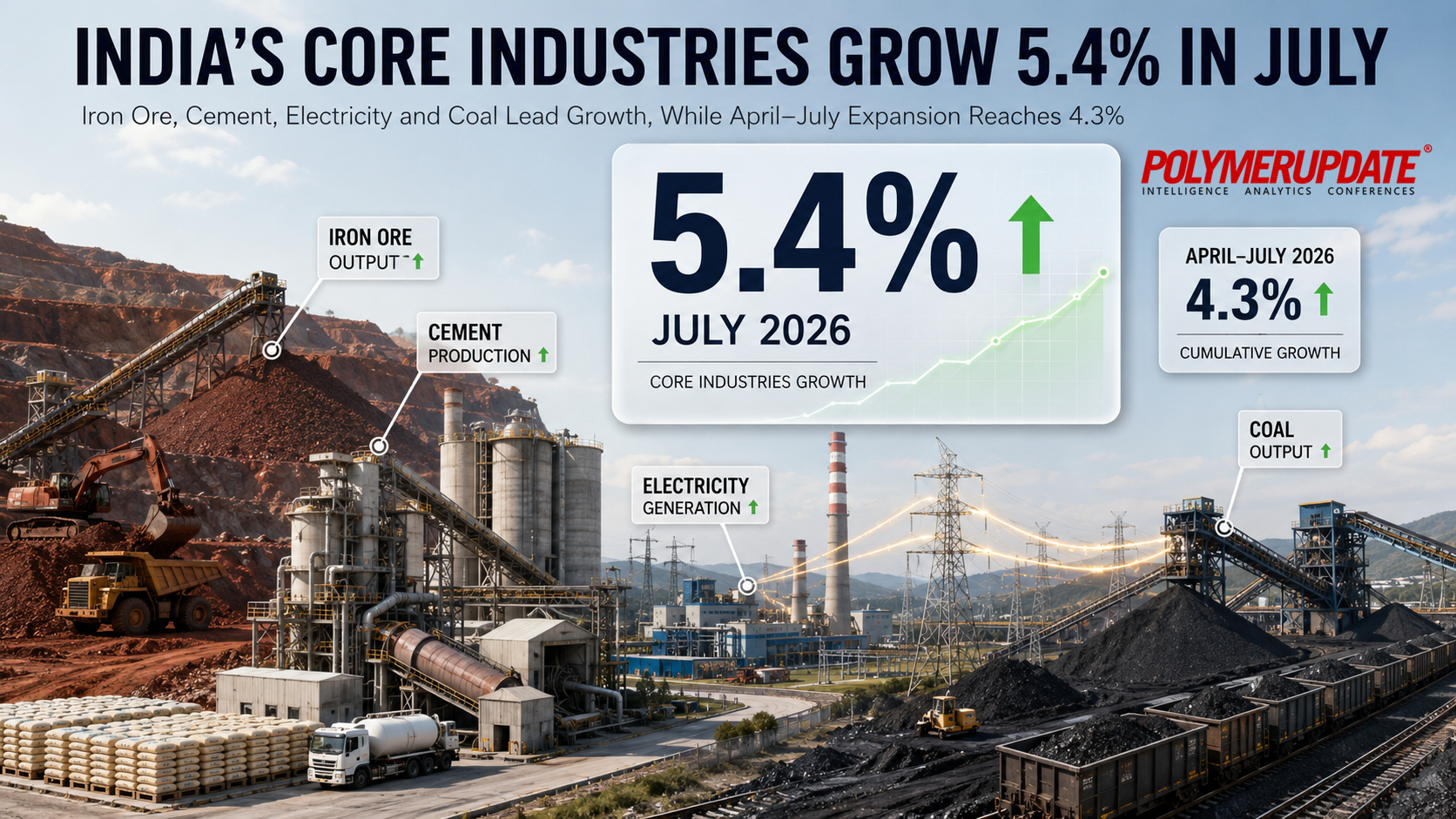
India’s eight core industries recorded a healthy 5.4 percent year-on-year growth in July 2026, driven by strong output in iron ore, cement, electricity and coal, although the pace moderated slightly from the revised 6 percent expansion registered in June, according to provisional data released by the Ministry of Commerce & Industry. The latest figures indicate that the country’s industrial activity continues to remain resilient despite global economic uncertainties and supply-chain disruptions, with infrastructure-linked sectors emerging as the principal engines of growth.
The Index of Core Industries (ICI), which measures the performance of eight key sectors accounting for 40.27 percent of the weight in the Index of Industrial Production (IIP), has also shown a marked improvement on a cumulative basis during the current financial year. Between April and July 2026, the core sector expanded by 4.3 percent, significantly higher than the 1.5 percent growth recorded during the corresponding period of the previous fiscal year, reflecting stronger momentum in construction, mining and power generation.
 Iron ore posts strongest growth
Among the eight industries, iron ore emerged as the standout performer with an impressive 29.5 percent year-on-year increase in production during July. The sharp rise was largely supported by robust domestic demand from steelmakers, higher mining activity and continued government emphasis on infrastructure development, which has boosted consumption of steel and other construction materials. Cement production registered the second-highest growth at 13.1 percent, underscoring sustained activity in housing, roads, railways and other infrastructure projects.
The double-digit expansion suggests that public capital expenditure and private construction continue to provide strong support to industrial demand. Electricity generation rose 9 percent from a year earlier as rising industrial consumption, commercial activity and seasonal demand lifted power output. Electricity, along with iron ore and cement, has consistently remained one of the largest contributors to overall core sector growth in recent months.
Coal and refinery products remain positiveCoal output increased 7.6 percent year on year, reflecting higher production from domestic mines aimed at meeting growing thermal power demand and reducing import dependence. The continued expansion in coal production has also helped improve fuel availability for power utilities during periods of elevated electricity consumption. Steel production recorded a more modest 2.9 percent growth in July.
Although the sector continued to expand, the pace remained relatively subdued compared with upstream raw materials such as iron ore, indicating cautious capacity utilisation amid fluctuating global steel prices and softer export demand. Refinery products grew 2.7 percent, supported by steady domestic consumption of transportation fuels and petrochemical feedstocks. However, refinery growth remained moderate as refiners balanced maintenance shutdowns and changing crude processing economics during the month.
Three sectors contractNot all core industries recorded positive performance in July. Natural gas, crude oil and fertilizers witnessed negative year-on-year growth, highlighting persistent challenges in domestic hydrocarbon production and seasonal variations in fertilizer output. The decline in crude oil production continues to reflect the long-term maturity of India’s producing fields and limited gains in domestic exploration, keeping the country heavily dependent on imported crude.
Lower natural gas output also underscores supply constraints despite rising demand from the power, fertilizer and city gas distribution sectors. Meanwhile, fertilizer production slipped into negative territory, largely due to operational and seasonal factors, although demand is expected to remain supported by the agricultural sector during the ongoing crop cycle.
Infrastructure sectors drive momentumThe July data reinforces the growing role of infrastructure-related industries in sustaining India’s industrial expansion. Iron ore, electricity and cement together accounted for the largest share of the overall increase in the Index of Core Industries, reflecting continued government investment in highways, railways, urban infrastructure and industrial projects. The broad-based improvement across mining, construction materials and power generation also provides a favourable signal for the manufacturing sector, as stronger core industry performance typically supports growth in the broader Index of Industrial Production in subsequent months.
Economists said the continued resilience of India’s core industries is being underpinned by sustained government capital expenditure and a gradual recovery in private investment. Higher spending on highways, railways, urban infrastructure, housing and industrial projects has boosted demand for essential inputs such as steel, cement, electricity and iron ore, while improving capacity utilisation and fresh investments by the private sector have further supported industrial production. They believe this investment-led momentum is likely to remain a key driver of core sector growth in the coming months.
June growth revised upwardThe ministry also revised the June 2026 core sector data upward, providing a stronger base for the latest industrial assessment. The final Index of Core Industries for June was revised to 120.7 from the provisional estimate of 119.6. As a result, the year-on-year growth rate for June has been upgraded to 6 percent from the earlier estimate of 5 percent.
The revision reflects updated production data submitted by source agencies and suggests that industrial activity during June was stronger than initially estimated. Such revisions are common in the core sector index, as provisional estimates are compiled using the latest available production figures and subsequently updated after receiving final data from reporting ministries and industry bodies.
OutlookDespite the slight moderation from June, July’s 5.4 percent expansion indicates that India’s industrial recovery remains on a firm footing. The sustained strength in mining, cement and electricity is expected to continue benefiting from ongoing infrastructure spending, while higher cumulative growth during the first four months of FY2026-27 points to improving underlying industrial momentum. However, the outlook is likely to remain mixed across sectors. Continued weakness in domestic crude oil and natural gas production, along with evolving global energy market conditions, could weigh on the energy segment.
At the same time, stable construction activity and government-led capital expenditure are expected to keep demand for steel, cement and mining products relatively robust in the coming months. With the cumulative core sector growth rising to 4.3 percent in April-July 2026 from 1.5 percent a year earlier, the latest data suggests that infrastructure-driven industrial expansion continues to provide a solid foundation for India’s broader economic growth trajectory.
DILIP KUMAR JHA
Editor
dilip.jha@polymerupdate.com



