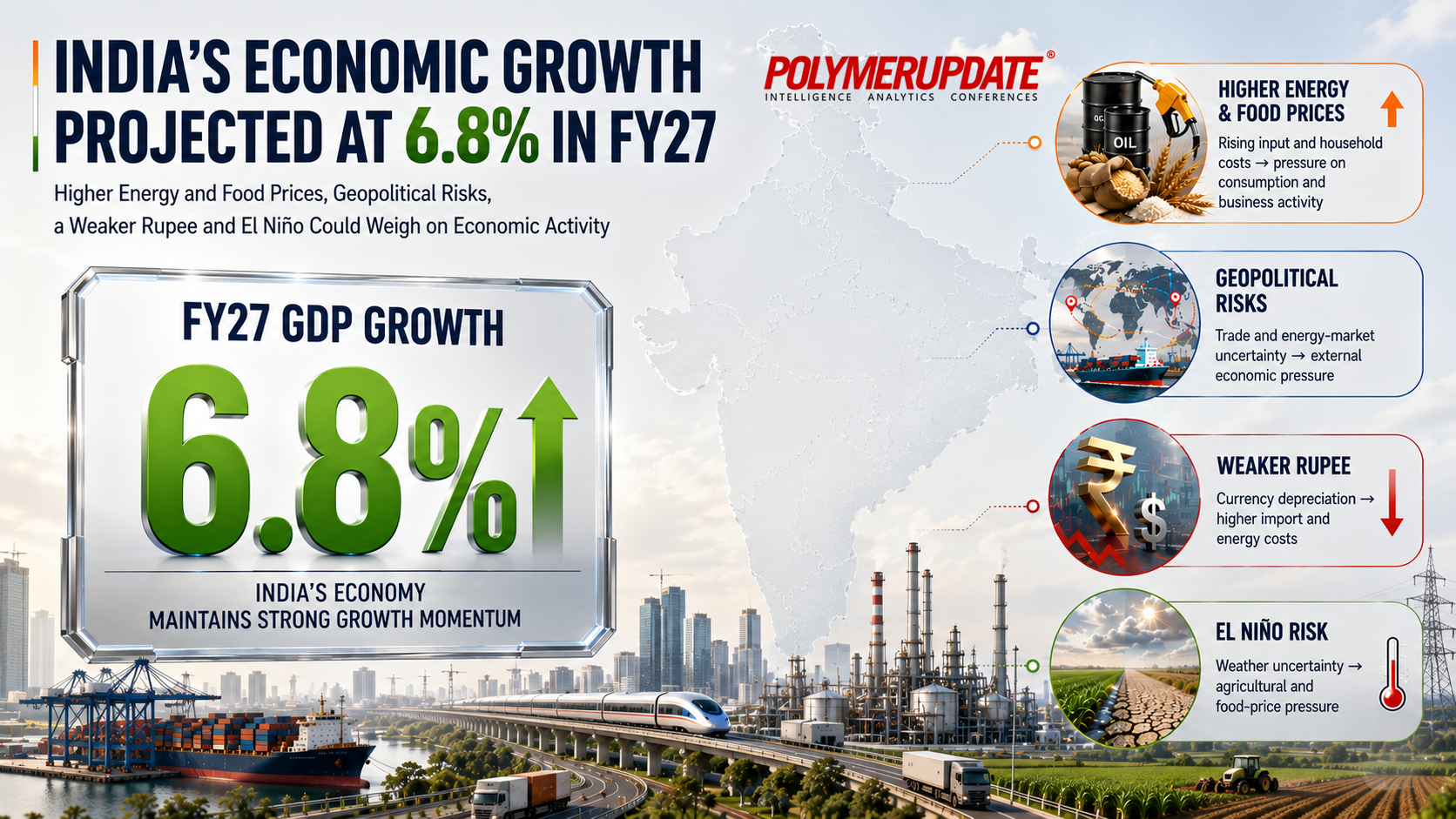
India’s economic growth is expected to moderate to 6.8 percent year on year (yoy) in FY27 (April-March) from 7.6 percent in FY26, as higher energy and food prices, geopolitical uncertainty, a weaker rupee and the potential impact of El Niño weigh on economic activity, leading credit rating agency India Ratings and Research projected in its latest report. The latest forecast stands marginally higher than its May 2026 estimate of 6.7 percent, but remains below the National Statistical Office’s (NSO) provisional estimate of 7.6 percent growth for FY26.
The ratings agency expects the unresolved West Asia conflict and its implications for energy prices and trade flows to remain key risks to the growth outlook. Achieving the government’s FY27 fiscal deficit target of 4.3 percent would remain challenging because of higher subsidies on liquefied petroleum gas and fertilisers. While stronger direct tax collections and non-tax revenues could support fiscal consolidation, indirect tax collections may remain a challenge.
“Crude oil price of the Indian basket averaged US$ 101.31 a barrel in the April-June 2026 quarter (1QFY27) and US$ 96.49 a barrel for April-July 2026. Our crude oil price assumption for FY27 is US$ 85 a barrel. Lower oil prices positively impact the Indian economy by reducing the trade/current account deficit (CAD). However, higher inflation due to El Niño may limit growth upside from lower oil prices,” said Devendra Pant, Chief Economist and Head – Public Finance, in the report released Tuesday.
 Lower crude oil prices
Ind-Ra has lowered its FY27 crude oil price assumption to US$ 85 a barrel from US$ 95 a barrel in its May 2026 forecast, reflecting expectations of softer international crude prices. The agency expects petrol and diesel pump prices to remain unchanged during the year. It has also projected the rupee-dollar exchange rate to average INR 93.98 in FY27, compared with INR 94.28 in its May forecast, implying a 6.4 percent depreciation from a year earlier.
Ind-Ra expects capital inflows of around US$ 70 billion through foreign currency non-resident bank (FCNR(B)) deposits and external commercial borrowings (ECBs). Such inflows are likely to provide support to the rupee by improving foreign currency liquidity and could help ease pressure on domestic financial markets. The expected inflows would also help strengthen India’s external financing position amid elevated energy import costs and persistent global and geopolitical uncertainties.
Inflation to remain elevatedAlthough real GDP growth is expected to slow, higher inflation will lift nominal GDP growth to 10.4 percent in FY27 from 8.9 percent in FY26. The GDP deflator is projected to rise 3.4 percent yoy, sharply higher than 1.1 percent in FY26. The report forecasts average Consumer Price Index (CPI) inflation at 4.9 percent in FY27, compared with 2.1 percent in FY26, while Wholesale Price Index (WPI) inflation is expected to rise to 8.5 percent from 0.7 percent. The agency attributed the increase primarily to higher food and energy prices.
The impact of El Niño remains a particular concern. Cumulative rainfall was 39.8 percent below normal through the end of June 2026, although improved rainfall in July and the first week of August reduced the deficit. Even so, rainfall remained 11.3 percent below normal as of August 7, while the distribution of rainfall remained uneven. The weak monsoon has already begun affecting food prices, and an adverse base effect is expected to keep food inflation elevated at least through October 2026. Ind-Ra assumes rainfall at 94 percent of the long-period average during August and September, resulting in seasonal rainfall at around 90.6 percent of normal.
Government capex remains key growth driverGross fixed capital formation (GFCF), the second-largest component of GDP from the demand side, accounted for 32.3 percent of GDP in FY26. Government investment in physical infrastructure is expected to remain the principal driver of capital formation in FY27, supporting manufacturing as well as cement and steel demand. Ind-Ra expects GFCF growth at 8.0 percent yoy in FY27, higher than its previous forecast of 7.2 percent, but marginally below 8.2 percent in FY26.
However, if fiscal risks rise because of government measures to cushion the economy from the West Asia crisis, public capital expenditure could be restrained. Quarterly GDP growth is projected at 6.9 percent in 1QFY27, 6.6 percent in 2QFY27, 6.7 percent in 3QFY27 and 6.9 percent in 4QFY27. These compare with the Reserve Bank of India’s forecasts of 7.0 percent, 6.4 percent, 6.5 percent and 6.8 percent, respectively.
Fiscal and external pressuresThe government’s target of reducing the fiscal deficit to 4.3 percent of GDP in FY27 from 4.4 percent in FY26 is likely to be difficult to achieve. Higher LPG and fertiliser subsidies, possible reductions in fuel excise duties and potential monetary support to mitigate the impact of El Niño could put additional pressure on government finances. The government to rely more on credit measures, including credit guarantees, rather than direct spending to address the economic impact of the West Asia crisis. However, direct cash support to farmers and other affected sections to offset the impact of El Niño cannot be ruled out.
The current account deficit is expected to widen to 1.5 percent of GDP in FY27 from 0.6 percent in FY26 and FY25, reflecting higher energy import costs and rupee depreciation. Rising commodity prices could further widen the deficit and exert downward pressure on the domestic currency. The external balance, comprising the current account and net foreign direct investment, is expected to more than double to negative 1.2 percent of GDP from negative 0.5 percent in FY26.
Bond yields to remain near 7%India’s 10-year government security yield breached 7 percent in late April 2026 but subsequently declined following joint government and RBI efforts to attract dollar inflows through FCNR(B) deposits and ECBs. Yields traded between 6.76 percent and 6.83 percent during the first week of August. Ind-Ra expects around USD70 billion of inflows through these channels, which should help address near-term external financing pressures. It expects the 10-year government bond yield to remain around 7 percent.
Risks remain tilted to the downsideThe principal downside risks to the FY27 growth outlook include the unresolved West Asia conflict, elevated inflation, a weaker rupee, slower-than-expected government capital expenditure, weak global trade growth and the high growth base created by FY26’s 7.6 percent expansion. The potential impact of El Niño represents another significant risk, particularly through food inflation and rural demand. The recently announced US decision to impose a 100 percent tariff on India over its purchases of Russian crude could also weigh on trade and economic activity.
Ind-Ra’s 6.8 percent growth forecast assumes crude oil prices settle at around USD 85/bbl. A sharper decline in oil prices, a weaker-than-expected El Niño impact and stronger capital inflows could push growth above the agency’s current estimate. Looking ahead, Ind-Ra expects real GDP growth to improve by 20-50 basis points in FY28 from its 6.9 percent FY27 forecast, assuming normal rainfall in 2027 and an even distribution across regions and time. Stable crude oil prices, steady capital flows, easy liquidity conditions, resilient domestic demand and continued government capital expenditure will be crucial for sustaining the recovery.
DILIP KUMAR JHA
Editor
dilip.jha@polymerupdate.com



