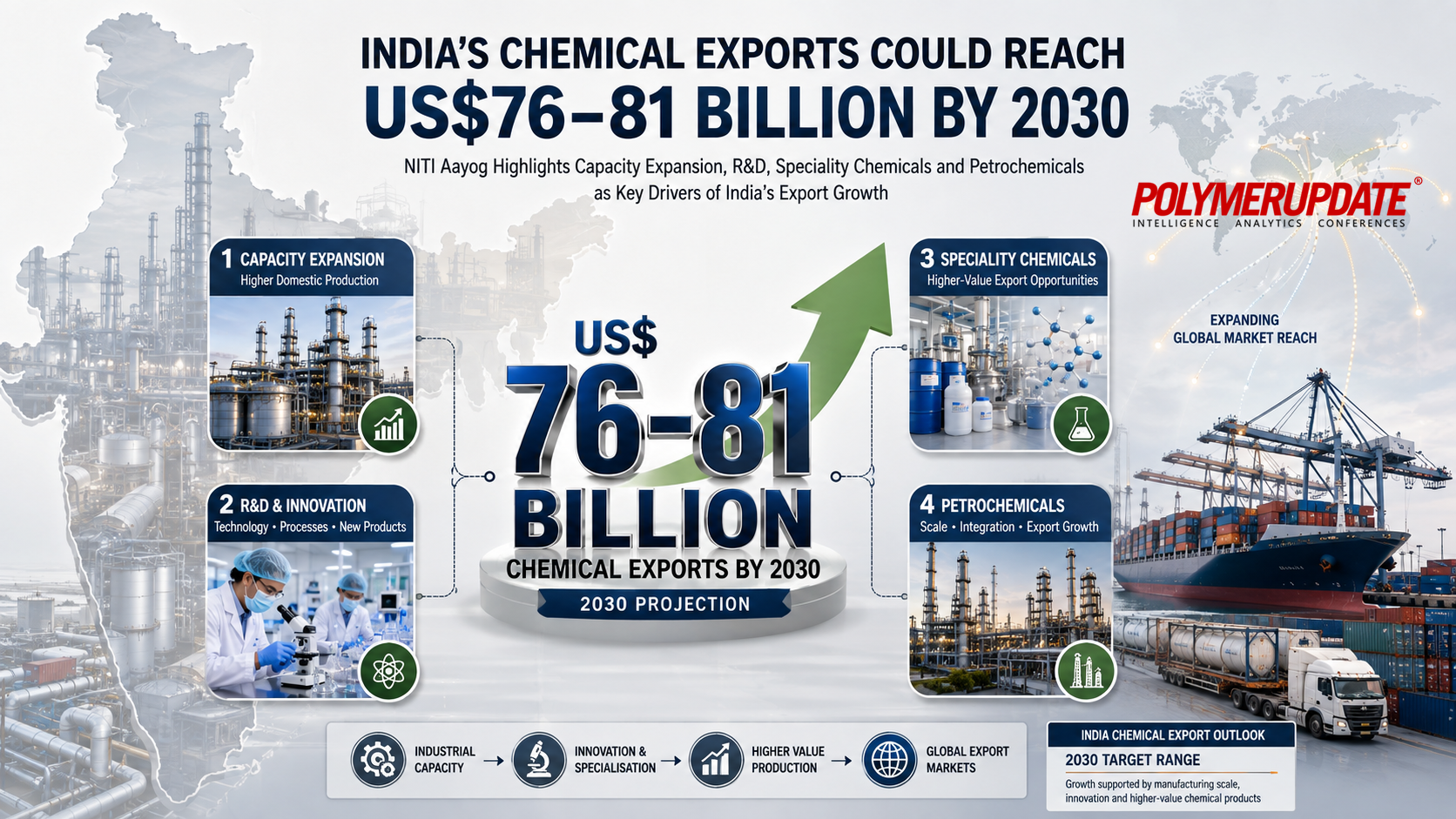
NITI Aayog, the main policy think tank of the Government of India, has projected that India’s chemical sector could double its exports to around US$81 billion over the next five years, by 2030. The growth is expected to be driven largely by substantial capital expenditure (capex) to expand production capacity and increased investment in research and development (R&D) to upgrade products in line with the requirements of overseas markets. A report released by NITI Aayog noted that a key objective for Indian chemical producers is to reduce import dependence, in line with Prime Minister Narendra Modi’s vision of making India self-reliant and emerging as a net-zero importer of chemicals within a defined timeframe.
India’s current annual chemical exports are estimated at US$32-38 billion, while government and industry projections envisage an ambitious expansion to US$76-81 billion by 2030. The overall domestic chemicals market is valued at more than US$260 billion. NITI Aayog stands for the National Institution for Transforming India. It is the principal policy think tank of the Government of India and provides policy recommendations, strategic advice and long-term development plans to the central and state governments. Established on January 1, 2015, NITI Aayog replaced the erstwhile Planning Commission.
 Aims to increase global participation
The ambitious export target is part of a broader strategy to increase India’s participation in the global chemicals value chain and strengthen its position as a major chemicals producer and exporter. The report has outlined a potential export basket comprising US$45 billion in speciality chemicals, US$5-10 billion in inorganic chemicals and around US$26 billion in petrochemicals by 2030. The combined export potential of US$76-81 billion would represent a significant expansion from current levels and require sustained investment, faster capacity creation, and improvements in technology and infrastructure across the sector.
According to the report, India’s chemicals market is projected to reach US$290-310 billion by fiscal 2030, accounting for around 5-6 percent of global chemical consumption. Rising domestic demand is expected to remain a key driver of growth, supported by industrialisation, urbanisation, expanding manufacturing activity, and increasing consumption across downstream sectors. However, meeting this demand through domestic production will require a substantial expansion in capacity. The report estimated that India’s chemical production would need to double to US$220-280 billion by fiscal 2030, from around US$110 billion in fiscal 2023.
10-11% growth targetTo achieve this objective, chemical consumption would need to grow at a compound annual growth rate (CAGR) of 10-11 percent over the next five fiscal years, while production would need to expand at a much faster 14 percent CAGR. The growth in production would not only help meet domestic requirements but also enable India to reduce its dependence on imported chemicals and intermediate products. Building adequate domestic capacity is therefore central to the country’s ambition of becoming a globally competitive chemicals manufacturing hub.
Speciality chemicals are expected to play a particularly important role in this transformation. The NITI Aayog report identified dyes and pigments, paints and coatings, agrochemicals, and flavours and fragrances as key segments capable of driving the expansion of speciality chemical exports. India has already established a presence in several international speciality chemical markets. The United States accounted for 17 percent of India’s speciality chemical exports in 2024, while Brazil accounted for another 16 percent. Despite this growing presence, India’s share of major global import markets was only around 8 percent, suggesting considerable scope for further expansion.
Plethora of opportunitiesThe relatively low share also highlights the opportunity for Indian producers to increase their participation in global supply chains at a time when multinational companies are seeking to diversify their sourcing and manufacturing bases. The country’s established manufacturing capabilities, large domestic market and availability of skilled manpower provide a strong foundation for such expansion. Government support and policy initiatives aimed at strengthening manufacturing and promoting investment could further enhance the competitiveness of the sector.
However, the report cautioned that several structural challenges need to be addressed if India is to achieve its 2030 ambitions. Infrastructure gaps, regulatory hurdles and the need for technological advancement remain significant constraints for the industry. The chemicals sector is capital-intensive and requires reliable infrastructure, uninterrupted access to energy and raw materials, efficient logistics, and predictable regulatory frameworks. Delays in obtaining approvals and fragmented infrastructure can increase production costs and reduce the competitiveness of Indian manufacturers in export markets.
Need for technological upgradationTechnological advancement is another critical requirement. Moving into higher-value speciality chemicals and advanced chemical products will require greater investment in research and development, process innovation, and modern manufacturing technologies. Strengthening links between industry, research institutions, and academia could help accelerate this transition. The report has therefore recommended targeted investments and policy interventions to create an innovation-driven ecosystem that can enable Indian companies to move up the chemicals value chain.
A stronger domestic chemicals industry could also have wider economic implications. The report estimated that the sector could generate between 700,000 and one million new jobs by the end of the decade as production capacity expands and new downstream industries emerge. The employment potential is likely to extend beyond direct manufacturing jobs, with growth expected in logistics, engineering, maintenance, research and development, distribution, and other supporting activities.
Petrochemical sector holds the keyThe petrochemical segment is expected to remain an important component of the export strategy, with a potential export target of around US$26 billion by 2030. Expanding petrochemical capacity could ensure greater availability of feedstocks and intermediates for downstream industries, including plastics, packaging, automotive components, consumer goods, and construction materials. At the same time, increasing domestic production of speciality and inorganic chemicals could help reduce import dependence in several strategic segments. A broader and deeper domestic chemicals ecosystem would reduce exposure to international supply disruptions and improve the resilience of Indian manufacturing.
For India, the opportunity is particularly significant as global chemical supply chains continue to evolve. Companies and countries are increasingly looking to diversify their sourcing and establish alternative production bases, creating an opportunity for India to capture a larger share of global trade. However, converting this opportunity into sustained export growth will require Indian producers to compete on quality, cost, scale, innovation, and reliability. Merely expanding capacity will not be sufficient.
Companies will need to develop higher-value products, meet international environmental and quality standards, and build long-term relationships with customers in key overseas markets. The NITI Aayog projections therefore represent both an opportunity and a challenge for the industry. Achieving exports of US$76-81 billion by 2030 would require rapid expansion in production, significant investment in technology and infrastructure, and a coordinated policy approach.
OutlookIf these conditions are met, India’s chemicals industry could evolve from being primarily driven by domestic demand into a major global manufacturing and export hub. The combination of a rapidly expanding domestic market, rising production capacity, and growing international demand could provide a strong foundation for India to substantially strengthen its position in the global chemicals value chain by 2030.
DILIP KUMAR JHA
Editor
dilip.jha@polymerupdate.com



