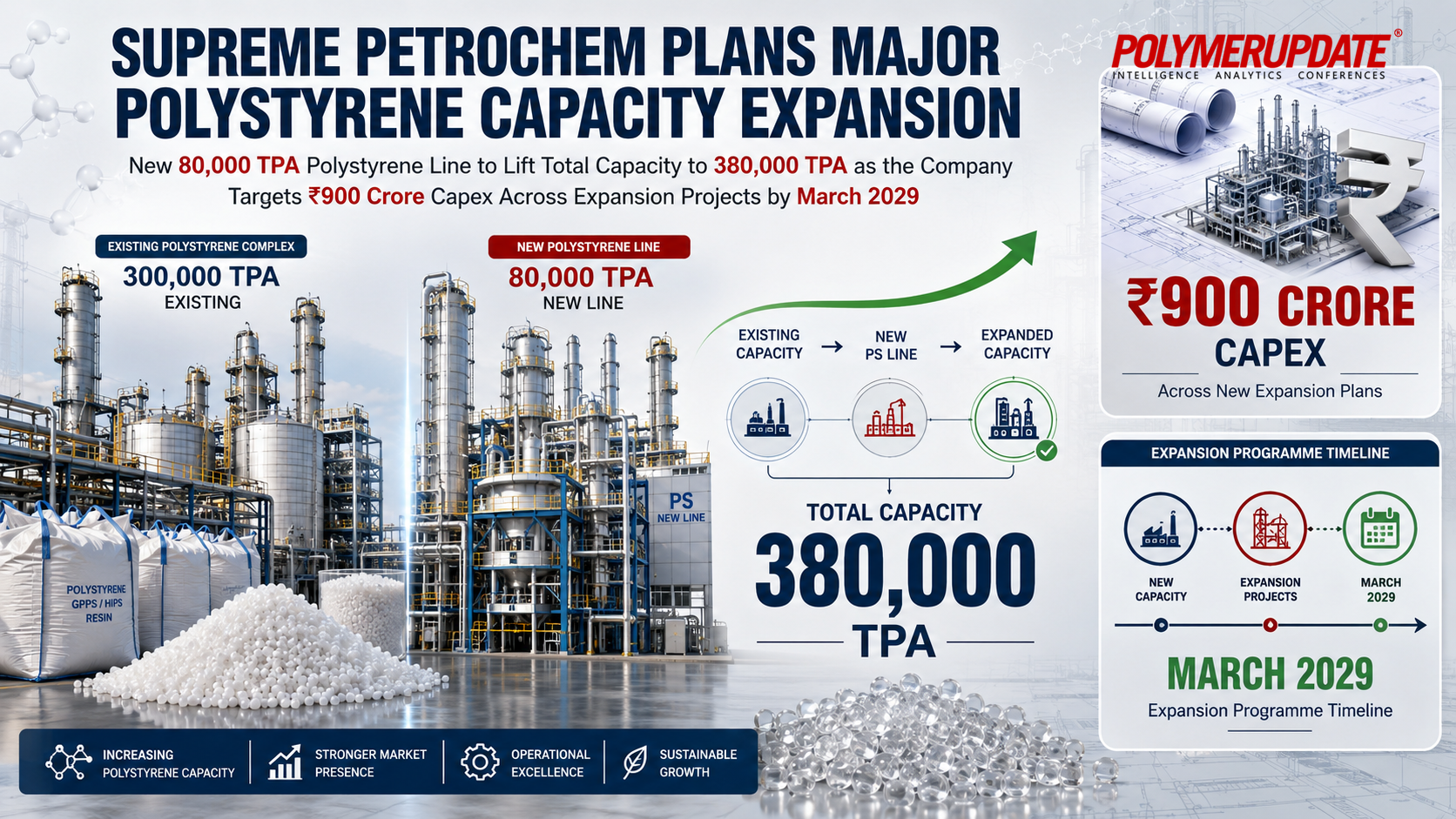
Mumbai-headquartered Supreme Petrochem Ltd (SPL), a leading Indian petrochemical company and India’s top producer and exporter of polystyrene, with a domestic market share of more than 50 percent, is planning to set up a new polystyrene line with an estimated capacity of 80,000 tonnes per annum (TPA), entailing a total capital expenditure of Rs 450 crore. The proposed expansion would increase the company’s total production capacity to 380,000 TPA from the existing 300,000 TPA upon completion. The project is proposed to be funded entirely through internal accruals, with commercial production expected to commence in December 2028.
Speaking to analysts, Rakesh Nayyar, Executive Director of Supreme Petrochem Ltd, said, “The board has approved the installation of a new 80,000 tonnes per annum polystyrene production line at its Amdoshi complex in Maharashtra. The project is expected to be completed by December 2028 and will increase the company’s total installed polystyrene capacity from 3,00,000 tonnes per annum to 3,80,000 tonnes per annum. The total estimated investment in the project is Rs 450 crore, which will be funded entirely through internal accruals.”
Additionally, the company has initiated projects to set up a new wide-width EPS board line with a capacity of 150,000 cubic metres, along with an expansion of its compounding capacity from 50,000 tonnes per annum to 80,000 tonnes per annum. These projects are expected to be commissioned by June 2027. Regarding its expansion projects, the company has also successfully completed the Phase II expansion of its EPS capacity.
 Alternate supply arrangements
During the April-June 2026 quarter, geopolitical tensions in West Asia and disruptions to cargo movement through the Strait of Hormuz led to significant interruptions in liquid and container shipments from the Gulf region. In addition, all three styrene plants in the region, which are among the company’s traditional suppliers, suspended operations due to safety concerns, creating significant supply chain challenges. The company established alternative supply arrangements and was able to meet the entire requirement of its domestic customers without interruption. However, exports remained minimal due to reduced availability of styrene monomer, a significant increase in freight rates, limited shipping availability and longer voyage times.
On the raw material front, styrene monomer prices in international markets remained elevated for most of the quarter and softened briefly towards the end of June. However, the renewed escalation of hostilities in West Asia has once again resulted in an increase in styrene monomer prices. Furthermore, the temporary suspension of import duties on commodity polymers, introduced to offset the impact of higher import costs, led to an unintended increase in imports, resulting in an erosion of market share for domestic producers.
Operational performanceOn the operational front, the sales volume of manufactured products stood at 70,842 metric tonnes during the April-June quarter, compared with 93,853 metric tonnes in the corresponding quarter of the previous year. Thus, sales volumes declined by 24.5 percent during the quarter. The decline in volumes was primarily due to negligible exports amid the West Asia crisis and subdued demand from the non-OEM segment during the quarter.
On a standalone basis, revenue from operations for the first quarter stood at Rs 1,693 crore, reflecting a growth of 22 percent year-on-year. The increase in revenue, despite lower sales volumes, was mainly attributable to a significant rise in raw material prices due to the conflict in West Asia. The company did not record any volume growth; rather, volumes declined. SPL reported a 25 percent reduction in volumes compared with the corresponding quarter of the previous year. The improvement in margins was primarily driven by a widening of the global deltas between building-block raw materials and end products.
Operating EBITDA stood at Rs 331 crore, reflecting strong growth of 188 percent year-on-year, while operating EBITDA margins improved to 19.53 percent. Total EBITDA, including other income, stood at Rs 348 crore, with a margin of 20.3 percent. Net profit after tax stood at Rs 236 crore, with a net profit margin of 13.96 percent for the quarter. Wider deltas in international markets between styrene monomer and downstream products benefited the company’s financial performance.
The base prices of polystyrene and other polymers are determined with reference to global market trends and prevailing global deltas. The company’s margins tend to improve when global deltas are strong, while margins are likely to normalize when global deltas weaken or return to normal levels. The margin expansion witnessed during the quarter was an aberration, as global deltas were exceptionally strong. For GPPS, global deltas increased from around US$200 to more than US$300, while for HIPS, they rose from the usual range of US$275–300 to more than US$400 at times. These exceptional margins are expected to normalize over time.
Shipping issuesSPL made efforts to increase exports, particularly to Europe, during the April-June 2026 quarter, with its product grades receiving approval from European authorities. However, disruptions in the region, a sharp increase in shipping freight rates, longer voyage times and issues related to the Red Sea have adversely affected exports. Consequently, exports have taken a back seat, particularly due to the limited availability of styrene monomer.
In view of the challenging export environment, the company has been focusing on meeting demand from domestic customers over the past four months. However, once the situation normalizes and shipping routes reopen, the company plans to increase exports of EPS, seeing significant potential for better realisations in overseas markets. The company exported a small quantity of EPS last year and plans to further increase export volumes, particularly to European markets.
Rs 900-cr capexNayyar said, “We have been able to sell our compounding materials smoothly, and we will continue to do so in the future as well. Meanwhile, our focus will be on value-added customers with sound credit discipline, while avoiding supplies to customers with a history of defaults. Even in our subsidiary company, we have been working over the past year to change this mindset. In the process, growth may sometimes be slower, but ultimately, our objective is to focus only on value-added business while maintaining strict credit discipline.”
In the near term, the company does not have any plans for further EPS capacity expansion. SPL is considering expanding capacity at its Chennai facility, but that project is still some time away. Currently, the company is focusing on its ABS Line 2 and XPS projects, along with its compounding lines. The company’s board has also recently approved the addition of a fifth polystyrene line. These are the key areas on which SPL is currently focusing. All the capacities are expected to be operational by March 2029, with a cumulative capital expenditure of Rs 900 crore.
DILIP KUMAR JHA
Editor
dilip.jha@polymerupdate.com



