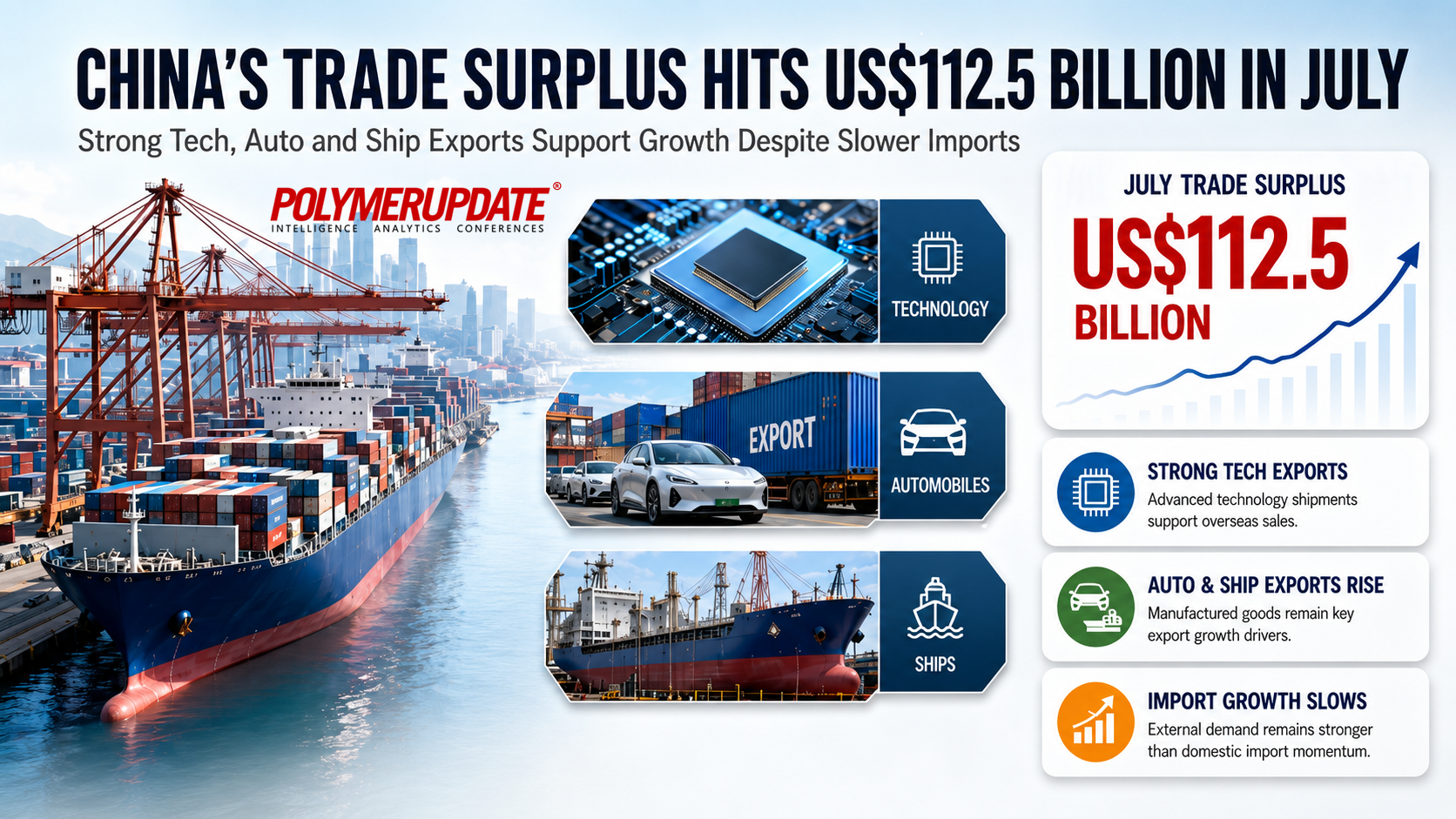
China’s trade growth remained robust in July, supported by strong external demand for higher-value products ranging from semiconductors and ships to automobiles and high-tech goods, even as imports moderated from the exceptionally strong pace recorded in June. The stronger export performance pushed China’s trade surplus to US$ 112.5 billion in July, above the market expectation of US$ 107.1 billion. The surplus was broadly in line with the US$ 112.6 billion estimate by ING Economics.
Chinese exports rose 23.9 percent year-on-year in July to US$ 397.85 billion, marking another strong month, although growth eased from 27 percent in June and was marginally above the 23 percent increase expected by the market. Imports also remained firm, increasing 27.5 percent year-on-year to US$ 285.35 billion, but slowed from 36 percent growth in June and fell short of the 29.7 percent market forecast. Sharp escalation in both exports and imports was driven by global demand for tech and green energy.
For the first seven months of 2026, China’s exports rose 18.5 percent year-on-year to US$ 2.52 trillion, while imports increased 26.7 percent to US$ 1.84 trillion. The cumulative trade surplus stood at US$ 687.4 billion, up 1 percent from a year earlier. This marked the first time since February that the year-to-date trade surplus returned to positive year-on-year growth. The latest data underscore the growing importance of external demand to China’s economic expansion at a time when domestic demand remains comparatively uneven.
 Higher-value exports drive growth
China’s export performance in July continued to reflect a structural shift towards higher-value-added products. Semiconductor exports surged 116.6 percent year-on-year, marking another month of triple-digit growth, while ship exports jumped 92.4 percent. Automobile exports increased 60.4 percent, although the pace moderated somewhat from previous months. High-tech exports remained strong, rising 52.7 percent year-on-year. The resilience of these sectors highlights the increasing role of technology-intensive and capital-intensive products in China’s export growth.
Rather than being driven solely by traditional low-cost manufactured goods, export momentum is increasingly being supported by semiconductors, advanced machinery, automobiles, ships and other higher-value products. Export growth was broad-based geographically as well. Shipments to Mexico rose 48.8 percent year-on-year in July, while exports to South Korea increased 46.6 percent. Exports to ASEAN markets climbed 38.4 percent, and those to Russia rose 34.9 percent. Exports to the European Union and Japan also remained healthy, increasing 16 percent and 14 percent, respectively.
One of the more significant developments was the continued recovery in Chinese exports to the United States. Exports to the US rose 17 percent year-on-year in July, marking the fourth consecutive month of double-digit growth. For the first seven months of the year, exports to the US were up 2.6 percent. The improvement has come despite renewed trade and technology tensions between Washington and Beijing. The US recently imposed restrictions affecting certain Chinese robotics products and power inverters and added 43 Chinese companies to its list under the Uyghur Forced Labour Prevention Act.
China responded with countermeasures, including export controls on drones destined for the US, while six US entities were added to Chinese countermeasure lists. For now, however, the broader trade truce between the two countries remains intact. The next major test could come during Chinese President Xi Jinping’s planned visit to the US on September 24. The outcome of the meeting could have significant implications for whether the current recovery in bilateral trade can continue into the fourth quarter.
Imports remain technology-ledChina’s imports also recorded strong growth in July, although the pace moderated from June. The 27.5 percent year-on-year increase was driven largely by technology-related products rather than traditional commodity imports. High-tech imports surged 58.8 percent year-on-year, while imports of automated data-processing machines jumped 198.8 percent. The strength of technology imports suggests continued investment in advanced manufacturing, automation and other technology-intensive industries. Commodity import patterns, meanwhile, showed a notable shift.
Oil imports remained in contraction, although the decline moderated substantially compared with June. Crude oil import volumes fell 24.3 percent year-on-year in July, an improvement from the 41.3 percent contraction recorded in June. Volumes nevertheless reached a three-month high. In value terms, oil imports declined 4.6 percent year-on-year. The weakness in crude imports remains closely watched by global commodity markets, particularly because Chinese demand is a major factor in determining the outlook for international oil prices.
China’s crude imports remain significantly below their pre-war normal levels, with the decline reflecting both supply-related disruptions and changing sourcing patterns. Instead, China appears to be increasing its reliance on alternative energy sources. Imports of coal and lignite surged 83.8 percent year-on-year in July, while natural gas imports rose 20.2 percent. The sharp rise in coal and natural gas imports indicates that China is compensating for weaker crude inflows with increased purchases of other fuels. The development could have implications for global energy markets, particularly for coal, liquefied natural gas and crude oil demand.
External demand remains key growth engineThe July trade figures provide further evidence that external demand has become one of the most important supports for China’s economic growth in 2026. While exports continue to benefit from strong demand for technology products, vehicles, ships and advanced manufactured goods, domestic consumption and other components of the economy have remained less evenly distributed. This divergence has created a K-shaped pattern in the Chinese economy, with export-oriented manufacturing and technology industries performing significantly better than some domestic-demand-sensitive sectors.
The strength of exports has also helped sustain industrial activity, providing an important offset to softer domestic demand. China’s policymakers have signalled a willingness to provide additional support to the economy following the July Politburo meeting. While the measures announced so far have been relatively limited, incremental policy easing could help strengthen domestic demand during the second half of the year. For now, however, external demand remains the more powerful driver of growth.
Complex trendThe July trade figures also highlight the increasingly complex nature of China’s trade relationships. Strong exports to the US are continuing despite technology restrictions and geopolitical tensions, while rapidly rising shipments to Mexico, South Korea, ASEAN and Russia are helping Chinese exporters diversify their markets. The sustainability of this export momentum will depend on several factors, including global demand, the evolution of US-China trade relations and the extent to which Beijing can maintain competitiveness in technology-intensive industries.
With the trade surplus now returning to positive year-on-year growth and exports continuing to expand at a double-digit pace, China’s external sector is likely to remain a critical pillar of economic growth in the months ahead. However, the durability of that momentum will increasingly depend on whether strong exports can be complemented by a meaningful recovery in domestic demand.
DILIP KUMAR JHA
Editor
dilip.jha@polymerupdate.com



