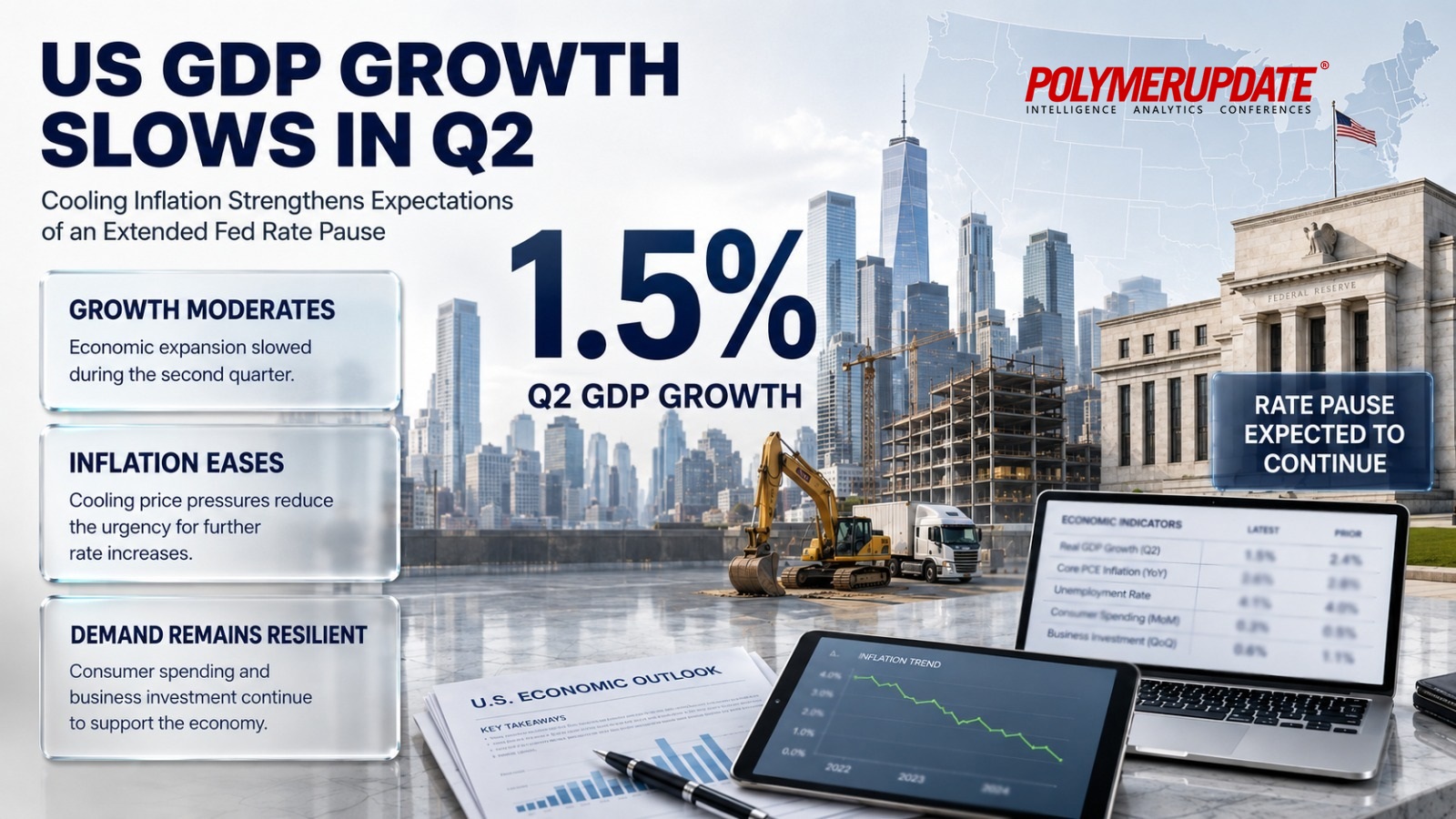
The United States economy expanded at a slower-than-expected pace in the second quarter, as gross domestic product (GDP) growth eased to an annualised 1.5 percent, falling short of market expectations of 2 percent. While the headline figure pointed to moderating economic momentum, underlying data painted a more resilient picture, with robust consumer spending and sustained business investment offsetting weakness from inventories, imports and government expenditure.
The weaker-than-anticipated GDP print, coupled with softer inflation data, reinforced expectations that the U.S. Federal Reserve is likely to keep interest rates unchanged for an extended period. Financial markets interpreted the latest macroeconomic data as reducing the likelihood of any near-term monetary tightening, prompting a decline in U.S. Treasury yields and keeping the dollar under pressure.
The Commerce Department's advance estimate showed that the world's largest economy continued to expand despite persistent global uncertainties and elevated geopolitical tensions. The growth rate broadly matched the pace recorded by the eurozone, signalling that the U.S. economy is gradually transitioning to a more sustainable expansion after several quarters of above-trend growth.
 Healthy domestic demand
Although the headline GDP figure disappointed, economists noted that domestic demand remained healthy. Consumer spending, which accounts for nearly 70 percent of U.S. economic activity, rebounded sharply during the April-June quarter. Personal consumption expenditure surged at an annualised 3.2 percent, a significant improvement from just 0.5 percent in the first quarter, highlighting the resilience of American households despite higher borrowing costs and lingering economic uncertainty.
The acceleration in household spending, however, came at the expense of savings. The household savings ratio fell further to 2.7 percent, one of the lowest levels in recent years, suggesting consumers are drawing more heavily on accumulated savings to sustain spending. While this has helped support economic growth in the near term, economists cautioned that persistently low savings could limit consumption growth if labour market conditions weaken or borrowing costs remain elevated.
Short-term issues cast a shadowBusiness investment also remained a bright spot during the quarter. Private fixed investment continued to post healthy gains, led by strong spending on technology and artificial intelligence-related infrastructure. Investment outside the technology sector also gathered momentum, indicating improving business confidence across a broader range of industries. Residential investment, which had struggled amid high mortgage rates in recent quarters, made a positive contribution to growth, suggesting that the housing sector may be stabilising.
Several temporary factors, however, weighed heavily on the headline GDP figure. A sharp rundown in business inventories reduced overall growth by 0.7 percentage points, while a surge in imports further dampened GDP calculations. Analysts attributed the increase in imports largely to strong demand for technology-related equipment and components, reflecting continued capital spending rather than weakening domestic production.
Easing government expenditureGovernment expenditure also declined by 0.8 percent during the quarter, reversing some of the gains recorded earlier. Economists believe the decline largely reflected the lingering effects of the prolonged U.S. government shutdown late last year, which created unusually large fluctuations in federal spending over successive quarters.
Alongside the GDP report, inflation data provided additional reassurance that price pressures continue to moderate. The core Personal Consumption Expenditures (PCE) Price Index—the Federal Reserve's preferred measure of inflation—rose just 0.1 percent month-on-month, below market expectations of 0.2 percent. The softer reading strengthened the central bank's decision to leave interest rates unchanged at its latest policy meeting.
Cooling inflationCooling inflation has become increasingly important for policymakers seeking to balance price stability with continued economic growth. Economists expect several structural factors to keep inflation contained over the coming months, including easing housing costs, slower wage growth and lower input prices across several industries.
Additional methodological changes to the calculation of the core PCE index, scheduled to take effect with the August inflation report due at the end of September, could further reduce the reported inflation rate. The revisions, involving portfolio management fees, computer software and legal services, are expected to lower the annual inflation reading by around 0.2 percentage points, providing further evidence that underlying price pressures are easing.
Corporate profitability may also receive support from tariff refunds and improved supply-chain conditions, helping businesses absorb higher operating costs without passing them fully on to consumers. Economists also note that any easing of geopolitical tensions in the Middle East, leading to lower crude oil and energy prices, would reinforce the ongoing disinflationary trend during the second half of the year.
Policy rate driversThe combination of slower economic growth and moderating inflation has strengthened market expectations that the Federal Reserve will maintain a prolonged pause in its policy cycle rather than resume interest rate increases. Investors now expect policymakers to closely monitor incoming labour market and inflation data before considering any further policy adjustments.
Despite the softer headline GDP figure, the broader composition of growth suggests the U.S. economy remains fundamentally resilient. Strong consumer demand, healthy business investment and improving housing activity continue to provide a solid foundation for expansion, even as temporary drags from inventories, imports and government spending weigh on overall output.
James Knightley, Chief International Economist, United States, ING Economics, “For global financial markets, the latest U.S. data carries important implications. A less aggressive Federal Reserve reduces upward pressure on global borrowing costs and supports risk assets, while a weaker U.S. dollar could provide relief for emerging-market economies and commodity-importing nations. At the same time, sustained consumer demand in the United States continues to underpin global trade and investment, reinforcing the country's role as the primary engine of global economic growth.”
While near-term uncertainties remain—including geopolitical tensions, evolving trade dynamics and the trajectory of energy prices—the latest economic indicators suggest the U.S. economy is slowing in an orderly manner rather than slipping towards recession. If inflation continues to moderate alongside steady domestic demand, the Federal Reserve is likely to remain on hold, allowing the economy to navigate a gradual soft landing over the remainder of the year.
DILIP KUMAR JHA
Editor
dilip.jha@polymerupdate.com



