The Federal Reserve left the federal funds rate unchanged at 3.5–3.75 percent for a fifth consecutive meeting in July 2026, in line with analysts' expectations, despite markets assigning roughly a one-in-three probability of a rate hike. The decision was taken at the two-day Federal Open Market Committee (FOMC) meeting held on July 28–29, with nine of the 12 members voting in favour of keeping rates unchanged, while the remaining three members supported a rate hike.
Notably, three FOMC members—Beth Hammack (Cleveland), Neel Kashkari (Minneapolis) and Lorrie Logan (Dallas)—dissented, voting for an immediate 25-basis-point (bps) rate hike. Their dissent leaves the door open to a possible rate increase in September. The central bank noted that economic activity continues to expand at a solid pace despite elevated uncertainty, partly stemming from the conflict in the Middle East. These were the same three members who had called on the Fed to drop its "easing bias" at the April FOMC meeting. Ahead of the July meeting, markets had priced in a slightly better than one-third chance of a 25-bps rate hike.
Announcing the FOMC decision, Fed Chair Kevin Warsh said: "Today, our Committee voted nine to three to maintain the target range for the federal funds rate at 3½ to 3¾ percent. The Committee is continuing its policy of maintaining ample reserves in the banking system. The economy is showing impressive resilience. Even with recent shocks, the trends remain positive and continue to reflect solid growth. Job gains have kept pace with labour force growth, and the unemployment rate has changed little. Inflation remains elevated relative to the Committee's 2 percent goal. The Committee remains resolute in delivering price stability."
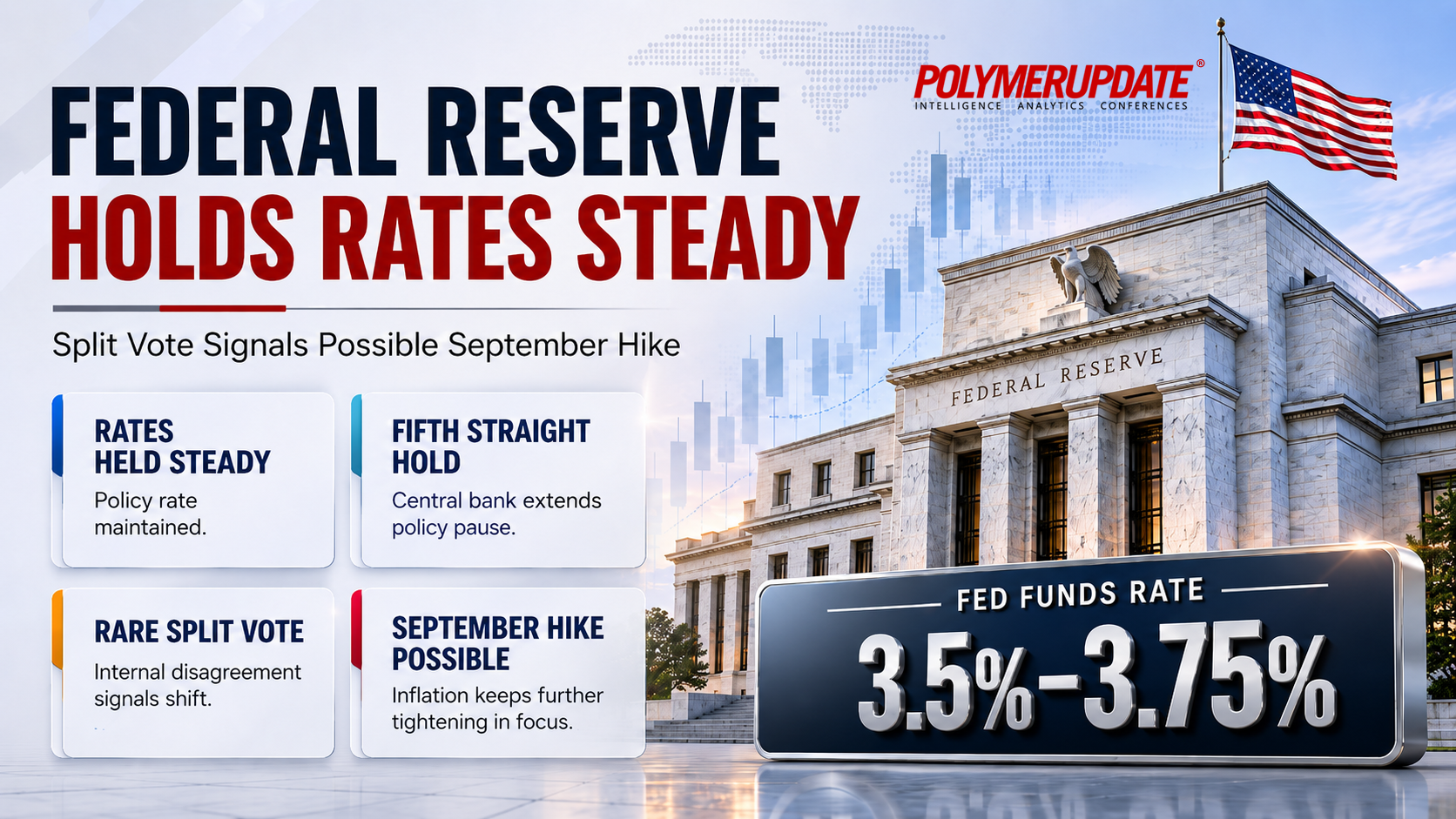 First split vote
Interestingly, this was the first split vote in recent years, with three dissenting members voting against the remaining nine members of the Committee. Warsh emphasised that the Committee's primary objective remains to keep inflation at manageable levels while continuing to work towards its 2 percent target. He also asserted, "This Fed will not waver."
Warsh added that the decision should not be interpreted as a "pause", but rather as part of the Committee's ongoing assessment of economic conditions. However, analysts remain divided over the Fed's next policy move and are now assigning a much higher probability to the central bank keeping interest rates unchanged at its September meeting than they had previously estimated.
James Knightley, Chief International Economist for the United States at ING Economics, commented: "The immediate market reaction has been a curve steepening, with two-year Treasury yields edging lower, the 10-year yield rising marginally, and the dollar softening slightly. Fed funds futures for September, which had been pricing in a cumulative 26 basis points (bps) of rate hikes ahead of the decision, are now pricing in 18 bps. As was the case last month, the accompanying statement was much briefer than those published when Jerome Powell was at the helm. There was nothing new in it, with the acknowledgement of 'solid' economic activity and 'elevated' inflation, alongside a continued commitment to price stability."
Inflation target missed for five yearsToday's interest rate decision was the closest call in several years. The rationale for leaving rates unchanged can be summarised as follows: the Fed has missed its inflation target for the past five years, and although some progress has been made, elevated oil prices amid a tight labour market could keep inflation higher for longer. US retail inflation stood at 3.5 percent in June, well above the Fed's 2 percent target, largely reflecting higher energy costs driven by the conflict in the Middle East.
The median dot plot from the June Summary of Economic Projections indicated one rate hike in 2026, with markets fully pricing in a 25-basis-point (bps) increase before the end of the year. Moreover, the decision could be viewed as a statement of intent by the new Fed Chair, reaffirming the central bank's commitment to price stability while helping to anchor the longer end of the US Treasury yield curve.
ING Economics noted that consumer confidence remains weak, while June's employment data showed job creation at less than half the expected level, accompanied by substantial downward revisions to the previous two months' figures. Inflation data also proved more benign than anticipated, with headline consumer prices falling 0.4 percent month-on-month and core inflation remaining unchanged during the month. Meanwhile, financial conditions tightened, with the 10-year US Treasury yield rising by 15 bps, the US dollar strengthening by 0.5 percentage points on a trade-weighted basis, the S&P 500 declining by 1 percent, and the Nasdaq falling by 5.5 percent.
High labour costRegarding inflation, oil prices have risen, but importantly, gasoline prices did not decline as much as they arguably should have when crude oil traded below US$ 70 a barrel a couple of weeks ago. In fact, the current oil price of around US$ 90 a barrel is broadly consistent with the prevailing retail gasoline price of approximately US$ 4.10 per gallon. Given the proximity of the midterm elections, President Trump is expected to continue pushing for a deal with Iran that would allow the reopening of the Strait of Hormuz, thereby lowering fuel costs for an electorate facing increasing financial pressure.
Meanwhile, shelter carries the largest weighting in the US inflation basket. With house prices rising by only around 1 percent year-on-year, and growing evidence from private-sector data providers suggesting that rental inflation has cooled considerably, the housing component is expected to continue contributing to the broader disinflationary trend.
Thirdly, the US$ 166 billion in IEEPA "Liberation Day" tariff refunds is providing a significant cash-flow boost to corporate America, which should help mitigate the impact of higher prices. Finally, the single largest cost input for corporate America is neither tariffs, energy nor semiconductors, but labour. Wage growth is slowing meaningfully, with Friday's Employment Cost Index expected to show labour costs rising by just 0.8 percent quarter-on-quarter, easing cost pressures for businesses.
DILIP KUMAR JHA
Editor
dilip.jha@polymerupdate.com



