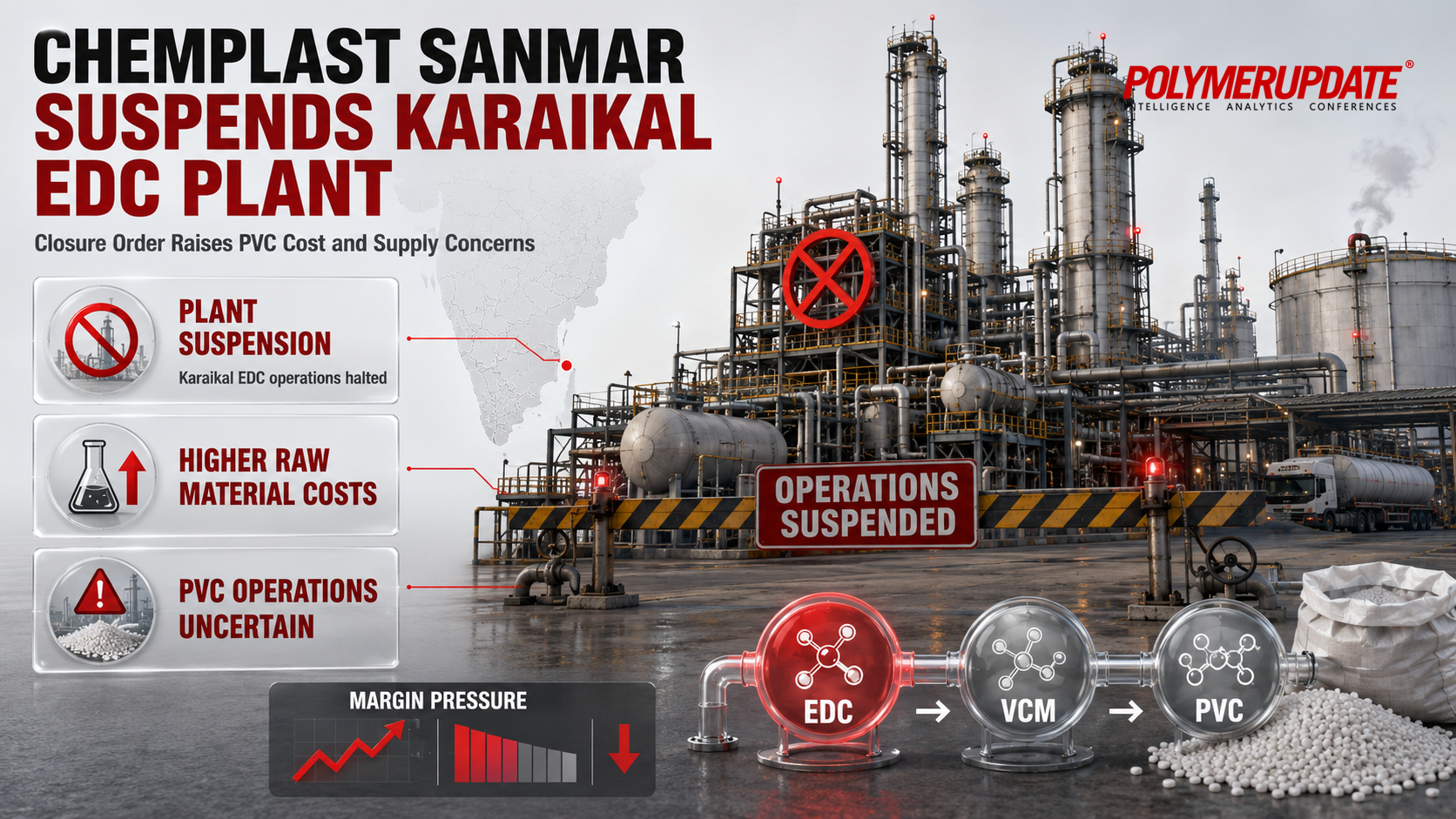
Chemplast Sanmar Ltd, the flagship business of the Sanmar Group and specializing in specialty paste PVC resins amongst others, has suspended operations at its captive Ethylene Di-Chloride (EDC) manufacturing plant in Karaikal, Puducherry, after the Puducherry Pollution Control Committee (PPCC) directed the company to immediately shut down the facility following a regulatory review. The latest order comes days after the Inspector of Factories issued a prohibition notice in the aftermath of a fire incident at the plant on July 17, 2026.
A company statement to the Bombay Stock Exchange (BSE) reads, “The Inspector of Factories, Puducherry, has issued a prohibition order with respect to one of our plants viz., Ethylene-Di-Chloride (EDC) manufacturing plant of Karaikal facility – Puducherry. Further, the Puducherry Pollution Control Committee has issued directions to be complied with stating, inter alia, that the operation of the EDC manufacturing plant shall be closed down forthwith and shall not resume the operation until further orders of the Puducherry Pollution Control Committee. The company is undertaking necessary corrective actions and is in the process of submitting a compliance report to the Puducherry Pollution Control Committee.”
Reports said that the company is preparing a comprehensive compliance report and implementing corrective environmental and safety measures to secure the revocation of the closure order and resume operations. Until regulatory approvals are obtained, production at the 84,000-tonnes-per-annum (TPA) captive EDC facility will remain suspended.
 An operational setback
The shutdown represents a significant operational setback for Chemplast Sanmar, as the Karaikal unit serves as a critical source of captive EDC feedstock for the company's downstream specialty paste polyvinyl chloride (PVC) operations. The disruption threatens to erode one of the company's key competitive advantages—backward integration—which has traditionally insulated it from volatility in international raw material markets.
Industry analysts believe the closure could exert pressure on the company's operating margins if the suspension extends beyond the near term. With captive EDC production halted, Chemplast Sanmar may have to rely on imported EDC to maintain downstream production. Such imports expose the company to fluctuations in global EDC prices, higher freight costs and exchange-rate volatility, particularly if the rupee weakens against the US dollar.
"The integrated EDC-PVC production chain has historically helped the company optimise raw material costs. Any prolonged interruption to captive production could significantly increase procurement expenses and affect profitability," an industry observer said.
Insurance coverageAlthough the physical damage resulting from the July 17 fire is expected to be covered under insurance, analysts note that business interruption costs, regulatory compliance expenditure and the financial impact of production downtime are unlikely to be immediately recoverable. Consequently, the company may continue to face earnings pressure until the plant resumes normal operations.
The regulatory action also comes at a challenging time for Chemplast Sanmar's financial performance. The company reported consolidated revenue from operations of Rs 1,255.55 crore during the fourth quarter of FY26, reflecting a healthy 9.1 percent year-on-year increase. However, despite improved revenues, it posted a consolidated net loss of Rs 280 crore for the full financial year 2025-26, compared with a loss of Rs 110 crore in the previous fiscal year, highlighting the difficult operating environment facing the company.
Delay to become profitableMarket participants believe the latest shutdown could delay the company's efforts to return to profitability. Higher raw material costs arising from imported EDC, coupled with compliance-related expenditure, may further compress margins if regulatory approvals take longer than anticipated. The sequence of regulatory actions began after a minor fire broke out at the Karaikal EDC plant on July 17. No casualties were reported in the incident. Following the accident, the Inspector of Factories issued a prohibition order on July 19, preventing the company from operating the facility until prescribed safety measures were implemented.
The subsequent intervention by the Puducherry Pollution Control Committee has broadened the regulatory scrutiny from factory safety to environmental compliance. The latest directive requires the company to demonstrate adherence to pollution control norms and implement corrective measures before authorities consider revoking the closure order.
Chemplast Sanmar has indicated that its immediate priority is to complete the required environmental and safety improvements and submit a detailed compliance report to the authorities. The company will also need the prohibition order issued by the Chief Inspector of Factories to be withdrawn before the facility can restart commercial operations.
Significance of regulatory complianceThe incident underscores the importance of regulatory compliance in India's specialty chemicals and chlorochemicals industry, where integrated manufacturing facilities operate under stringent environmental and industrial safety standards. Companies with backward-integrated production systems benefit from lower raw material costs and greater supply-chain security, but such facilities are also subject to rigorous oversight by multiple regulatory agencies.
For Chemplast Sanmar, the Karaikal facility plays a strategic role by converting chlorine produced within its integrated operations into EDC, an essential intermediate used in PVC manufacturing. The temporary loss of this captive capability reduces operational flexibility and increases dependence on external suppliers at a time when international chemical markets remain susceptible to price fluctuations and logistics disruptions.
Key gaugesInvestors are expected to closely monitor three key developments over the coming weeks. These include approval of the company's corrective compliance report by the Puducherry Pollution Control Committee, revocation of the prohibition order issued by the Inspector of Factories, and management's assessment of the financial impact arising from higher raw material sourcing costs and production downtime.
Industry experts also point to the possibility of additional capital expenditure if regulators mandate further upgrades to environmental protection systems or factory safety infrastructure before permitting operations to resume. While the company has not indicated a timeline for restarting the plant, a swift regulatory clearance would be crucial in limiting operational disruptions and containing the impact on profitability. Conversely, an extended shutdown could intensify margin pressures, delay the company's earnings recovery and increase reliance on imported feedstock, undermining the cost advantages of its integrated manufacturing model.
OutlookThe coming weeks are therefore expected to be critical for Chemplast Sanmar as it works to restore regulatory confidence, resume production and safeguard the competitiveness of its downstream PVC business.
DILIP KUMAR JHA
Editor
dilip.jha@polymerupdate.com



