Iranian missiles have struck over half of operational refineries in the Middle East and crippled energy infrastructure and petrochemical supply to the world in less than four months of the Israel-US joint attack on Iran and Tehran’s retaliation on the US defence and military infrastructure in Gulf countries. The military conflict has inflicted unprecedented damage on the Middle East's energy infrastructure, disrupting oil refining, natural gas production and petrochemical manufacturing across the Gulf region.
The destruction has not only reduced refining capacity but has also sent shockwaves through global petrochemical supply chains, raising concerns over prolonged shortages and higher costs for downstream industries worldwide. Industry assessments based on satellite imagery and energy market intelligence indicate that between 37 and 39 oil refineries, natural gas fields, storage terminals and other strategic energy facilities across nine countries have either been directly damaged or significantly disrupted since the conflict began.
The attacks represent one of the most extensive assaults on energy infrastructure in modern history, affecting both upstream production in the Middle East and downstream processing in the import-reliant countries such as India and China. While India expanded import base and sourced crude oil from a wide number of countries, China, on the other hand, reduced imports and instead met its petroleum demand by releasing inventories from the Strategic Petroleum Reserve (SPR), thus preventing the energy price from an unabated steep rise and stabilized the market.
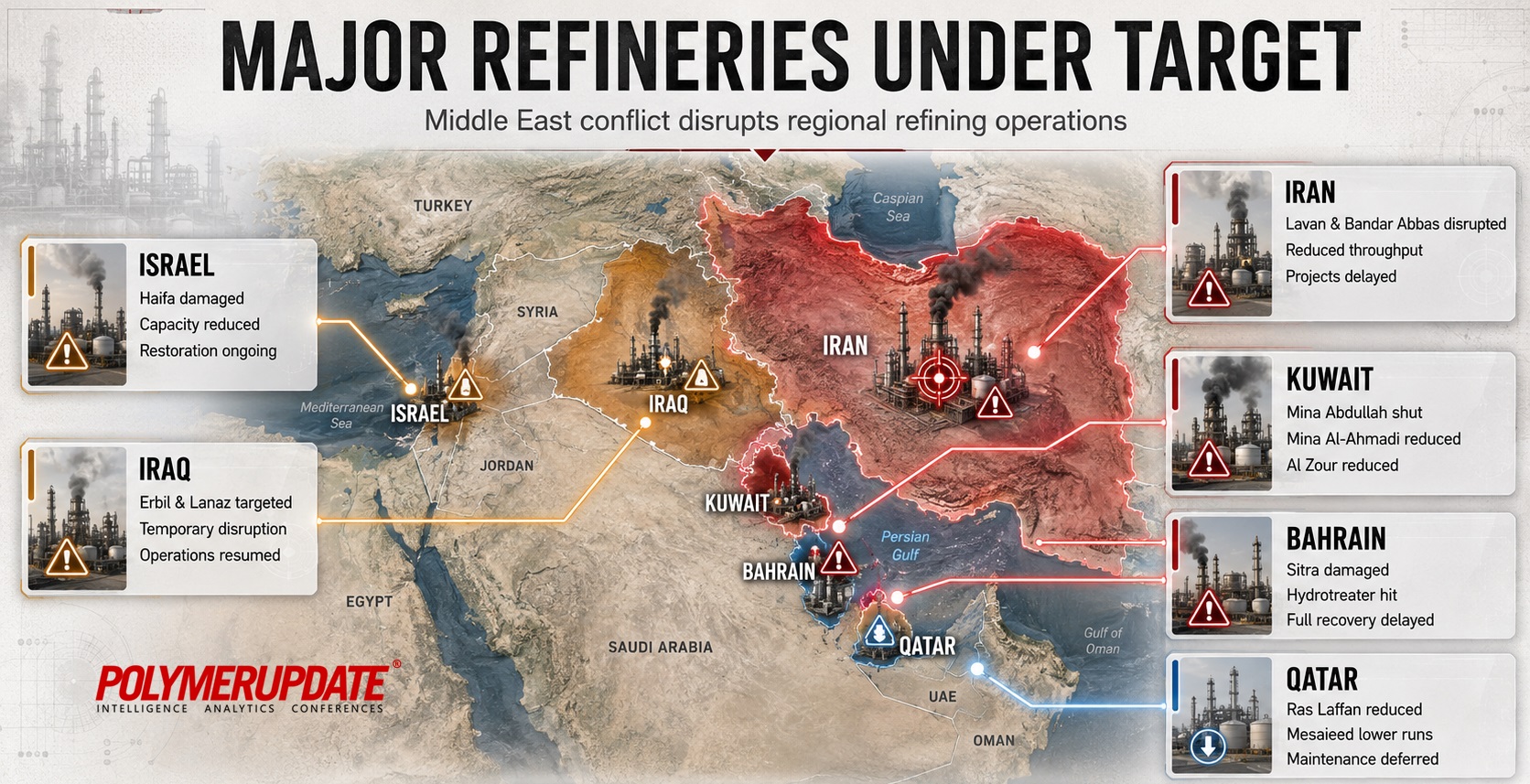
| Major refineries under target |
| Countries | Remarks |
| Bahrain | The Sitra Refinery in Bahrain has sustained significant damage during the Middle East conflict, with drone strikes severely affecting its diesel hydrotreater unit. The unit is not expected to resume operations before November 2026. The attacks also damaged two hydrogen production units, which remain under technical assessment. In addition, several processing units have either been shut down or have been operating at reduced rates since the disruption. Consequently, the refinery is expected to require an extended period before returning to full operational capacity. |
| Iran | The Middle East conflict has disrupted operations across several Iranian refineries, leading to reduced throughput, operational constraints and delays to expansion projects. Among the worst affected are the LORC Lavan Refinery and the PGSOC Bandar Abbas Refinery, both of which have experienced significant operational disruptions. The conflict has also delayed several refinery expansion and modernisation projects due to supply chain disruptions, equipment shortages and heightened security risks. To ensure adequate domestic fuel supplies, many Iranian refineries have postponed scheduled maintenance turnarounds, prioritising continued operations despite increasingly challenging conditions. |
| Iraq | The ongoing Middle East conflict disrupted operations at two major refineries in Iraq's Kurdistan Region—the Kar Group's Erbil Refinery and the Lanaz Refinery—after both facilities were targeted in drone attacks. The strikes temporarily affected refinery operations and reduced processing rates, although both plants have since resumed normal operations. |
| Israel | During the ongoing Middle East conflict, the 197,000-barrel-per-day (bpd) Haifa Refinery sustained damage that temporarily reduced its processing capacity. Although the refinery continues to face operational challenges, it is making sustained efforts to restore and maintain full throughput. |
| Qatar | Owing to persistent geopolitical tensions in the Middle East, the Ras Laffan Refinery implemented a precautionary shutdown during the second quarter of 2026 and is currently operating at reduced throughput. Likewise, the Mesaieed Refinery has been running at lower processing rates since March 2026 and has deferred its scheduled crude and condensate maintenance shutdown to 2027 in response to ongoing regional operational and security challenges. |
| Kuwait | Recent geopolitical tensions in the Middle East have damaged Kuwait's 346,000-barrel-per-day (bpd) Mina Al-Ahmadi Refinery and the 454,000-bpd Mina Abdullah Refinery. Since March 2026, the Mina Al-Ahmadi and Al Zour refineries have been operating at reduced processing rates, while the Mina Abdullah Refinery remains shut down as repair and restoration work continues. |
Source: News reports
Total 73 active refineriesThe Middle East is home to 73 active crude oil refineries, making it one of the world's most significant refining hubs. Iraq has the highest number of individual refining sites, operating 14 facilities across the country, while Saudi Arabia dominates the region in terms of processing capacity with approximately 3.3 million barrels per day (bpd), accounting for around 27 percent of the Middle East's total refining capacity. The region's largest refinery is Saudi Arabia's Ras Tanura Refinery, which has the capacity to process 550,000 bpd of crude oil, underscoring the Kingdom's pivotal role in global petroleum refining and fuel supply.
The widespread destruction has sharply curtailed regional refining operations, with nearly 9 percent of global oil refining capacity estimated to have been taken offline during the peak of the disruption. The outages have tightened supplies of petroleum products while increasing uncertainty over the security of critical energy infrastructure in one of the world's most important hydrocarbon-producing regions.
Kuwait the worst affected
Among the worst affected countries is Kuwait, where two of the nation's largest refineries suffered missile and drone strikes. The 346,000-barrel-per-day Mina Al-Ahmadi refinery and the 454,000-barrel-per-day Mina Abdullah refinery, both central to Kuwait's domestic fuel production and exports, sustained damage that forced operators to reduce processing rates. The decline in refinery throughput has constrained supplies of refined petroleum products while adding pressure to regional fuel markets.
Beyond Kuwait, strategic energy facilities and associated logistics infrastructure in Bahrain, Saudi Arabia, Qatar and the United Arab Emirates have also suffered varying degrees of damage. Storage terminals, pipelines, export facilities and crude handling infrastructure have either been directly targeted or affected by nearby attacks. Fujairah, one of the world's largest oil storage and bunkering hubs located outside the Strait of Hormuz, experienced disruptions that complicated crude exports and fuel distribution throughout the Gulf.
The cumulative impact has significantly weakened the region's ability to process crude oil and maintain stable petroleum product exports. The damage has also increased operational risks for refiners, shipping companies and energy traders already grappling with heightened geopolitical uncertainty.
Petrochemicals - the biggest sufferersThe petrochemical industry has emerged as one of the biggest casualties of the conflict. Iran, a major producer of petrochemical feedstocks and polymer raw materials, has witnessed extensive destruction of its manufacturing infrastructure. Military strikes severely damaged critical export-oriented facilities, particularly around the South Pars petrochemical complex in Asaluyeh, one of the world's largest integrated gas and petrochemical hubs.
Industry estimates suggest that approximately 75 percent of Iran's total petrochemical production capacity has become non-operational following repeated attacks on processing plants, utilities and export terminals. Even more severe has been the collapse of export capability, with nearly 85 percent of the country's overseas petrochemical shipments effectively halted due to damaged infrastructure, disrupted logistics and restricted port operations.
Supply disruptions beyond IranThe disruption extends well beyond Iran. Integrated petrochemical complexes across the Gulf have also been forced to reduce production or temporarily suspend operations because of security concerns, feedstock shortages and damage to associated infrastructure. Saudi Arabia's Sadara petrochemical complex, one of the world's largest integrated chemical manufacturing facilities, has reportedly experienced operational disruptions, limiting output of several high-value chemical intermediates.
As a result, regional production of essential petrochemical feedstocks such as ethylene and propylene has been severely affected. Supplies of polyurethane raw materials, including methylene diphenyl diisocyanate (MDI) and toluene diisocyanate (TDI), have also been constrained, disrupting manufacturing chains serving industries ranging from automotive and construction to consumer goods, packaging, appliances and insulation materials.
The shortage of these intermediate chemicals is reverberating across global manufacturing sectors. Ethylene and propylene form the backbone of the plastics industry and are essential building blocks for polyethylene, polypropylene and numerous industrial chemicals. Similarly, MDI and TDI are critical components in the production of polyurethane foams used extensively in furniture, refrigeration, construction and transportation.
Sharp reduction in regional outputThe International Energy Agency (IEA) has estimated around 14 million barrels per day (bpd), around 13 percent of the total annual world consumption since the Middle East war began on February 28. The sharp reduction in regional output has tightened supplies of naphtha, liquefied petroleum gas (LPG) and other petrochemical feedstocks that underpin global polymer production. Manufacturers across Asia, Europe and North America are already facing rising raw material costs, while buyers are encountering longer delivery schedules and increased supply uncertainty.
Industry observers describe the current disruption as the most significant shock to international petrochemical supply chains since the oil crises of the 1970s. Unlike previous geopolitical events that primarily affected crude oil production, the present conflict has simultaneously disrupted upstream hydrocarbon extraction, refining, petrochemical manufacturing, storage infrastructure and export logistics, amplifying its impact across multiple sectors.
The consequences are expected to extend well beyond energy markets. Higher feedstock costs are likely to raise production expenses for manufacturers of plastics, synthetic fibres, packaging materials, automotive components, electronics, construction products and countless consumer goods. Inflationary pressures may intensify as companies pass on increased input costs throughout global supply chains.
Growing vulnerabilityFor the energy industry, the conflict underscores the growing vulnerability of concentrated refining and petrochemical capacity in geopolitically sensitive regions. It also highlights the interconnected nature of global energy and manufacturing supply chains, where disruptions to a handful of strategic facilities can rapidly influence industrial production and commodity prices across continents.
While governments and industry participants continue to assess the full extent of the damage, restoring damaged refineries, petrochemical plants and export infrastructure is expected to require significant investment and many months of repair work. Until stability returns to the region, global energy and chemical markets are likely to remain volatile, with supply security and geopolitical developments continuing to dictate market direction.
DILIP KUMAR JHA
Editor
dilip.jha@polymerupdate.com



