The Brent–WTI crude oil price spread has long been watched by energy traders as an important market indicator, but in an increasingly volatile geopolitical environment it has become one of the clearest barometers of global oil market stress. While crude oil prices are primarily driven by supply and demand fundamentals, the difference between the world's two leading crude benchmarks often provides deeper insight into geopolitical risks, transportation bottlenecks and regional supply imbalances.
The dramatic movements witnessed in the Brent–WTI spread during 2026 underscore its growing importance. What began the year as a relatively normal price differential of around US$ 3 a barrel widened sharply to nearly US$ 14 a barrel amid escalating geopolitical tensions before reversing into negative territory following ceasefire developments. The subsequent rebound to around US$ 8 a barrel reflects that while immediate fears have eased, markets continue to assign a premium to internationally traded crude because of lingering supply risks.
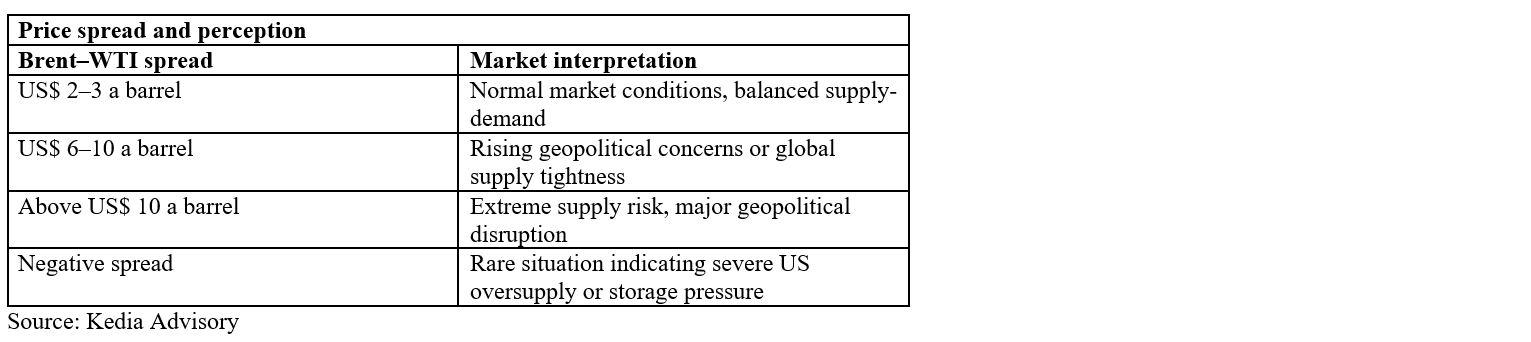
The spread represents the price difference between Brent crude, the international benchmark, and West Texas Intermediate (WTI), the benchmark for the United States. Under normal market conditions, Brent typically trades at a premium of about US$ 2-3 a barrel over WTI, largely reflecting transportation costs, quality differences and the global accessibility of Brent-linked crude.
Reflection of market sentimentHowever, this seemingly simple price gap often serves as a real-time measure of market sentiment. During periods of geopolitical uncertainty, traders rapidly increase the value assigned to Brent because it reflects globally traded crude oil that could be affected by disruptions to international supply routes. WTI, by contrast, remains more closely tied to domestic US market fundamentals.
Brent crude, produced in the North Sea, serves as the pricing benchmark for nearly two-thirds of internationally traded crude oil. Its price is highly sensitive to developments affecting global energy markets, including conflicts in the Middle East, production decisions by OPEC+, disruptions to key shipping lanes and changes in worldwide economic activity. Whenever concerns emerge over the security of global oil supplies, Brent prices generally respond first because replacement barrels in international markets become more valuable.
 Quality differentials
WTI crude, meanwhile, is a high-quality, low-sulphur crude delivered at Cushing, Oklahoma, the principal storage hub for US oil. Unlike Brent, WTI prices are driven primarily by domestic factors such as US shale production, crude inventories, refinery demand, pipeline capacity and export infrastructure.
This distinction explains why Brent usually trades above WTI. Since Brent reflects the cost of internationally available crude while WTI is influenced by the balance within the US market, global disruptions tend to widen the premium. One of the principal drivers of the spread is the geopolitical risk premium. During conflicts or periods of heightened uncertainty, concerns over potential disruptions to crude exports from major producing regions quickly lift Brent prices.
High premiumEvents affecting the Middle East, the Strait of Hormuz or Red Sea shipping routes typically increase the premium on globally traded crude far more rapidly than they influence WTI. Transportation dynamics also contribute to the price difference. WTI is stored inland at Cushing, making it vulnerable to pipeline constraints and regional storage build-ups that can weigh on prices. Brent, linked to seaborne trade, enjoys greater flexibility to reach international markets, allowing it to respond more directly to global supply-demand conditions.
Regional supply-demand imbalances further influence the spread. A surge in US shale production or rising domestic inventories can pressure WTI prices even when international markets remain tight. Conversely, disruptions to global crude supplies may push Brent sharply higher despite relatively comfortable US inventory levels. The sharp swings in 2026 illustrate how rapidly geopolitical developments can reshape oil market pricing.
Long-term averageFor much of the early period, the Brent–WTI spread remained close to its long-term average of around US$ 3 a barrel. However, as geopolitical tensions intensified and concerns mounted over possible disruptions to international shipping routes and Middle Eastern crude exports, Brent attracted a significant risk premium.
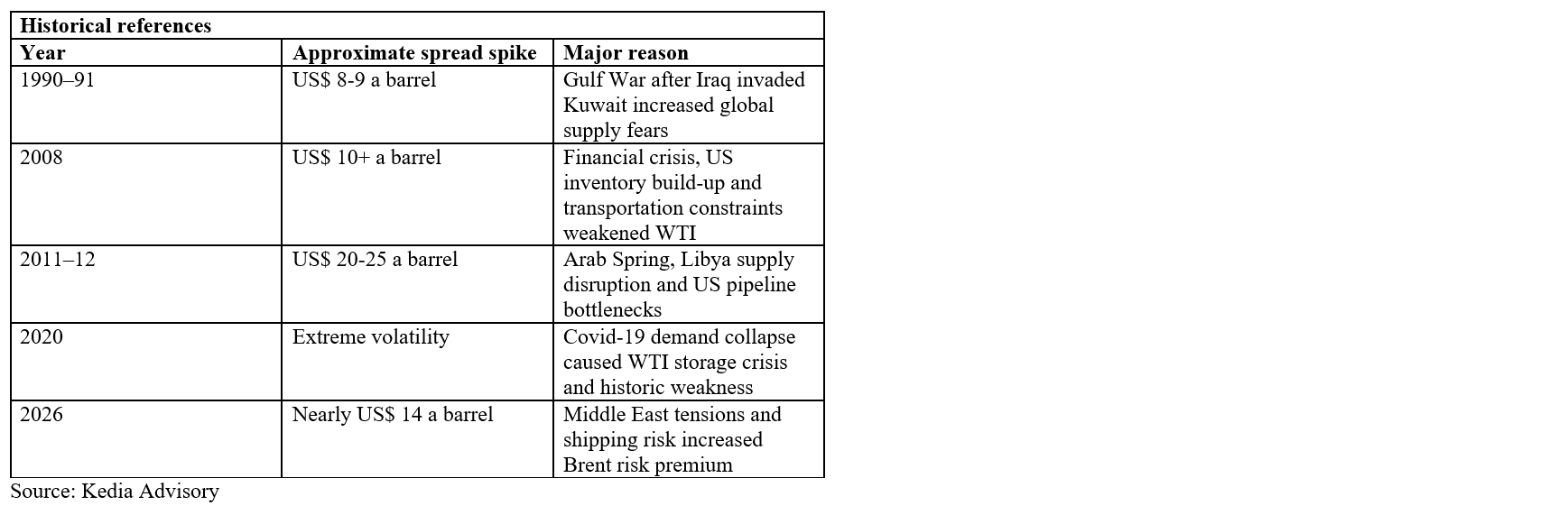
The spread widened to nearly US$ 14 a barrel, signalling that traders were increasingly pricing in the possibility of substantial disruptions to global oil supplies. The surge reflected concerns over the security of Middle Eastern exports, risks to key maritime trade corridors and uncertainty regarding future crude availability.
The market reaction proved equally swift when diplomatic efforts reduced immediate fears. Ceasefire discussions and easing geopolitical tensions prompted a rapid unwinding of the risk premium, causing the spread to collapse and briefly move into negative territory at around minus US$ 2.8 a barrel. Such an unusual move demonstrated how quickly market sentiment can reverse when perceived supply risks diminish. Although the spread has since recovered to around US$ 8 a barrel, it remains well above its historical average, suggesting that traders continue to factor geopolitical uncertainty into global crude prices.
Historical backgroundLooking back over several decades, major expansions in the Brent–WTI spread have frequently coincided with periods of significant geopolitical instability or severe market dislocation. Episodes such as the Gulf War, the Arab Spring, the Covid-19 pandemic and more recent Middle East tensions all produced substantial widening in the spread as concerns over global supply security intensified.
Professional oil traders therefore monitor the spread not merely as a pricing differential but as an important indicator of broader market conditions. A widening spread generally signals rising geopolitical risks, stronger international demand for crude, transportation concerns or the possibility of supply disruptions. Conversely, a narrowing spread often indicates easing geopolitical tensions, improving supply conditions and greater confidence in the availability of internationally traded crude.
The spread is typically analysed alongside crude inventories, OPEC+ production policy, refinery margins and global shipping data to assess the overall structure of the oil market.
OutlookLooking ahead, several factors are likely to determine the future direction of the Brent–WTI spread. Developments in the Middle East, production decisions by OPEC+, security along major shipping routes, US crude inventory trends and demand growth across emerging economies will all play important roles in shaping the premium attached to globally traded crude.
As long as geopolitical uncertainty persists, the Brent–WTI spread is likely to remain an essential indicator for investors, traders and policymakers. More than just the price difference between two benchmark crudes, it has evolved into one of the most reliable real-time measures of global oil market stress and changing perceptions of supply security.
DILIP KUMAR JHA
Editor
dilip.jha@polymerupdate.com



