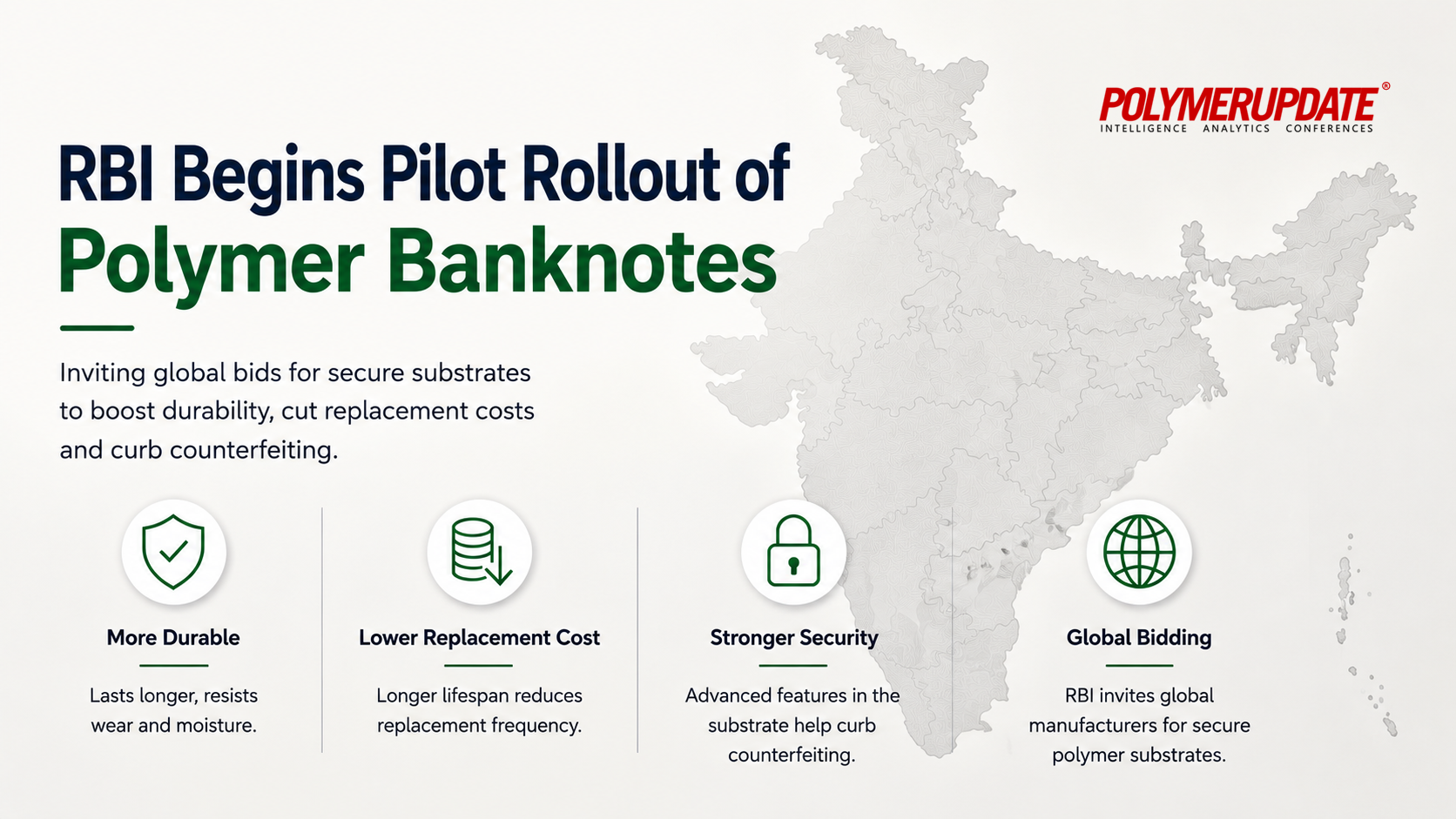
The Reserve Bank of India (RBI) has taken a significant step towards modernising the country's currency system by initiating the process to introduce polymer banknotes. The central bank has invited global expressions of interest (EoIs) for the supply of specialised polymer substrate sheets, paving the way for a pilot rollout of polymer currency notes that are expected to begin with the Rs 10 and
Rs 20 denominations.
The move marks a renewed attempt to replace conventional paper-based banknotes with more durable polymer notes, a technology that has already been adopted by several advanced economies, including Australia, Canada, the United Kingdom and New Zealand. If the pilot proves successful, the RBI is expected to expand the use of polymer substrates to higher denominations in future phases.
 Tender notice
The RBI's wholly owned currency-printing subsidiary, Bharatiya Reserve Bank Note Mudran Private Ltd. (BRBNMPL), issued the global EoI on July 17, seeking manufacturers and suppliers capable of providing opacified polymer substrate sheets embedded with advanced security features for Indian banknotes. According to the tender document, the indicative requirement is for 68,000 reams of polymer substrate, with each ream comprising 500 sheets. The quantity is intended to meet the immediate needs of the pilot project. In the EoI, BRBNMPL stated that the procurement is only the first phase of the initiative.
"We seek competitive offers from manufacturers and suppliers of opacified polymer substrate with security features suitable for printing banknotes. The indicative requirement in this EOI is meant for immediate requirements. Once our field trials are successful, we intend to procure larger quantities of substrate across different denominations," the document noted.
Advanced security featuresThe RBI has laid considerable emphasis on incorporating sophisticated security features into the polymer substrate to safeguard against counterfeiting. The proposed polymer notes are expected to include transparent windows carrying portraits, metallic numerals, magnetic pseudo threads, shadow images and iridescent security patterns. These features have become standard in polymer banknotes worldwide due to their effectiveness in enhancing authenticity while making duplication significantly more difficult.
The RBI has also stipulated that the polymer substrate must be compatible with the existing printing infrastructure of BRBNMPL and the government-owned Security Printing and Minting Corporation of India Ltd. (SPMCIL), thereby avoiding the need for major investments in new printing equipment.
Longer life, lower replacement costsOne of the principal reasons behind the RBI's renewed interest in polymer currency is the significantly longer lifespan of polymer notes compared with conventional cotton-based paper notes. Paper currency deteriorates rapidly under India's climatic conditions and heavy circulation, becoming soiled, torn or damaged after repeated handling. Such notes are routinely withdrawn from circulation and replaced with freshly printed ones, resulting in substantial recurring expenditure.
Polymer notes, by contrast, are highly resistant to moisture, dirt, folding and general wear and tear. International experience suggests that polymer banknotes typically remain in circulation four to five times longer than paper notes, substantially reducing replacement requirements. The financial implications of replacing damaged currency are considerable. According to RBI data, printing replacement notes for soiled currency cost approximately Rs 5,101 crore during FY2024. The expenditure increased further to around Rs 6,373 crore in FY2025 as the number of unfit notes rose sharply.
During FY2025 alone, nearly 23.8 billion soiled or damaged banknotes were withdrawn and destroyed, underscoring the scale of the replacement challenge faced by the central bank. By extending the operational life of banknotes, polymer substrates could help reduce printing frequency, lower production costs and improve the efficiency of India's currency management system over the long term.
Second attempt after 2012 trialAlthough the current initiative represents an important milestone, it is not India's first experiment with polymer banknotes. The RBI had earlier launched a pilot project in 2012 by introducing polymer Rs 10 notes in select cities. However, that initiative was eventually discontinued owing to technological limitations related to printing, processing and handling of polymer currency. Since then, advances in printing technology and currency processing systems have significantly improved the feasibility of polymer banknotes.
Modern automated teller machines (ATMs), currency sorting machines and cash-handling equipment are now capable of accurately identifying and dispensing polymer notes, addressing one of the key operational challenges that existed during the earlier trial. The improved manufacturing processes available today have also enhanced the quality and durability of polymer substrates, making them more suitable for large-scale circulation.
Global experiencePolymer banknotes were first introduced by Australia in 1988 and have since gained widespread acceptance across the world. Countries such as Canada, New Zealand, the United Kingdom, Singapore, Vietnam, Romania and several others have adopted polymer currency because of its durability, enhanced security features and lower lifecycle costs.
Besides lasting significantly longer, polymer notes are less susceptible to water damage and retain their appearance for extended periods, improving both hygiene and public confidence in the currency.
Many central banks have also reported lower incidences of counterfeiting following the introduction of polymer banknotes because of the sophisticated security elements that are difficult to replicate.
Industry participationThe RBI has specified that prospective bidders must possess at least three years of experience in supplying polymer substrates to central banks or equivalent currency-printing authorities. This requirement is intended to ensure that only experienced global manufacturers participate in the pilot project. Interested companies have been asked to submit their expressions of interest by August 18, 2026.
The pilot project will help the RBI evaluate the operational performance, durability, public acceptance and overall cost-effectiveness of polymer banknotes under Indian conditions. If the field trials deliver satisfactory results, the central bank is expected to proceed with larger procurements and gradually expand polymer currency to additional denominations. The initiative reflects the RBI's broader objective of strengthening currency security while improving the efficiency and sustainability of India's cash management system. As one of the world's largest users of physical currency, India could benefit substantially from longer-lasting banknotes that reduce replacement costs, improve durability and incorporate next-generation anti-counterfeiting technologies.
Participation criteriaTo ensure the highest standards of quality and reliability, the Reserve Bank of India has laid down stringent eligibility criteria for companies seeking to participate in the polymer banknote initiative. Both domestic and international bidders—including technology collaborators, joint venture partners and subsidiaries—must have a minimum of three years' experience in supplying polymer substrate with integrated security features to a central bank or a banknote and security printing organisation. Additionally, each bidder must be capable of supplying at least 20,400 reams, equivalent to 30 percent of the indicative procurement quantity, to qualify for the tender.
As part of the evaluation process, applicants are required to submit at least 10 sample polymer sheets for laboratory testing to verify their quality, durability and compatibility with India's banknote printing systems. The samples must be certified as free from animal tallow or DNA content. Bidders are also required to furnish documentary evidence of their financial net worth, manufacturing capacity and eligibility to obtain the necessary security clearances, ensuring that only technically and financially competent suppliers are considered for the project.
DILIP KUMAR JHA
Editor
dilip.jha@polymerupdate.com



