This week, PP prices in Asia moved higher across most assessed grades and regions, supported by firmer upstream energy markets, low inventory levels, and stronger futures on the Dalian Commodity Exchange. Prices in Southeast Asia recorded relatively modest gains, while South Asian markets saw broader increases across grades.
An industry source in Asia, on condition of anonymity, informed a Polymerupdate team member, "PP prices in Asia increased on the back of higher upstream costs amid ongoing geopolitical tensions. Market sentiment improved as producers withdrew lower-priced offers and signaled price hikes of USD 30–50/mt. Firmer Dalian Commodity Exchange futures, low producer inventories, and rising Gulf-to-Asia freight rates further supported the market, as heightened security concerns reduced vessel availability and increased transportation costs, despite reports suggesting the Strait of Hormuz remained open. Meanwhile, volatility in regional currencies added to market uncertainty, encouraging sellers to maintain firm offers, while buyers continued to adopt a cautious procurement approach.”
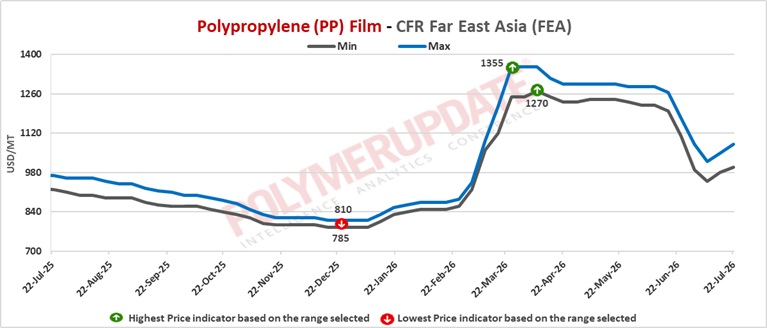
In Far East Asia, PP block copolymer grade prices were assessed at USD 1040-1100/mt CFR levels, a sharp gain of USD (+50/mt) week on week. BOPP grade prices were assessed at USD 1000-1080/mt CFR levels, moving higher, USD (+20/+40/mt) from the previous week. PP film grade prices were assessed at USD 1000-1080/mt CFR levels, gaining, USD (+20/+30/mt) week on week. PP injection grade and PP raffia grade prices were assessed at USD 980-1050/mt CFR levels, firming, USD (+20/mt) compared to the prior week.
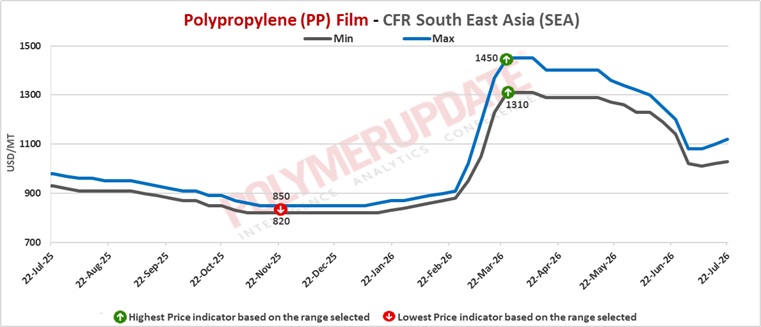
In South East Asia, PP block copolymer grade prices were assessed at USD 1040-1140/mt CFR levels, edging higher, USD (+10/+20/mt) week on week. BOPP grade prices were assessed at USD 1030-1100/mt CFR levels, moving higher, USD (+10/+20/mt) from the previous week. PP film grade prices were assessed at USD 1030-1120/mt CFR levels, gaining, USD (+10/+20/mt) week on week. PP injection grade and PP raffia grade prices were assessed at USD 1010-1080/mt CFR levels, firming, USD (+10/+20/mt) compared to the prior week.
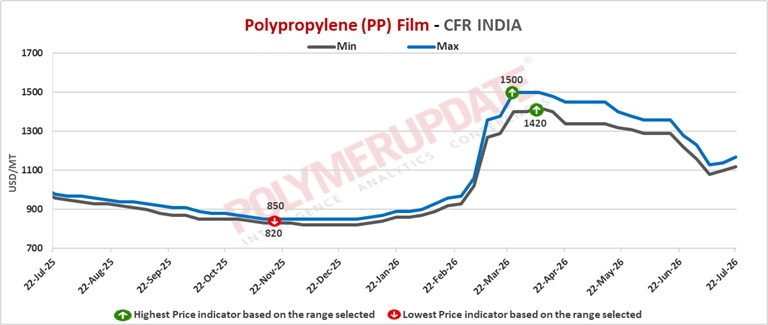
In India, PP block copolymer grade prices were assessed at USD 1120-1190/mt CFR levels, gaining, USD (+20/+30/mt) week on week. BOPP grade prices were assessed at USD 1110-1170/mt CFR levels, firming, USD (+20/+30/mt) week on week. PP film grade prices were assessed at USD 1120-1170/mt CFR levels, rising, USD (+20/+30/mt) compared to the prior week. PP injection grade and PP raffia grade prices were assessed at USD 1100-1140/mt CFR levels, moving higher, USD (+20/+30/mt) week on week.
In Pakistan, PP block copolymer grade prices were assessed at USD 1120-1210/mt levels, rising, USD (+10/mt) week on week. BOPP grade and PP film grade prices were assessed at USD 1090-1180/mt CFR Pakistan levels, edging higher, USD (+10/mt) week on week. PP injection grade and PP raffia grade prices were assessed at USD 1060-1140/mt CFR Pakistan levels, gaining, USD (+10/mt) compared to the previous week.
In Sri Lanka, PP block copolymer grade prices were assessed at USD 1220-1300/mt CFR levels, a sharp gain of USD (+40/mt) from last week. BOPP grade and PP film grade prices were assessed at USD 1190-1240/mt CFR levels, a spike of USD (+40/mt) from the previous week. PP injection grade and PP raffia grade prices were assessed at USD 1140-1200/mt CFR levels, a sharp rise of USD (+40/mt) from the previous week.
In Bangladesh, PP block copolymer grade prices were assessed at USD 1150-1220/mt CFR levels, rising, USD (+20/mt) week on week. BOPP grade and PP film grade prices were assessed at USD 1090-1170/mt CFR levels, edging higher, USD (+20/mt) week on week. PP injection grade and PP raffia grade prices were assessed at USD 1070-1140/mt CFR levels, moving higher, USD (+20/mt) compared to the previous week.
Feedstock propylene values in China were assessed at USD 965-975/mt CFR China levels, unchanged week on week. Propylene values in Korea were assessed at USD 925-935/mt FOB Korea levels, also holding steady from the previous week. The stability in the assessed propylene values suggests that the immediate cost side support to PP came more from broader energy strength and freight cost pressures than from directly higher monomer assessments during the week.
This news synopsis and insights are generated using Polymerupdate’s advanced Artificial Intelligence (AI) systems, leveraging proprietary data, pricing benchmarks, and domain expertise. The content is intended for informational purposes only and does not represent the official views of Polymerupdate. Users are advised to conduct their own independent research before making any commercial or business decisions.



