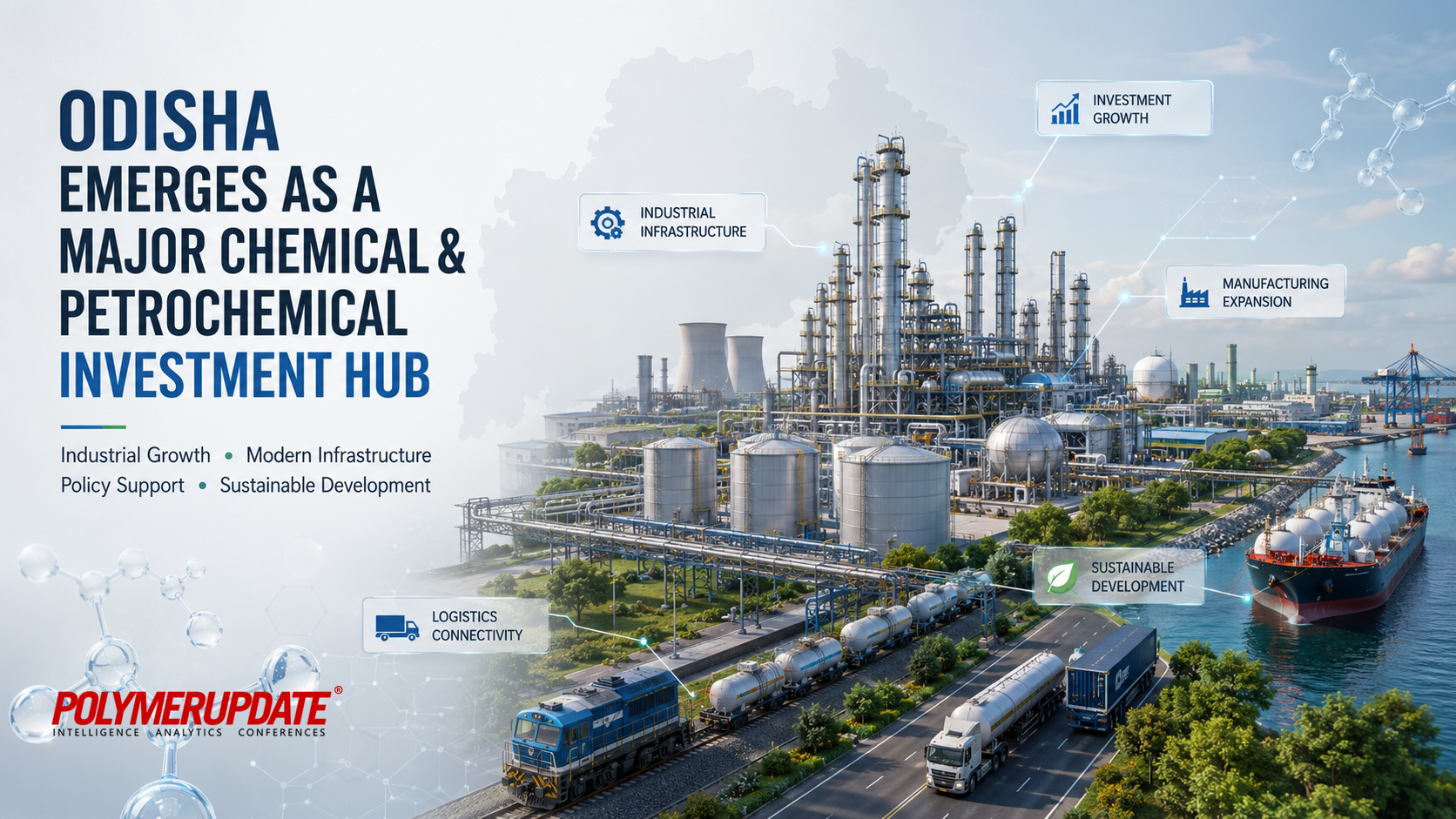
Odisha has firmly established itself as one of India's fastest-growing destinations for chemical and petrochemical investments, attracting proposals worth nearly Rs 2 lakh crore over the past two years. Backed by an investor-friendly policy framework, modern infrastructure, strategic coastal advantages and an increasing emphasis on sustainable industrial development, the state is rapidly transforming into a major manufacturing hub for chemicals, petrochemicals and downstream industries.
The surge in investments marks a significant shift in India's industrial landscape, with Odisha increasingly competing with established manufacturing centres in Gujarat, Maharashtra and Andhra Pradesh. Industry experts believe the state's integrated development strategy, combining policy support with world-class infrastructure, is creating a compelling value proposition for both domestic and international investors.
 Policy initiatives
The Odisha government has played a pivotal role in driving this transformation through a series of targeted policy initiatives aimed at attracting large-scale investments. A comprehensive package of fiscal incentives, including capital subsidies, tax benefits and simplified regulatory procedures, has significantly improved the state's attractiveness, particularly for investments in the high-impact chemical sector.
A key pillar of Odisha's industrial strategy has been the development of the Petroleum, Chemicals and Petrochemical Investment Region (PCPIR), which is emerging as one of India's most promising integrated chemical manufacturing ecosystems. The PCPIR is expected to serve as a catalyst for attracting anchor investments while simultaneously encouraging the growth of a broad network of ancillary and downstream industries.
According to Hemant Sharma, Additional Chief Secretary, Industries and MSME Department, Government of Odisha, and Chairman of the Industrial Promotion and Investment Corporation of Odisha Ltd. (IPICOL), the state's policy ecosystem has been carefully designed to create an enabling environment for investors by combining fiscal incentives with efficient governance and faster project implementation.
Geographical advantageOne of Odisha's strongest competitive advantages lies in its strategic location on India's eastern coastline. The state offers excellent maritime connectivity through its ports, enabling efficient import of raw materials and export of finished chemical products to markets across Asia and beyond. This geographical advantage has become increasingly important as companies seek to optimise supply chains and reduce logistics costs.
The government's substantial investments in port infrastructure, industrial corridors and logistics facilities have further enhanced Odisha's attractiveness as a manufacturing destination. A large industrial land bank, expanding transportation networks and dependable access to utilities provide investors with the confidence required for executing large capital-intensive projects. Equally important has been the state's emphasis on simplifying administrative procedures. The implementation of an effective single-window clearance mechanism has substantially reduced project approval timelines, enabling industries to commence operations more quickly. Faster approvals have emerged as a critical differentiator at a time when businesses are increasingly seeking certainty in project execution.
Sustainability on cardOdisha's industrial vision extends beyond traditional chemical manufacturing. Recognising the global transition towards cleaner technologies and low-carbon manufacturing, the state has placed sustainability at the centre of its industrial policy. The government is actively promoting investments in green hydrogen, green ammonia and renewable energy infrastructure, creating opportunities in emerging sectors expected to witness strong global demand over the coming decades.
By encouraging cleaner production technologies and environmentally responsible manufacturing practices, Odisha aims to position itself as a preferred destination for future-ready industries. The emphasis on sustainability also aligns with the evolving priorities of multinational corporations, many of which are integrating environmental, social and governance (ESG) standards into their long-term investment decisions. Odisha's focus on renewable energy and cleaner industrial processes is therefore expected to strengthen its competitiveness in attracting global capital.
Massive investmentSeveral leading companies have already announced or initiated significant investments with cumulative capital expenditure worth Rs 200,000 crore in the state over the past two years. Indian Oil Corporation Ltd. remains one of the largest investors, expanding its presence through projects linked to the PCPIR and strengthening the petrochemical value chain around Paradip. The development of integrated chemical clusters is expected to generate significant multiplier effects across the economy.
Besides creating large-scale direct and indirect employment opportunities, these clusters are likely to stimulate investments in downstream industries including fertilisers, specialty chemicals, performance materials, polymers and other value-added chemical products. Such integrated industrial ecosystems improve competitiveness by enabling companies to source raw materials locally, reduce transportation costs and establish close linkages between upstream and downstream manufacturing units. This clustering approach is expected to enhance operational efficiencies while encouraging innovation and technology adoption.
DiversificationOdisha is also diversifying into newer industrial segments including coal gasification, advanced materials and battery technologies. These sectors are expected to play an increasingly important role as India accelerates its clean energy transition and seeks to reduce import dependence for critical industrial inputs. Despite its impressive progress, Odisha continues to face competition from states with longer-established industrial ecosystems and stronger manufacturing bases. Gujarat, Maharashtra and Tamil Nadu remain major investment destinations, particularly for specialty chemicals and petrochemicals.
To maintain its growth momentum, the Odisha government is focusing on continuous policy improvements, infrastructure expansion and skill development. Building a highly trained workforce capable of supporting technologically advanced manufacturing operations is emerging as another priority area. The state has also adopted a collaborative approach by maintaining regular engagement with industry associations, investors and business leaders. This ongoing dialogue enables policymakers to identify operational challenges, refine investment policies and respond quickly to evolving industry requirements.
A holistic approachIndustry analysts believe Odisha's integrated development model offers valuable lessons for other states seeking to attract large-scale industrial investments. Rather than relying solely on fiscal incentives, Odisha has focused on creating a comprehensive ecosystem that combines infrastructure readiness, regulatory efficiency, sustainability and long-term policy stability. This holistic approach is increasingly resonating with investors looking beyond short-term incentives and seeking locations capable of supporting decades of industrial growth.
Looking ahead, Odisha appears well positioned to consolidate its status as one of India's leading chemical and petrochemical manufacturing destinations. Continued investments in infrastructure, renewable energy, logistics and technology are expected to attract additional domestic and foreign investment while deepening integration across the chemical value chain.
With global supply chains undergoing significant restructuring and India emerging as an attractive manufacturing alternative, Odisha stands to benefit from growing investor interest in the chemicals and petrochemicals sector. If the current momentum is sustained, the state could emerge as one of the country's most important industrial growth engines, driving employment, exports, technology adoption and sustainable manufacturing over the coming decade.
DILIP KUMAR JHA
Editor
dilip.jha@polymerupdate.com



