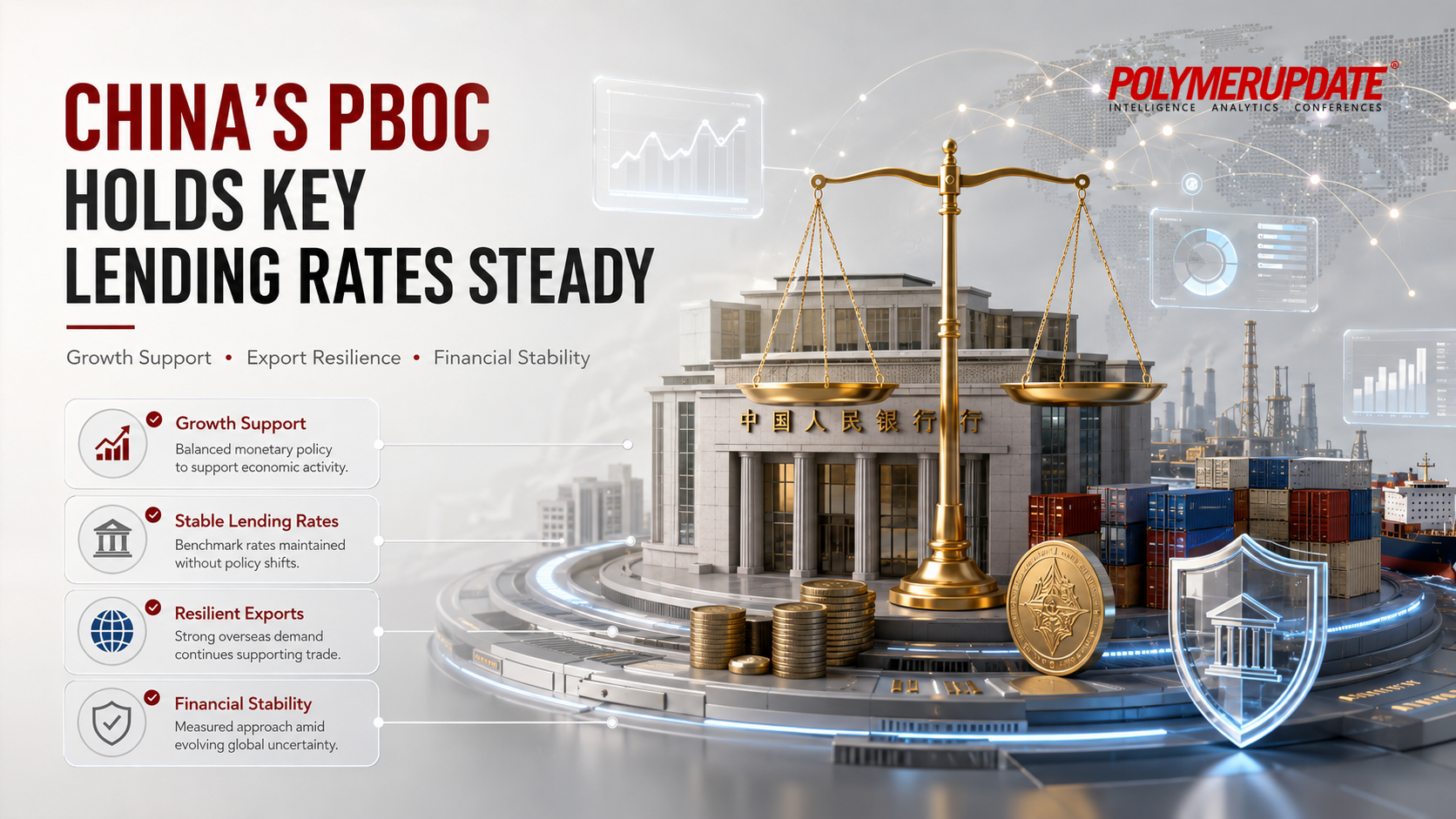
China's central bank kept its benchmark lending rates unchanged in July, extending a prolonged period of monetary policy stability as policymakers weighed slowing domestic economic growth against mounting external uncertainties stemming from geopolitical tensions and an increasingly fragile global economy. The People's Bank of China (PBOC) left the one-year Loan Prime Rate (LPR) unchanged at a record-low 3 percent, while the five-year LPR, the benchmark used for mortgage lending, remained at 3.5 percent.
The widely anticipated decision marked the 14th consecutive month that the central bank has maintained its benchmark lending rates, underscoring Beijing's preference for targeted policy support rather than broad-based monetary easing. The decision comes at a time when China's economy is navigating a delicate recovery. While economic activity has continued to expand, second-quarter gross domestic product (GDP) growth slowed to its weakest pace since the fourth quarter of 2022, reflecting persistent weakness in the property sector, subdued domestic consumption and cautious private investment.
 Exports trigger growth
Despite the softer domestic outlook, China's export sector has remained a bright spot. Robust overseas demand for artificial intelligence-related products, semiconductors, advanced electronics and other high-technology goods has helped sustain export growth, providing an important cushion against slowing domestic demand. The resilience of exports has reduced the urgency for aggressive monetary easing, allowing policymakers to adopt a wait-and-watch approach.
The National Interbank Funding Center (NIFC), which publishes the benchmark rates, confirmed that both the one-year and five-year LPRs remained unchanged from the previous month. The one-year LPR serves as the benchmark for most corporate and household loans, while the five-year LPR is widely used by banks in pricing residential mortgage loans. By keeping both rates unchanged, authorities signalled their intention to maintain stable financing conditions while avoiding excessive liquidity that could fuel financial risks or speculative activity.
Striking balanceEconomists said the PBOC's latest decision reflects its effort to strike a balance between supporting economic growth and preserving financial stability amid an uncertain global environment. The ongoing geopolitical tensions in the Middle East have injected fresh uncertainty into global financial markets, energy prices and international trade. Although China has so far weathered these external shocks relatively well, policymakers remain cautious about the potential impact on business confidence, commodity prices and export demand should geopolitical tensions intensify further.
At the same time, Beijing continues to grapple with structural challenges at home. Weak consumer confidence, sluggish property investment, elevated local government debt and uneven private sector activity continue to weigh on the broader economic recovery. Rather than relying primarily on benchmark lending rate reductions, the PBOC has increasingly shifted its focus toward managing short-term liquidity through the seven-day reverse repo rate, which currently stands at 1.4 percent. The reverse repo rate has gradually emerged as the central bank's principal monetary policy instrument, allowing authorities greater flexibility in adjusting liquidity conditions without altering longer-term lending benchmarks.
PBOC maintains financial stabilityMarket participants note that this evolving policy framework enables the central bank to respond more precisely to changing economic conditions while maintaining stability in financial markets. Financing costs across the economy remain historically low despite the absence of fresh rate cuts. Official data showed that the weighted average interest rate for newly issued corporate loans stood at around 3.0 percent in June, approximately 20 basis points lower than a year earlier. Meanwhile, the average interest rate on new residential mortgage loans remained close to 3.1 percent, broadly unchanged from the corresponding period last year.
The relatively low borrowing costs have helped ease financing pressures for businesses and households, encouraging investment and supporting consumption even as broader economic momentum remains uneven. Analysts believe the central bank is likely to continue relying on targeted liquidity measures, selective credit support and fiscal coordination rather than aggressive interest rate reductions over the coming months.
Supportive policyThe Chinese government has already indicated that macroeconomic policy will remain supportive throughout 2026. According to this year's Government Work Report, Beijing will continue implementing a more proactive fiscal policy alongside an appropriately accommodative monetary policy to sustain economic recovery while safeguarding financial stability. Fiscal measures are expected to play a greater role in stimulating infrastructure investment, supporting technological innovation, promoting advanced manufacturing and boosting domestic consumption.
Monetary policy, meanwhile, is expected to remain flexible, with the PBOC retaining the option of adjusting reserve requirement ratios, conducting liquidity injections or fine-tuning short-term policy rates if economic conditions deteriorate significantly. For now, however, the central bank appears comfortable maintaining its current policy stance. The combination of relatively resilient exports, easing financing costs and continued fiscal support has provided policymakers with room to assess incoming economic data before considering additional monetary stimulus.
OutlookInvestors will closely monitor upcoming indicators on industrial production, retail sales, fixed-asset investment, credit growth and the property market for clearer signs of whether China's recovery can regain momentum during the second half of the year. Much will also depend on developments beyond China's borders. Continued geopolitical tensions in the Middle East, evolving global trade conditions and the outlook for demand in major export markets could significantly influence Beijing's future monetary policy decisions.
By keeping benchmark lending rates unchanged for another month, the PBOC has reinforced its message that policy continuity and measured support remain its preferred strategy as China seeks to navigate a complex mix of domestic economic challenges and an increasingly uncertain global environment.
DILIP KUMAR JHA
Editor
dilip.jha@polymerupdate.com



