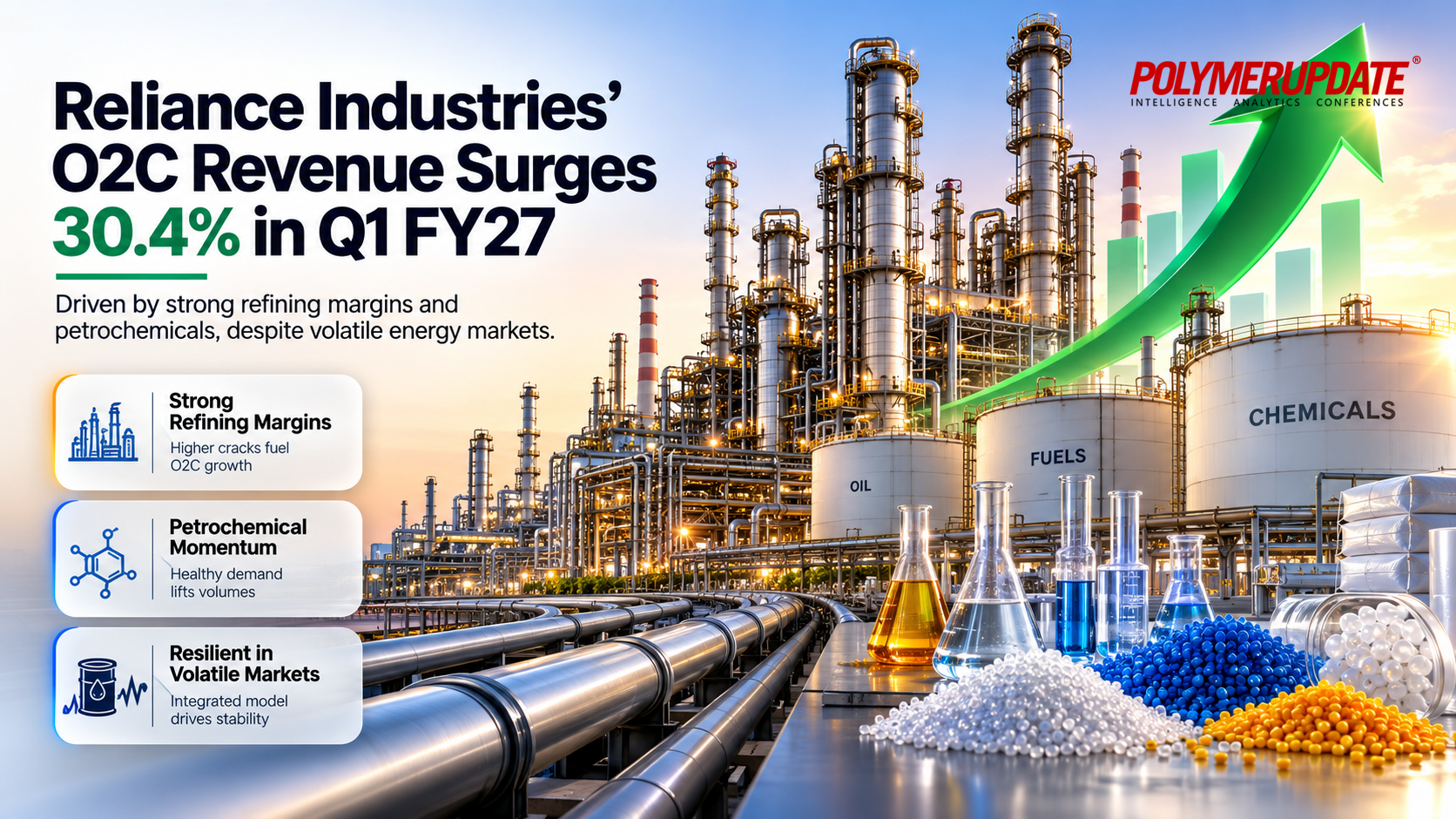
Oil-to-Chemicals (O2C) revenue of Reliance Industries Ltd (RIL) outperformed rest of the segmental businesses during the April-June 2026 quarter due to a substantial increase in income from the core oil and gas derivatives, and downstream products, a company statement said. Accounting for nearly 60 percent of overall consolidated revenue, O2C segment posted 30.4 percent yoy jump in revenue for the April-June 2026 quarter, compared to 12 percent yoy growth from Jio Platforms Ltd, 7.4 percent yoy growth from Reliance Retail Ventures Ltd, and 14.1 percent yoy jump in JioStars Business.
Notably, the consolidated revenue of the company grew by 24.5 percent yoy during the April-June 2024 quarter. The company's O2C business emerged as one of the strongest performers during the quarter, benefiting from exceptionally strong refining margins for transportation fuels and improved downstream petrochemical spreads despite an extremely volatile global energy market.
Revenue from the O2C segment rose to Rs 2,01,803 crore during the April-June quarter from Rs 1,54,804 crore a year earlier. Sequentially, O2C revenue increased from Rs 1,84,944 crore recorded in the previous quarter. The sharp rise in revenue was largely driven by a 54.1 percent year-on-year increase in international crude oil prices, although part of the gain was offset by lower production resulting from planned maintenance shutdowns.
Segment earnings before interest, tax, depreciation and amortisation (EBITDA) climbed 17.2 percent to Rs 17,010 crore, supported by record-high middle distillate refining cracks, stronger downstream petrochemical margins and operational efficiencies. The O2C business also benefited from diversification of its crude sourcing strategy, efficient product placement in supply-deficit markets and favourable economics from ethane-based petrochemical production.
Commenting on the performance, Mukesh D. Ambani, Chairman and Managing Director, Reliance Industries Limited said: “Reliance has made a steady start to FY27, with all businesses delivering strong operating performance. Our diverse business portfolio has once again demonstrated its resilience in a quarter which witnessed continuing geopolitical tensions and volatile commodity markets. The O2C business delivered strong performance during the quarter, supported by all-time high middle distillate cracks and improved downstream petrochemical deltas. This was achieved despite a challenging global energy market backdrop with disrupted supply chains. Our teams navigated this difficult environment with operational agility and ensured adequate availability of essential fuels and materials in the domestic markets.”
 External shocks
However, the company’s profitability was partially constrained by several external factors. Higher premiums on physical crude cargoes, elevated freight charges and rising marine insurance costs reduced overall margin capture. In addition, Reliance diverted propane and butane feedstock to maximise domestic liquefied petroleum gas (LPG) production and maintained stable retail fuel prices despite higher input costs, resulting in under-recoveries in its fuel marketing operations. The reintroduction of the Special Additional Excise Duty (SAED) on diesel, petrol and aviation turbine fuel also adversely affected domestic refining margins.
The quarter unfolded against an exceptionally turbulent backdrop for global energy markets. Global oil demand declined by 4.8 million bpd year-on-year to 99.1 million bpd, reflecting weaker consumption across major fuel categories. Diesel demand fell by around one million bpd, while gasoline demand declined by about 600,000 bpd. Demand for jet fuel and kerosene also softened.
Meanwhile, Dated Brent crude averaged US$ 104.5 a barrel during the quarter, nearly US$ 37 a barrel higher than a year earlier, following the closure of the Strait of Hormuz during the Middle East conflict, which disrupted an estimated 13 million barrels per day (bpd) of global crude supplies and tightened international oil markets. Global refinery throughput also declined sharply to 77.6 million bpd, down 4.7 million bpd from the previous year. The disruptions also weighed heavily on India's petrochemical sector.
Polymer demand contractionDomestic polymer demand contracted by 21.7 percent yoy during the quarter as higher prices, supply shortages and feedstock constraints reduced consumption across several industries. Polyethylene demand plunged 30.8 percent, polypropylene consumption fell 20.3 percent, while polyvinyl chloride demand declined 8.1 percent. Higher product prices encouraged buyers to procure only immediate requirements, while downstream demand remained subdued across packaging, agriculture, construction, automotive, furniture, household products, appliances, paints, FMCG and raffia applications.
India's polyester market also witnessed significant weakness. Overall polyester demand declined 18.1 percent year-on-year, with polyester staple fibre (PSF) demand falling 25.8 percent and polyester filament yarn (PFY) consumption declining 22.5 percent. Reliance attributed the slowdown to global economic uncertainty, volatile raw material prices, lower operating rates at downstream manufacturing units due to gas and LPG shortages, as well as labour constraints. Polyethylene terephthalate (PET) demand also eased 3.7 percent as downstream buyers adopted cautious procurement strategies while increased use of recycled PET gained momentum because of favourable economics.
Positive refining activitiesDespite these challenges, refining economics remained favourable. Middle distillate cracks surged sharply after the outbreak of the Middle East conflict in April before moderating during May and June. Nevertheless, quarterly refining margins remained substantially above year-earlier levels. Downstream petrochemical margins also improved as supply disruptions pushed up product prices, although higher feedstock costs partly offset these gains.
Feedstock markets experienced considerable volatility during the quarter. Naphtha prices increased by 61 percent yoy, while ethylene dichloride (EDC) prices almost doubled owing to elevated crude oil prices and supply disruptions. In contrast, US ethane prices averaged 21.3 cents per gallon, down 11 percent from a year earlier, reflecting lower US natural gas prices and providing favourable economics for ethane cracking operations.
Consolidated revenues upAt the consolidated level, RIL reported a 24.5 percent year-on-year increase in gross revenue to Rs 3,40,257 crore. Besides the strong contribution from the O2C segment, Jio Platforms recorded a 12 percent rise in revenue, supported by subscriber additions, improved average revenue per user (ARPU) and continued expansion in digital services. Reliance Retail Ventures Ltd. posted a 7.4 percent increase in revenue to Rs 90,408 crore, while adjusted revenue growth, excluding the RCPL demerger, stood at 11.6 percent. The oil and gas business also registered a 3.2 percent increase in revenue, aided by higher realisations from KG-D6 crude and condensate, favourable currency movements and stronger coal bed methane production.
Looking ahead, Ambani expressed confidence that Reliance's diversified businesses, financial strength and operational capabilities would support sustained growth during FY27. He said the company remained optimistic about the year ahead as it advances the phased commissioning of its new energy projects while preparing for the landmark public listing of Jio Platforms, which is expected to unlock significant long-term value for shareholders.
DILIP KUMAR JHA
Editor
dilip.jha@polymerupdate.com



