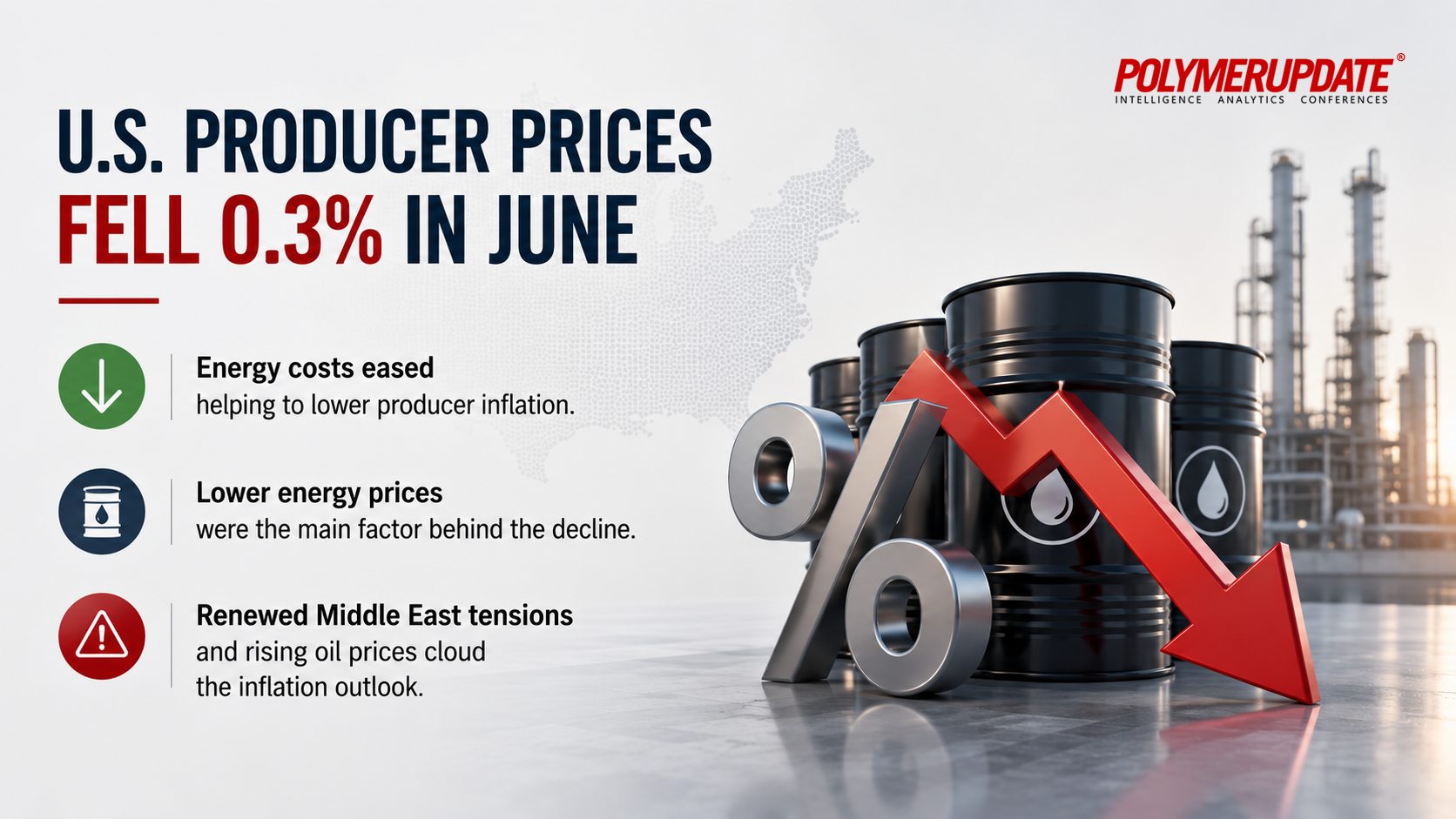
U.S. producer prices unexpectedly declined in June, recording their steepest monthly fall in more than a year as lower energy costs eased inflationary pressures across the wholesale economy. However, economists cautioned that the relief could prove temporary as renewed geopolitical tensions in the Middle East threaten to drive oil prices higher and reignite inflation.
Data released by the U.S. Bureau of Labor Statistics (BLS) on Wednesday showed that the Producer Price Index (PPI) for final demand fell 0.3 percent in June from the previous month, the largest monthly decline since April 2025. The reading surprised financial markets, with economists polled by Reuters expecting wholesale prices to remain unchanged following May's previously reported increase.
The latest report also included significant revisions to earlier data. May's producer inflation was revised sharply lower to a 0.6 percent increase from the initially reported 1.1 percent, while revisions covering the February-May period reflected the inclusion of delayed reports and corrected submissions from businesses. On an annual basis, producer prices rose 5.5 percent in June, slowing from the 6.0 percent increase recorded in May.
An analyst from an international currency trading firm commented, “Producer prices in the US declined 0.3 percent month0on-month (mom) in June 2026, following a downwardly revised 0.6 percent rise in May and below forecasts of a flat reading. It is the first decrease in PPI since August 2025 and the largest since April last year. Prices of goods went down 1.4 percent, the most since July 2022, led by a 12 percent slump in gasoline. Cost for diesel fuel, jet fuel, fresh vegetables (except potatoes), crude petroleum, and thermoplastic resins and materials also fell. Meanwhile, prices of services rose 0.2 percent, rebounding from a 0.1 percent decline in May, with half of the gain coming from a 13 percent surge in margins for fuels and lubricants retailing.”
 Falling commodity prices
The softer-than-expected wholesale inflation report follows Tuesday's release of consumer price data showing the largest monthly decline in the Consumer Price Index (CPI) since April 2020. Together, the two reports suggest inflationary pressures had begun easing before the recent escalation in hostilities involving the United States and Iran, offering policymakers some reassurance that previous monetary tightening continues to cool price growth.
The moderation in producer prices was overwhelmingly driven by energy, with goods prices falling 1.4 percent during June, marking their largest monthly decline since July 2022. Energy product prices plunged 6.4 percent, reversing much of May's sharp increase. Gasoline prices dropped 12 percent, accounting for nearly two-thirds of the decline in wholesale goods prices, while natural gas prices fell 6.4 percent.
Declining energy costsThe decline in energy costs also extended to crude petroleum and thermoplastic resins and materials, easing input costs for manufacturers across several industries. However, residential electricity prices continued to rise, increasing 0.7 percent during the month. The sharp fall in energy prices reflected lower global crude oil prices through much of June following a temporary easing of tensions in the Middle East. That trend has since reversed after renewed military confrontation between Washington and Tehran.
The collapse of a fragile ceasefire and attacks on commercial vessels transiting the Strait of Hormuz—one of the world's most critical oil shipping routes—have pushed crude oil prices to their highest level in a month. Meanwhile, economists warned that June's benign inflation data may therefore offer only temporary comfort.
Food price moderationFood prices also contributed to the moderation in wholesale inflation. Wholesale food costs declined 0.6 percent during June as agricultural commodity prices weakened. Fresh fruit and melon prices fell 2.2 percent, while fresh and dried vegetables declined 6.0 percent. Grain prices plunged 12 percent, with additional price declines recorded for eggs, oilseeds, beef, pork and poultry.
Excluding food, energy and trade services, the narrower measure of producer inflation—a gauge closely monitored by Federal Reserve policymakers—rose only 0.1 percent during the month. On an annual basis, the index increased 5.1 percent, suggesting that underlying inflation pressures continue to moderate gradually despite remaining well above the central bank's long-term objective.
Core goods prices, excluding food and energy, rose a modest 0.2 percent after increasing 0.7 percent in each of the previous two months. However, one notable exception remained the technology sector, where prices linked to artificial intelligence infrastructure continued to climb. Wholesale prices for electronic computers and computing equipment surged 2.5 percent during June, reflecting robust demand associated with AI-related investment.
Mixed services sectorThe services sector presented a more mixed picture. Wholesale services prices rebounded 0.2 percent after declining 0.1 percent in May. More than 60 percent of the increase was driven by higher trade service margins received by wholesalers and retailers. Price increases were also recorded across several consumer-oriented sectors, including furniture retailing, apparel, jewellery, footwear and accessories, loan services and hospital inpatient care. Portfolio management fees and securities brokerage services also became more expensive during the month.
At the same time, travel-related services remained subdued. Airline fares fell 0.4 percent, while hotel and motel room prices declined 1.0 percent, reflecting softer demand and easing travel costs. These categories feed directly into the Personal Consumption Expenditures (PCE) Price Index—the Federal Reserve's preferred measure of inflation. Based on both the June producer and consumer price reports, economists estimate that the core PCE Price Index likely increased 0.2 percent during June after rising 0.3 percent in May. Annual core PCE inflation is projected to ease slightly to 3.3 percent from 3.4 percent, still considerably above the Federal Reserve's 2 percent target.
Employment growth slowdownThe inflation data, coupled with signs of slowing employment growth during June, have effectively eliminated expectations of an interest rate increase at the Federal Reserve's July 28-29 policy meeting. Financial markets now overwhelmingly expect policymakers to leave the federal funds rate unchanged within its current range of 3.50 percent to 3.75 percent. Nevertheless, investors continue to assign meaningful probability to another rate increase in September. Federal Reserve Chair Kevin Warsh reiterated before lawmakers that the central bank remains committed to restoring price stability, while declining to provide specific guidance on the timing of future policy actions.
Financial markets welcomed the softer inflation figures. Wall Street equities traded higher following the report, the U.S. dollar weakened against major currencies and Treasury yields declined as investors reduced expectations of near-term monetary tightening. Despite the encouraging inflation readings, economists remain cautious about the outlook. Renewed gains in crude oil prices following escalating geopolitical tensions have increased concerns that energy could once again become a major source of inflationary pressure in the months ahead.
The unemployment rate in India remained unchanged from the previous month at 5.5 percent in June of 2026, the highest in nearly one year, slightly above market expectations that it would ease to 5.4 percent. The surge in energy prices due to the halt of commercial vessel flows in the Persian Gulf weakened the rupee and dampened the purchasing power for household and businesses. The unemployment rate rose to 6.6 percent for urban centers from 6.4 percent in the previous month. This was enough to offset a 0.1 percentage point drop for unemployment in rural areas of India, easing from a one-year high.
OutlookWith geopolitical uncertainty once again dominating global energy markets, Federal Reserve policymakers are expected to remain data-dependent, balancing encouraging signs of moderating inflation against the risk that renewed oil price shocks could derail progress toward restoring price stability.
DILIP KUMAR JHA
Editor
dilip.jha@polymerupdate.com



