The India–UK Comprehensive Economic and Trade Agreement (CETA) officially came into force today, i.e. July 15, 2026, marking a significant milestone in bilateral economic relations between the two countries. Signed on July 24, 2025, the landmark agreement is expected to deepen trade and investment ties by improving market access, lowering trade barriers, and fostering greater economic cooperation across a wide range of sectors.
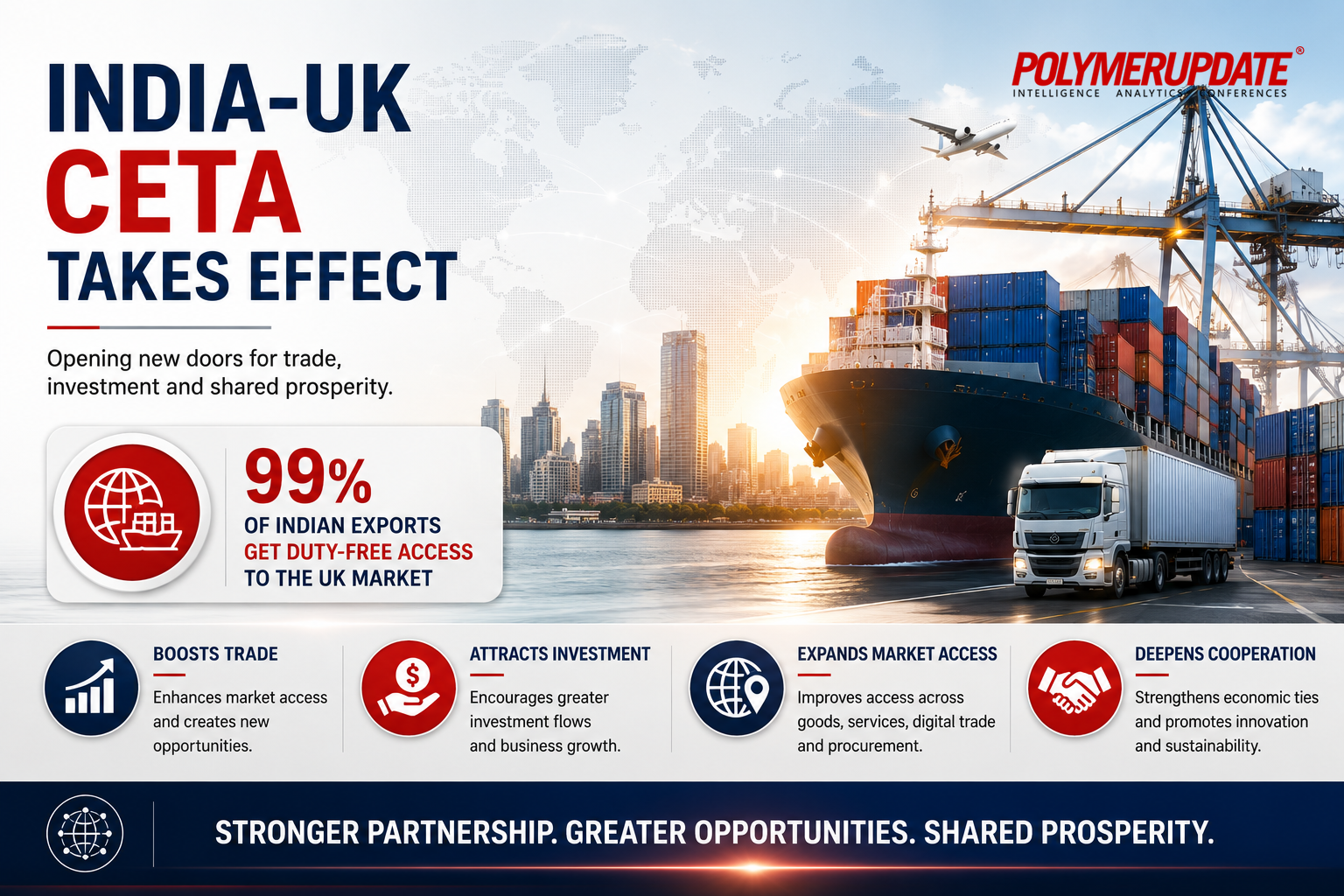
Under the agreement, nearly 99 percent of Indian exports to the United Kingdom will enjoy immediate duty-free access, providing a major boost to India's export competitiveness. The pact also substantially reduces tariffs on thousands of goods, creating new opportunities for businesses in both countries, enhancing supply chain integration, and strengthening bilateral trade while supporting long-term economic growth.
 A milestone achievement
The India-UK Comprehensive Economic and Trade Agreement (CETA) marks a major milestone in the economic partnership between the two countries. It seeks to deepen trade and investment through improved market access, simplified trade procedures, enhanced services commitments, and greater professional mobility. CETA further creates new opportunities across agriculture, fisheries, manufacturing, services, and other key sectors by reducing trade barriers and improving export competitiveness.
At the same time, it safeguards India's sensitive sectors through calibrated market access and phased tariff liberalisation. The agreement promotes digital trade, innovation, sustainable development, and stronger people-to-people linkages. By strengthening bilateral cooperation across multiple areas, the agreement lays the foundation for a more inclusive, future-oriented economic partnership.
A landmark trade agreementThe India-UK (United Kingdom) Comprehensive Economic and Trade Agreement (CETA) is a modern, comprehensive and landmark trade agreement. It seeks to deepen economic integration between India and the UK through enhanced market access, trade liberalisation and tariff concessions. India will benefit from one of the most ambitious services commitments ever offered by the UK under a Free Trade Agreement. By granting zero-duty access on nearly 99 percent of India's exports, covering almost 100 percent of the trade value, the CETA is expected to strengthen India's export competitiveness.
The agreement is also expected to expand bilateral trade, attract investment and create new opportunities for businesses. Beyond its economic and commercial significance, the CETA has been designed as an inclusive and future-oriented agreement. It seeks to ensure the benefits of trade reach every section of the society. More than a trade agreement, the CETA lays the foundation for a resilient, innovation-driven and people-centric economic partnership.
Current bilateral tradeIndia and the UK share a strong and expanding economic partnership. In 2025, India recorded a GDP of US$ 3.96 trillion, while the UK economy stood at US$ 3.84 trillion, reflecting the significance of both economies in global trade. Merchandise trade between the two countries reached US$ 25.12 billion in 2025- 26, with India's exports to UK valued at US$ 13.44 billion and imports at US$ 11.68 billion, resulting in a trade surplus of US$ 1.76 billion.
Services trade has been equally robust, with total bilateral services trade touching US$ 35.44 billion in 2024. India exported services worth US$ 21.66 billion to the UK and imported US$ 13.78 billion, generating a services trade surplus of US$ 7.88 billion.
Immense benefitsThe CETA has been designed to deliver broad-based benefits across various sectors of the economy. It also ensures that the gains from trade are widely shared. For example, Indian farmers and fisherfolk are expected to benefit from improved access to the UK market through tariff elimination. This is likely to create new export opportunities and strengthen incomes. The agreement recognises the importance of sustainable livelihoods for forest-dependent communities. It encourages responsible resource management and environmental cooperation.
Labour-intensive sectors such as textiles, leather, footwear, gems and jewellery, handicrafts, food processing, auto components, plastics, and organic chemicals are poised to witness higher exports. This is likely to boost employment generation. The agreement places strong emphasis on inclusive and future-ready growth. It expands opportunities for women, youth, MSMEs, businesses, and professionals. Dedicated provisions promote greater participation of women and under-represented groups in trade, innovation, and entrepreneurship. It also reinforces commitments to internationally recognised labour rights, gender equality, and fair working conditions.
UK market penetrationImproved access to the UK services market, mobility provisions, and recognition of professional qualifications create new opportunities. These opportunities benefit skilled Indian professionals and young talent. Small and Medium Enterprises stand to gain from simplified customs procedures, paperless trade, and digital systems. These measures reduce compliance costs and improve market access. Indian MSMEs will also benefit from duty-free access to 99 percent of Indian exports entering the UK. It includes textiles, leather, jewellery, footwear, and food products- saving 4- 16 percent in tariffs.
Businesses benefit from streamlined trade facilitation measures, digital cooperation, and stronger integration into global value chains. This enhances ease of doing business and supports sustained economic growth. The agreement further promotes digital trade facilitation and electronic certification. It leverages established mechanisms such as the Single Window and Authorised Economic Operator (AEO) frameworks.
Investment partnershipsThe UK is India's 6th largest inward investor. It has made cumulative equity investments of US$ 35 billion until September 2024. India's outward investment in the UK stood at US$ 19 billion until March 2024. As of July 2025, there are 971 Indian companies operating in the UK that employ over 100,000 people. Moreover, there are 667 British companies operating in India, with over 500,000 people.
India and the UK signed the Migration and Mobility Partnership (MMP) Agreement on 4 May 2021. The agreement aims to facilitate faster movement of working professionals which is an important pillar of the India-UK economic partnership. In November 2022, the Young Professional Scheme between India and the UK was announced, made on the sidelines of the G20 Bali Summit. Under the scheme, 3,000 visas are issued every year. Graduates aged 18–30 years receive a two-year visa. The scheme allows them to live and work in each other's country.
The UK is home to a large Indian diaspora of 1.864 million people, according to the 2021 Census. This accounts for 2.6 percent of the UK's population which was estimated at 68 million in 2022. The census also recorded 369,000 Indian passport holders living in the UK. The Indian diaspora has high rates of employment and professional qualifications. It has made valuable contributions to academia, literature, arts, medicine, science, sports, industry, business, and politics.
Safeguarding national interestThe India–UK CETA balances trade liberalisation with the protection of India's strategic sectors, domestic industries, and long-term development priorities. India has offered tariff concessions on 89.5 percent of its tariff lines, covering 91 percent of the UK's exports. 24.5 percent of the UK's export value will receive immediate duty-free access, with concessions on other products to be implemented gradually. Sensitive sectors which include agriculture and strategically important industries have been protected through exclusions or phased tariff reductions.
Products under agriculture include dairy, cereals and millets, pulses, apples, edible oils, oats, and vegetables CETA also protects high-value products such as gold, jewellery, lab-grown diamonds, certain essential oils, critical energy fuels, marine vessels, worn clothing, critical polymers, their monofilaments, smartphones, and optical fibres.
Strategically important products have been considered carefully. These include sectors where domestic capacity is being developed under Make in India and the Production Linked Incentive (PLI) Scheme. Tariff concessions are phased over 5, 7, or 10 years through gradual tariff reductions. Further, India has gradually and selectively opened its market for alcoholic beverages. For automobiles, India has adopted a calibrated, phased, and development-oriented quota-based liberalisation strategy. At the same time, it continues to protect sensitive segments of India's automotive industry.
DILIP KUMAR JHA
Editor
dilip.jha@polymerupdate.com



