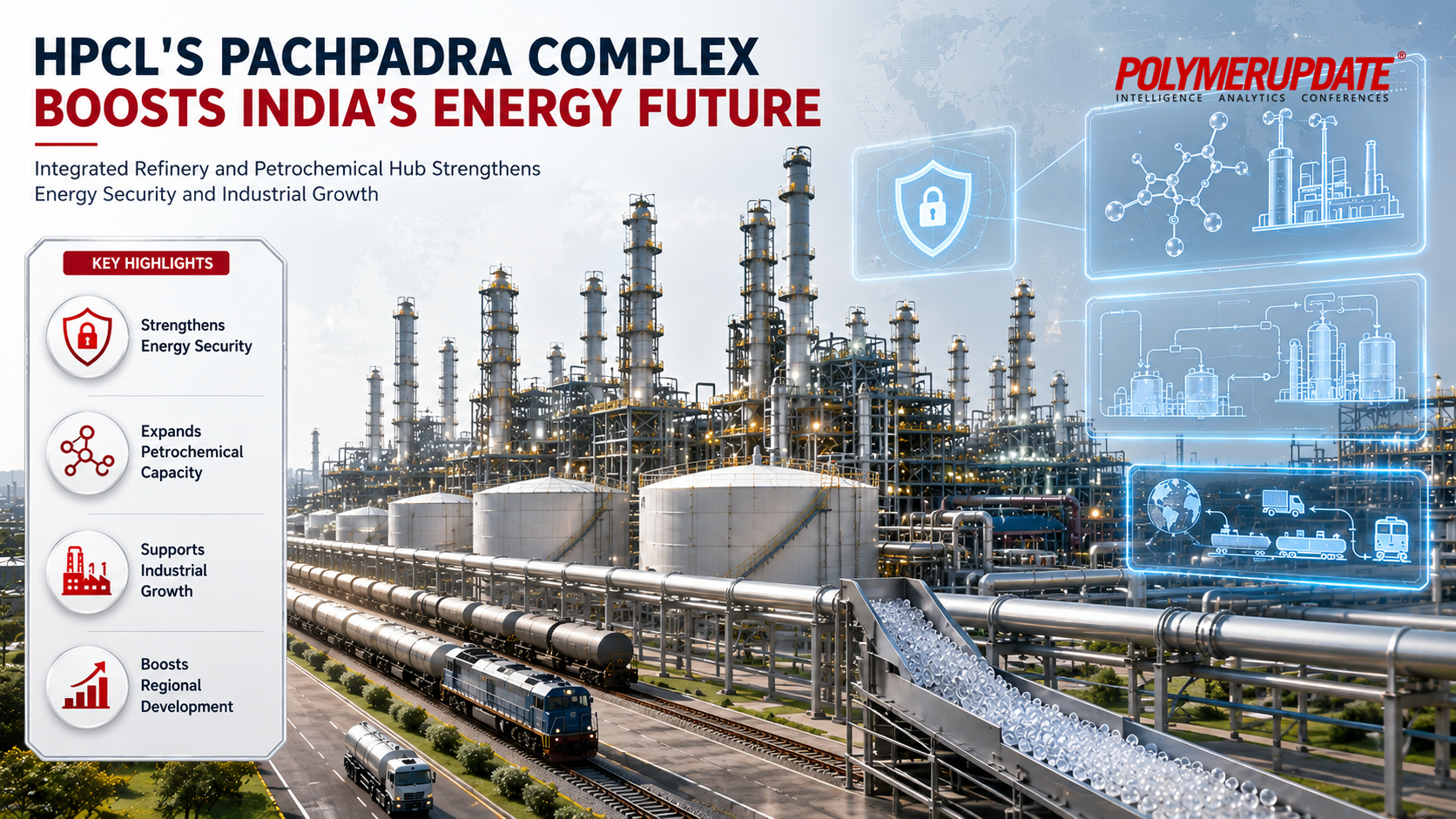
Hindustan Petroleum Corporation Ltd (HPCL), a Maharatna public sector undertaking under the Ministry of Petroleum and Natural Gas, has inaugurated India's first greenfield integrated refinery-cum-petrochemical complex in Pachpadra, Rajasthan, marking a major milestone in the country's energy and petrochemical security. The project is expected to transform India's refining and petrochemical landscape by meeting the growing demand for petroleum derivatives across downstream industries, reducing dependence on imports, and generating broad-based economic benefits.
Recently inaugurated by Prime Minister Narendra Modi, the Pachpadra refinery-cum-petrochemical complex heralds a new era for India's energy and petrochemical sectors. The project represents a significant milestone in strengthening the country's energy security while fostering regional economic development and industrial growth. It is a joint venture between HPCL and the Government of Rajasthan, with equity stakes of 74 percent and 26 percent, respectively. Beyond its immediate economic significance, the project marks a decisive step towards India's ambition of becoming a global leader in the refining and petrochemical industries, with the commissioning of the country's first greenfield integrated refinery-cum-petrochemical complex at Pachpadra.
 Project delay
The commissioning of the project was delayed by approximately 10 weeks following a fire incident in the Crude Distillation Unit (CDU) on April 20, 2026, just a day before its scheduled inauguration on April 21, 2026. The incident temporarily disrupted commissioning activities and necessitated additional safety inspections, repairs, and operational assessments before the project could proceed. The Crude Distillation Unit has since been restored to service and is now operating normally, paving the way for the next phase of the integrated complex.
With refinery operations back on track, HPCL has outlined plans to commission its petrochemical units during the fourth quarter of 2026. The company expects the initial capacities of the petrochemical complex to come on stream by November or December 2026, marking the beginning of commercial operations. The phased startup is expected to strengthen HPCL's downstream integration, enhance value addition, and improve the company's presence in the petrochemical sector.
Engineering marvelConstructing the state-of-the-art refinery in the arid landscape of Rajasthan's Balotra district demanded engineering capabilities on an extraordinary scale. Built under challenging climatic and logistical conditions, the project involved moving nearly 15 million cubic metres of earth—equivalent to around six times the volume of Egypt's Great Pyramid of Giza—highlighting the massive groundwork required to prepare the site. The construction also consumed approximately 1.6 million cubic metres of concrete, nearly five times the quantity used in Dubai's Burj Khalifa, reflecting the immense structural requirements of one of India's largest energy infrastructure projects.
The refinery's engineering complexity is further demonstrated by the use of around 300,000 metric tonnes of steel—roughly forty times the amount used in the Eiffel Tower—and the installation of nearly 28,000 kilometres of electrical cabling across the integrated complex. Among its most striking features is the 125-metre-high Coke Dome, which surpasses the scale of India's iconic Gol Gumbaz. These engineering achievements underscore the refinery's status as one of the country's most ambitious industrial projects, setting new benchmarks in the design and execution of large-scale energy infrastructure.
Strategic investmentDeveloped as a joint venture between Hindustan Petroleum Corporation Ltd (HPCL) and the Government of Rajasthan, the Pachpadra refinery and petrochemical complex represents an investment of approximately Rs 79,459 crore, making it one of India's largest greenfield energy projects. Strategically located in Balotra district, the integrated complex has been designed to strengthen the country's refining and petrochemical capabilities while reducing dependence on imported value-added petrochemical products. The project is also expected to serve as a catalyst for industrial development, employment generation, and economic growth across western India.
The facility has a crude processing capacity of 9 million metric tonnes per annum (MMTPA) and is integrated with a petrochemical complex capable of producing 2.4 MMTPA of petrochemical products. Designed with the flexibility to process both Rajasthan's indigenous crude and imported crude grades, the refinery features a Nelson Complexity Index of 17.0, placing it among the world's most sophisticated refining facilities. Its advanced configuration enables the production of a wide range of high-value petroleum fuels and petrochemical feedstocks while maximizing operational efficiency.
A key highlight of the complex is its petrochemical yield of more than 26 percent, significantly higher than that of conventional refineries and setting new benchmarks for value addition, efficiency, and sustainability. The refinery has already commenced the production of petroleum products from crude oil, marking an important milestone in its phased commissioning. As the integrated petrochemical units become operational, the complex is expected to strengthen domestic supply chains, support downstream industries such as plastics, chemicals, textiles, packaging, and automotive manufacturing, and enhance India's self-reliance in the petrochemical sector.
Regional developmentThe inauguration ceremony also witnessed Prime Minister Narendra Modi unveiling and laying the foundation stones for a series of development projects worth more than Rs 1.06 lakh crore. Spanning urban transport, railway infrastructure, renewable energy, power transmission, and road connectivity, these projects underscore the government's broader strategy of strengthening infrastructure, improving logistics, and accelerating industrial and economic development across Rajasthan. The investments are expected to enhance regional connectivity while supporting long-term growth through improved energy and transportation networks.
Beyond its refining operations, the Pachpadra refinery is expected to emerge as a catalyst for the development of downstream petrochemical and plastic parks, creating a robust industrial ecosystem in the region. The availability of domestically produced petrochemical feedstocks is likely to encourage investments in micro, small and medium enterprises (MSMEs) as well as industries such as packaging, textiles, automotive components, and agricultural films. Industry experts believe the integrated complex will generate substantial value addition, attract fresh manufacturing investments, and position Rajasthan as a major hub for high-value petrochemical and industrial production.
Social impactThe Pachpadra refinery project has already emerged as a significant generator of employment, with its construction phase creating substantial livelihood opportunities across the region. At its peak, the project provided direct employment to nearly 35,000 engineers, technicians, skilled workers, and labourers engaged in construction and allied activities. Beyond the project site, it also supported an estimated 100,000 indirect jobs across sectors such as logistics, transportation, construction materials, engineering services, equipment manufacturing, hospitality, and local businesses, highlighting its broad economic multiplier effect.
The employment impact is expected to strengthen further as the refinery and integrated petrochemical complex gradually ramp up operations. The commissioning of downstream petrochemical units is likely to attract ancillary industries, logistics providers, maintenance services, and manufacturing enterprises, creating sustained demand for skilled and semi-skilled workers. The development of petrochemical and plastic parks around the refinery is also expected to spur entrepreneurship and generate additional employment opportunities through the growth of micro, small and medium enterprises (MSMEs).
For Rajasthan, a state whose economy has traditionally been driven by agriculture and mining, the refinery marks an important step towards industrial diversification and long-term economic resilience. By fostering large-scale manufacturing, attracting fresh investments, and creating a robust industrial ecosystem, the project is expected to broaden the state's economic base while improving income levels and living standards. As industrial activity expands, local communities are likely to benefit from enhanced infrastructure, better employment prospects, and greater opportunities for skill development, positioning the region as an emerging hub for energy and petrochemical-led growth.
Energy securityThe refinery-cum-petrochemical complex is expected to play a pivotal role in strengthening India's energy security by enhancing domestic refining and petrochemical production capacity, thereby reducing reliance on imported fuels, feedstocks and petrochemical products. By ensuring a more stable supply of critical raw materials for industries such as plastics, chemicals, textiles, pharmaceuticals and automotive manufacturing, the project is set to reinforce domestic supply chains, improve industrial resilience and support the country's expanding manufacturing base. The facility is also expected to contribute to import substitution, conserve foreign exchange and improve India's overall trade balance in the long term.
Aligned with the Government of India's Make in India and Viksit Bharat (Developed India) vision, the project represents a significant milestone in the country's industrial transformation. Beyond its economic contribution, the refinery has been designed with advanced environmental management systems, energy-efficient technologies and stringent emission control measures to meet global sustainability benchmarks. According to HPCL officials, the integration of modern environmental safeguards and sustainable operating practices will not only minimise the project's ecological footprint but also strengthen India's position as a competitive, responsible and future-ready player in the global refining and petrochemical industry.
DILIP KUMAR JHA
Editor
dilip.jha@polymerupdate.com



