India's specialty chemical industry is expected to witness moderate revenue growth this fiscal, supported by resilient domestic demand but weighed down by subdued exports, rising input costs and continued pricing pressure from Chinese competitors. While the sector is projected to remain on a growth trajectory, profitability is likely to come under pressure as higher crude-linked raw material costs and weaker export realisations compress operating margins.
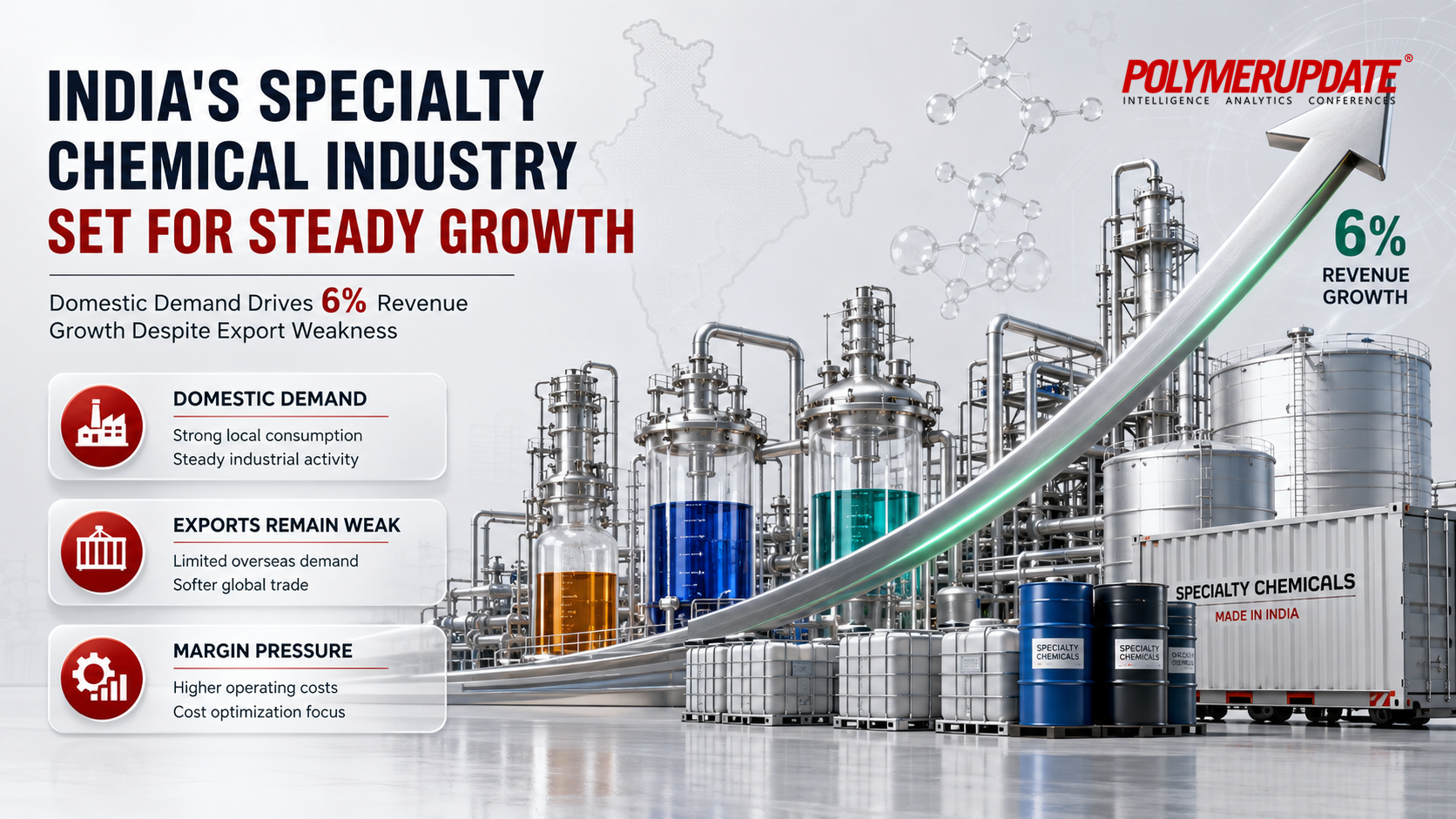
According to an analysis by Crisil Ratings covering 126 companies accounting for nearly 40 percent of the industry's revenue, specialty chemical manufacturers are expected to register revenue growth of around 6 percent this fiscal, compared with approximately 8 percent recorded in each of the previous two financial years. The moderation reflects a challenging external environment marked by global supply disruptions, cautious overseas procurement and lingering uncertainty in international trade.
Although easing geopolitical tensions in West Asia have improved sentiment, export demand is expected to remain subdued in the near term, with trade flows likely to normalise only over the next couple of quarters if the current geopolitical stability continues. Domestic demand, however, is expected to provide a strong cushion. The Indian market contributes nearly two-thirds of the industry's revenue and continues to benefit from diversified end-user industries, including agriculture, consumer products, pharmaceuticals and industrial manufacturing.
 Export weakness
Among domestic segments, agrochemicals account for nearly 30 percent of industry revenue, followed by dyes and pigments at around 22 percent and flavours and fragrances at approximately 14 percent. This diversified demand base is expected to help domestic sales grow by 7-8 percent during the fiscal year, partially offsetting weakness in overseas markets. However, sustained dumping by Chinese manufacturers would continue to restrict any significant improvement in pricing power for Indian companies.
"Supported by diversified end-user segments, domestic demand will remain the key growth driver this fiscal and support 7-8 percent growth in industry revenue. Though exports will stay muted amid global disruptions, trade flows should normalise over the next couple of quarters if the recent easing of the West Asia conflict holds. Pricing could also receive some support following China's recent reduction in export incentives for select chemical products," said Anuj Sethi, Senior Director at Crisil Ratings.
Positive revenue growthWhile revenue growth is expected to remain positive, profitability is likely to weaken considerably. Industry operating margins are projected to decline to 14-14.5 percent this fiscal from around 16 percent in the previous year, translating into a contraction of 150-200 basis points. The primary reason is the muted performance of exports, which typically generate better margins than domestic sales. At the same time, higher crude-linked raw material costs cannot be fully passed on to customers because of intense global competition and soft export demand.
The extent of margin pressure is expected to vary significantly across different product segments, depending on their raw material mix and pricing flexibility. Manufacturers dependent on ethylene and propylene feedstocks are likely to face the sharpest profitability pressure because these inputs are closely linked to crude oil prices and offer limited pricing power. In contrast, companies using benzene, toluene and xylene (BTX)-based feedstocks are expected to perform relatively better due to their higher share of value-added products and greater ability to pass on cost increases.
Resilient segmental revenueSimilarly, manufacturers specialising in fluorine-based chemistries are likely to remain comparatively resilient because of their niche product positioning, specialised applications and stronger pricing power.
Recent customs duty exemptions on select petrochemical inputs may provide some cost relief. However, rating analysts believe these measures will not be sufficient to offset the broader volatility in feedstock prices. The industry is also recalibrating its investment strategy in response to the evolving business environment.
"Crude-linked inputs, accounting for nearly one-third of raw material costs, will continue to weigh on profitability, though the recent softening in crude and chemical input prices should limit the decline in operating margin to 150-200 basis points this fiscal. Chinese competition would continue to constrain pricing flexibility, while global supply chains may require several quarters to return to normal. Any improvement in profitability would therefore be gradual and contingent upon continued stability in West Asia and sustained moderation in input costs," said Poonam Upadhyay, Director at Crisil Ratings.
Moderating capital expenditureSpecialty chemical manufacturers are expected to moderate their capital expenditure to around Rs 16,500 crore this fiscal, with investments increasingly focused on strategic priorities such as backward integration, import substitution and development of niche chemical products. These investments are aimed at strengthening supply chain resilience, reducing dependence on imported intermediates and improving long-term competitiveness rather than pursuing aggressive capacity expansion.
Most companies are expected to finance these investments through internal accruals. However, lower profitability combined with increased working capital requirements may put pressure on balance sheets.
As a result, leverage metrics are expected to deteriorate modestly during the year. The industry's debt-to-EBITDA ratio is projected to increase to around 2.2 times this fiscal from 1.9 times in the previous year, while the interest coverage ratio is expected to decline to about six times from nearly 7.5 times. Although these levels remain manageable for most companies, they reflect the financial strain arising from slower earnings growth and elevated operating costs.
Uncertain futureLooking ahead, industry performance will depend on several external and domestic factors. Analysts believe the pace of feedstock cost normalisation, easing competitive pressure from Chinese exporters, recovery in global industrial demand and the ability of companies to selectively raise prices will determine whether profitability improves in the second half of the fiscal year. If geopolitical tensions in West Asia remain contained and global supply chains continue to stabilise, exports could gradually recover, supporting both revenue growth and margins.
However, any renewed escalation in regional conflicts or sharp increase in crude oil prices could delay recovery and intensify cost pressures for an industry that remains closely tied to global commodity cycles. Despite these near-term challenges, the long-term outlook for India's specialty chemical sector remains favourable, supported by structural demand growth, increasing global diversification of supply chains and continued investment in high-value specialty products. The current fiscal, however, is expected to test the sector's resilience as companies navigate a complex mix of geopolitical uncertainty, volatile input costs and intense international competition.
DILIP KUMAR JHA
Editor
dilip.jha@polymerupdate.com



