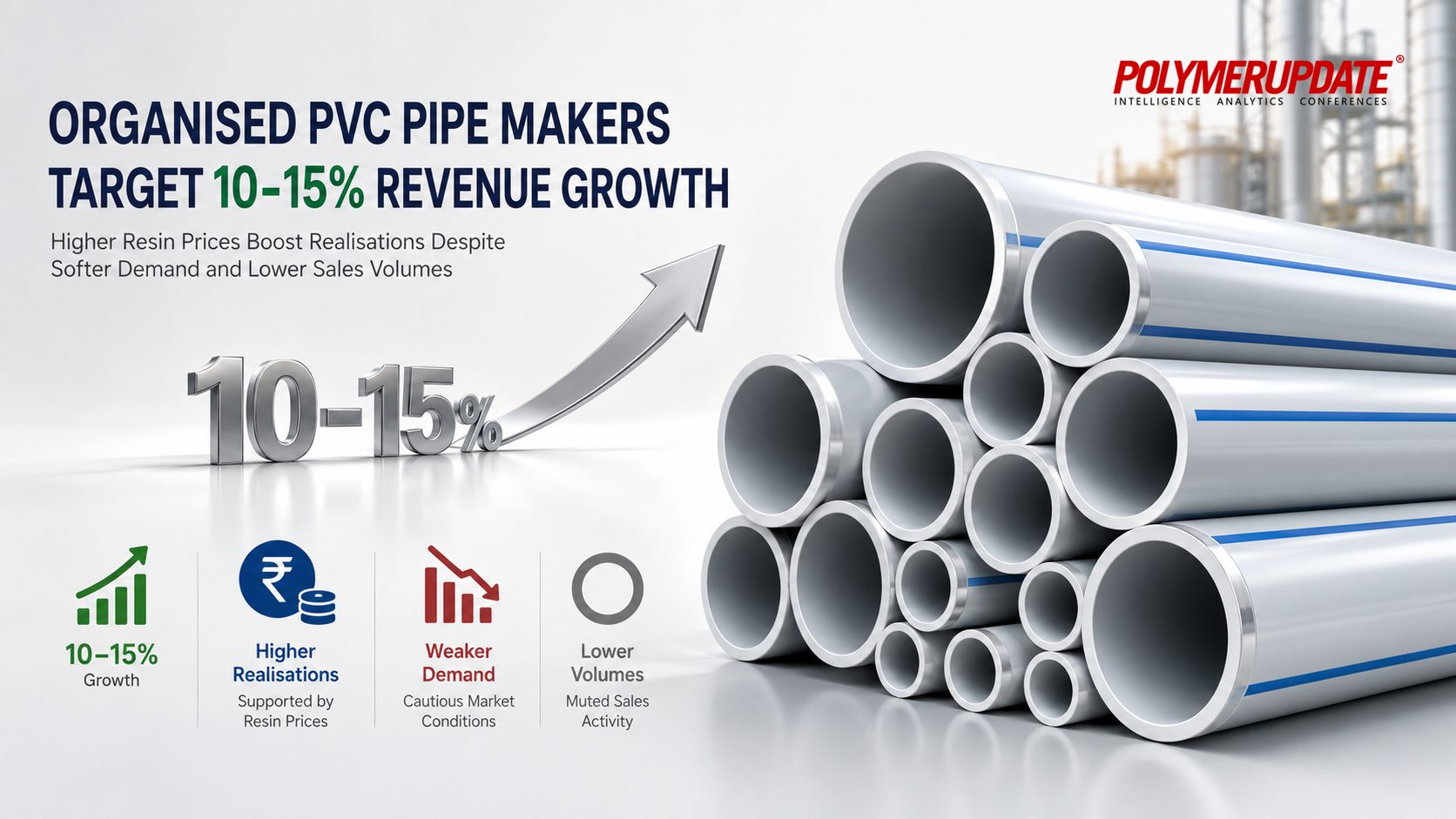
Organised polyvinyl chloride (PVC) pipe and fitting manufacturers are expected to register robust revenue growth of 10-15 percent in the current fiscal, supported primarily by higher product realisations stemming from elevated resin prices following the recent conflict in West Asia. However, the industry's volume growth is likely to remain under pressure as demand softens in key end-use segments amid inflationary concerns and higher project costs.
According to an analysis by Crisil Ratings covering five leading PVC pipe manufacturers with combined revenues of around Rs 20,000 crore—representing nearly 60 percent of the organised sector's turnover—the industry is poised to benefit from favourable pricing dynamics despite a moderation in physical sales. The PVC pipe industry has witnessed largely flat revenue growth over the past two fiscals despite healthy volume expansion. This year, the trend is expected to reverse as higher input costs are passed on to customers, resulting in stronger revenues even as sales volumes decline.
 Growth drivers
The sharp increase in crude oil prices during the West Asia conflict pushed up global PVC resin prices, the key raw material used in pipe manufacturing. Since nearly two-thirds of India's PVC resin requirement to the tune of approximately 4 million tonnes is imported, domestic pipe producers remain highly vulnerable to fluctuations in international energy markets and currency movements. India’s domestic PVC resin production is estimated at around 1.6 million tonnes.
"Higher crude prices and a depreciating rupee are expected to keep resin prices elevated. As two-thirds of resin requirements of PVC pipe makers are imported, accounting for 75-80 percent of their total costs, rising resin prices—although expected to moderate in the third quarter—will drive realisations 12-15 percent higher on-year this fiscal, with players expected to pass on much of the cost increase to their customers. This should support strong revenue growth and profitability," said Himank Sharma, Director, Crisil Ratings.
Supply-demand dynamicsAlthough the ceasefire announced in West Asia has eased concerns over supply disruptions and may gradually soften resin prices in the coming months, average prices are still expected to remain above pre-conflict levels for most of the fiscal year. This pricing environment is likely to support profitability. Industry earnings before interest, taxes, depreciation and amortisation (EBITDA) per tonne are projected to rise to around Rs 23,000 this fiscal from Rs 21,200 in the previous year. The expected increase of 8-10 percent would help manufacturers regain profitability levels last seen in fiscal 2024 after two years of margin pressure.
Demand dynamics, however, present a mixed picture. The irrigation sector, which accounts for approximately 45 percent of total PVC pipe consumption in India, is expected to witness modest growth of 2-4 percent this fiscal. Demand from agriculture is likely to receive support from increased irrigation requirements for the 2026 crop season and the launch of the Jal Jeevan Mission (JJM) 2.0 in March 2026.
Infrastructure projectsThe government has allocated Rs 67,670 crore for JJM 2.0, nearly three times the allocation under the previous phase, creating significant opportunities for water infrastructure and rural pipeline projects. On the other hand, demand from plumbing, housing and urban water supply applications—which together account for the remaining 55 percent of PVC pipe consumption—is expected to remain subdued. Elevated construction costs, inflationary pressures and cautious spending in the real estate sector are likely to weigh on fresh demand. Consequently, overall PVC pipe sales volumes are projected to decline by 3-5 percent this fiscal, marking a departure from the steady growth trajectory witnessed over recent years.
The rise in resin prices is also creating challenges on the working capital front. Manufacturers are required to hold higher-value inventories, increasing their funding requirements and dependence on short-term borrowings. Industry inventory levels had already increased by around five days to 75 days as of March 31, 2026, primarily due to the sharp rise in resin prices during March. This comes after inventories remained relatively low over the preceding two fiscals. Going forward, inventory holdings are expected to rise further as companies seek to secure raw material availability amid ongoing market uncertainties.
"This fiscal, organised PVC pipe makers are expected to add 5-10 percent to existing capacities, entailing a capex outlay of Rs 2,500-2,700 crore. This will drive a 13-15 percent increase in gross block. Additionally, inventory holding at manufacturers' end is set to rise by around 10 days to approximately 85 days. Despite the planned capital expenditure and incremental working capital requirements, healthy cash accruals will limit reliance on external debt," said Rushabh Borkar, Associate Director, Crisil Ratings.
Capacity utilisationCapacity utilisation across the sector is expected to remain steady at around 70 percent. Given the anticipated moderation in demand growth, manufacturers are likely to adopt a cautious approach toward large-scale capacity expansion, focusing instead on incremental additions and operational efficiencies. Despite rising working capital requirements and ongoing capital expenditure plans, the sector's credit outlook remains stable. Strong balance sheets, healthy operating cash flows and improved profitability are expected to offset the impact of higher borrowing needs.
As India continues to expand its rural water infrastructure and irrigation network, organised PVC pipe manufacturers remain well positioned to benefit from long-term structural demand. While geopolitical tensions have temporarily altered the industry's cost structure, the resulting increase in realisations is likely to provide a significant boost to revenues and margins during the current fiscal year.
DILIP KUMAR JHA
Editor
dilip.jha@polymerupdate.com



