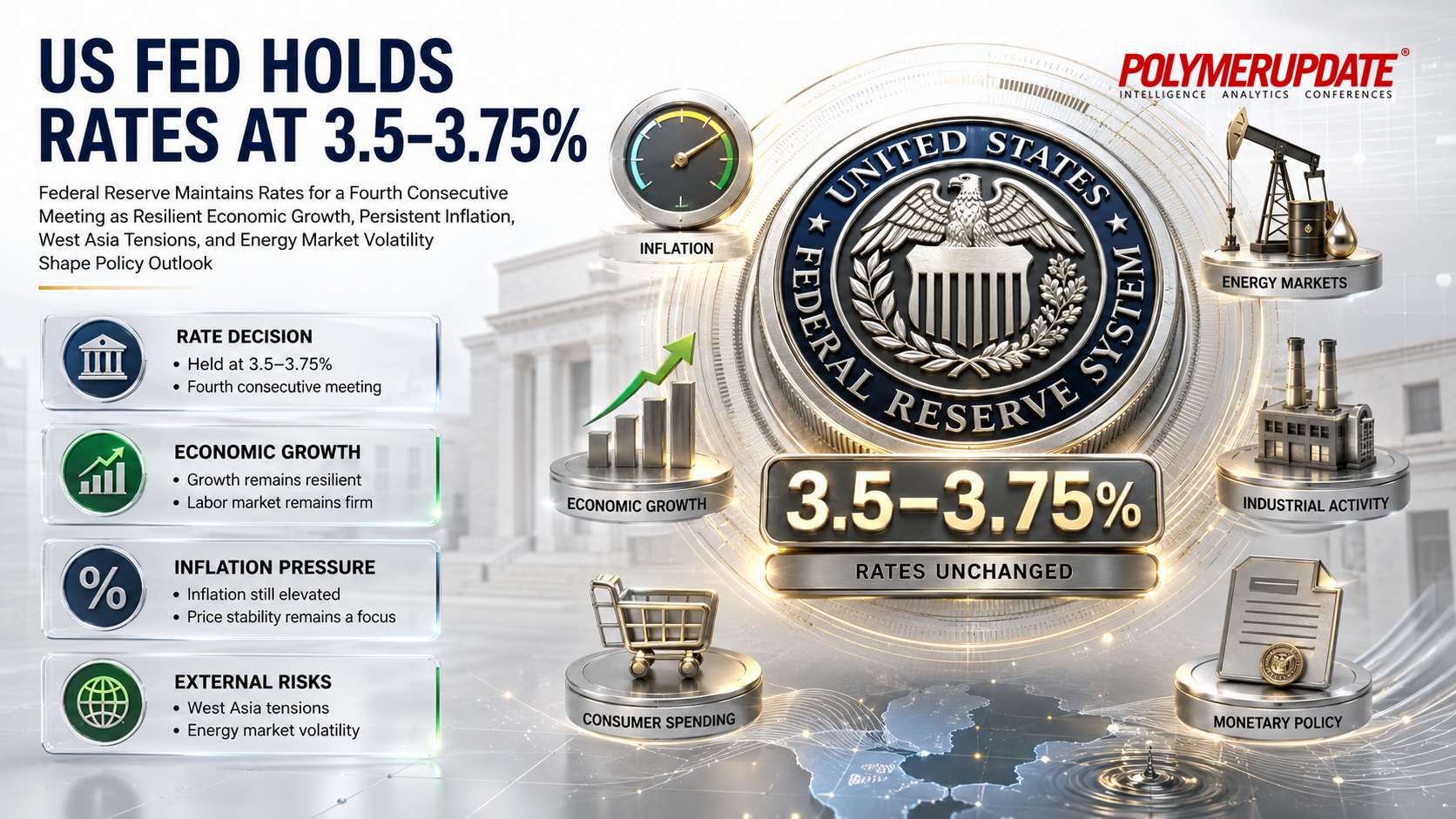
The United States Federal Reserve (US Fed) on Wednesday maintained its benchmark federal funds rate at 3.5-3.75 percent for the fourth consecutive policy meeting, reflecting a cautious approach as policymakers seek to balance resilient economic growth with persistent inflationary pressures. The widely expected decision comes amid elevated global uncertainty, particularly following recent geopolitical tensions in West Asia that triggered volatility in energy markets and contributed to higher inflation.
By keeping borrowing costs unchanged, the Fed signalled confidence in the underlying strength of the US economy while reaffirming its commitment to bringing inflation back toward its long-term target without undermining employment and economic expansion. The decision, which was widely anticipated by economists and financial markets, came at the conclusion of the Federal Open Market Committee (FOMC) meeting held on June 16-17. All 12 voting members unanimously backed the move to maintain the current policy rate as policymakers assessed the evolving economic landscape, including the inflationary impact of recent geopolitical tensions in West Asia.
The latest policy meeting was chaired by newly appointed Federal Reserve Chairman Kevin Warsh, who underscored the central bank’s commitment to restoring price stability while sustaining employment growth. Describing the deliberations as reflective of the Fed’s long-standing traditions, Warsh said the meeting was characterized by rigorous debate, open-mindedness and a shared commitment to ensuring that monetary policy remains aligned with the institution’s objectives.
“We are here to serve our legislative remit—price stability and maximum employment—and these objectives guided our business in the meeting just concluded. The Committee decided to maintain the target range for the federal funds rate at 3.5 to 3.75 percent in support of the Fed’s dual mandate. The Committee also reaffirmed its policy of maintaining ample reserves in the banking system,” Warsh said during the post-policy press conference.
 Resilient economic growth
Despite heightened uncertainty arising from the conflict in the Middle East, the Fed observed that economic activity in the United States continues to expand at a solid pace. According to Warsh, productivity growth and capital investment remain robust, while labour market conditions have stayed broadly stable. Employment gains have continued to keep pace with workforce growth, and the unemployment rate has remained relatively unchanged. Fed officials noted that while economic growth remains healthy, inflation continues to run above the central bank’s long-term target of 2 percent, warranting continued policy caution.
Reflecting the economy’s resilience, the Fed projected real Gross Domestic Product (GDP) growth of 2.2 percent for 2026. Although slightly lower than the 2.4 percent forecast issued in March, the projection signals continued expansion in economic activity. The central bank retained its GDP growth forecast for 2027 at 2.3 percent. The unemployment rate currently stands at approximately 4.3 percent, while policymakers expect the federal funds rate to average around 3.8 percent by the end of this year and 3.6 percent by the end of 2027.
Inflation emerges as key concernA major focus of the policy review was the persistence of elevated inflation, which has remained above the Fed’s target for more than five years. The central bank sharply revised its Personal Consumption Expenditures (PCE) inflation forecast for 2026 to 3.6 percent, compared with 2.7 percent projected earlier. The outlook for 2027 was also raised to 3.3 percent from 2.7 percent. Recent consumer price data further reinforced concerns about rising price pressures.
According to official figures, the annual Consumer Price Index (CPI)-based inflation rate accelerated to 4.2 percent year-on-year in May 2026 from 3.8 percent in April, marking the highest reading since April 2023. The increase represented the third consecutive monthly rise in headline inflation and was largely driven by surging energy prices following disruptions in global oil markets linked to geopolitical tensions in the Middle East.
On a monthly basis, CPI rose by 0.5 percent in May, in line with market expectations. Energy-related costs accounted for nearly 60 percent of the overall increase, highlighting the significant role of higher fuel prices in driving inflationary pressures across the economy. The inflation spike has become a growing burden for American households, particularly as elevated prices continue to erode purchasing power. However, policymakers noted that underlying inflation trends outside the energy sector remain comparatively moderate, offering some reassurance that broader price pressures have not become entrenched across the economy.
Inflation-focussed approachWarsh emphasized that ensuring price stability would remain the central priority under his leadership.
“The newly appointed Committee will deliver price stability. At any institution, a change in leadership is a natural and timely opportunity to reaffirm its mission, review current practices, and consider whether those practices best meet our objectives. My colleagues and I will work closely together to identify improvements in the conduct of monetary policy,” he said.
Warsh also signalled a shift toward clearer communication, noting that the latest policy statement was intentionally shorter and simpler than previous versions. “You might have already noticed something—a difference in today’s policy statement. It’s a bit shorter, a bit simpler, and it dispenses with some older language,” he remarked.
Divided outlookThe Fed’s latest projections revealed a split among policymakers regarding the future path of interest rates. Nine officials expect at least one rate increase before the end of 2026, with six of them anticipating two or more hikes. Another nine policymakers projected either no change in rates or a potential rate cut, highlighting the uncertainty surrounding inflation and economic growth prospects. Only 18 of the 19 policymakers submitted interest-rate projections for the end of 2026, as Chairman Warsh did not provide a forecast.
With inflation remaining stubbornly above target and geopolitical risks continuing to influence energy markets, the Federal Reserve appears poised to maintain a cautious stance in the months ahead. While robust economic growth and a stable labour market provide room for patience, policymakers remain determined to ensure that inflation returns sustainably toward the 2 percent objective.
DILIP KUMAR JHA
Editor
dilip.jha@polymerupdate.com



