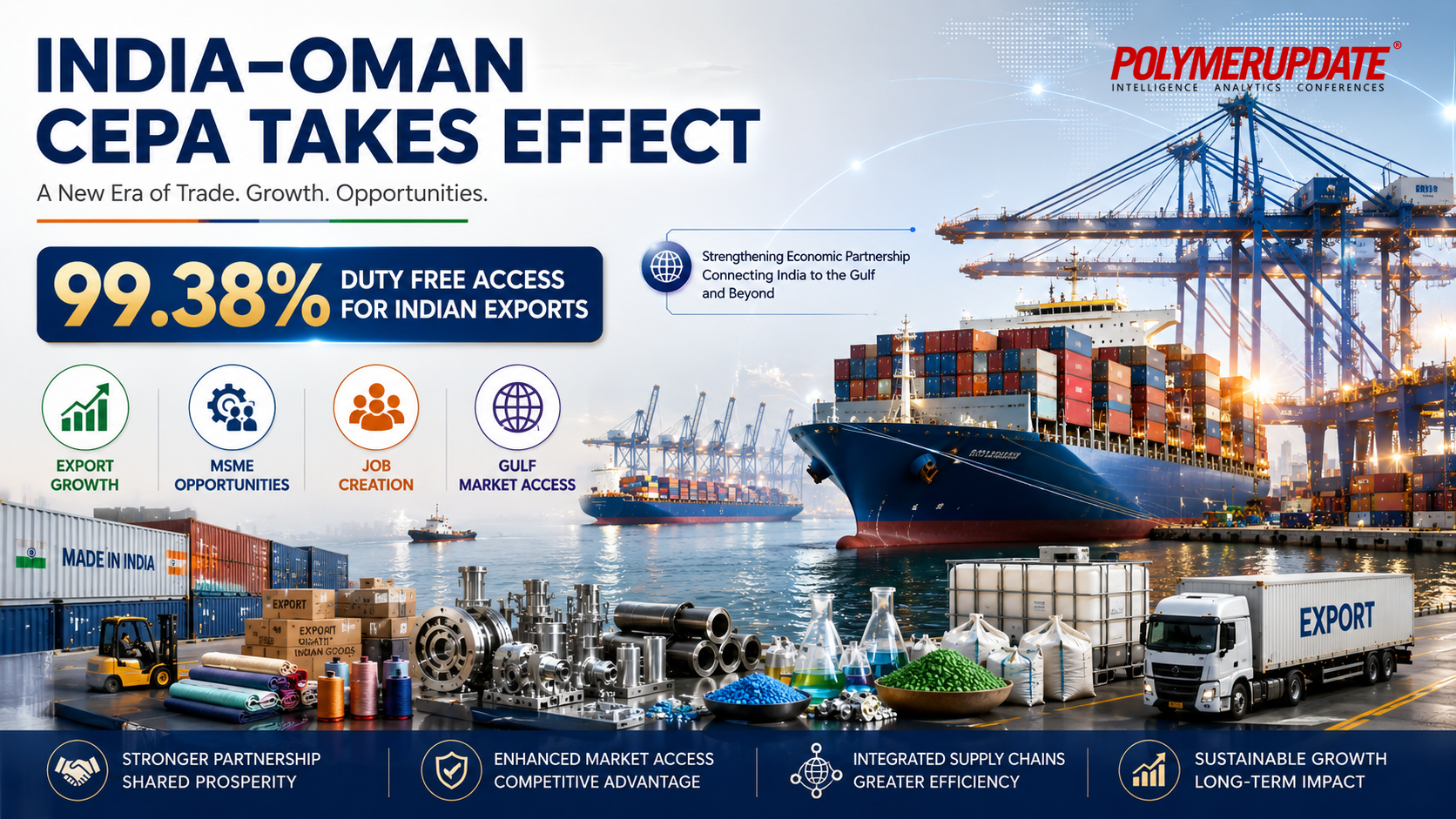
The landmark India-Oman Comprehensive Economic Partnership Agreement (CEPA), which came into force on June 1, offers duty-free access for 99.38 percent of Indian products to the Oman market, India’s Union Minister of Commerce and Industry, Piyush Goyal, said in a statement on Monday. The agreement is expected to serve as a transformational trade gateway for Indian products to the Gulf region via Muscat and has enabled India to become only the second country after the United States to secure a comprehensive bilateral trade pact with Oman.
Goyal added, “The India-Oman CEPA pact was signed on December 18, 2025, in Muscat in the presence of India’s Prime Minister Narendra Modi and His Majesty Sultan Haitham bin Tarik Al Said. After completion of internal processes by both sides, the agreement has entered into force today. The India–Oman Comprehensive Economic Partnership Agreement (CEPA) entering into force marks a defining milestone in bilateral economic relations and opens a transformative new chapter in strategic trade and investment cooperation between the two countries.”
On this occasion, the first consignments availing preferential tariff benefits under the agreement — including agriculture and gems and jewellery exports from Mumbai, Kolkata and Chennai — were flagged off to mark the pact’s entry into force. The India-Oman CEPA represents another major milestone in India’s deepening engagement with the Gulf region and reflects the country’s broader strategy of building resilient, trusted and diversified trade partnerships that support manufacturing competitiveness, employment generation, services exports and integration into global value chains.
 Bilateral trade
Oman is India’s second-largest trading partner in the Gulf region and serves as a strategic gateway to the wider Gulf Cooperation Council (GCC) market through its advanced port infrastructure. Bilateral trade between India and Oman reached US$11.18 billion in FY 2025-26, registering growth from US$10.61 billion in FY 2024-25. Successfully concluded through a structured negotiation process, the agreement reinforces India’s expanding economic and trade footprint and strategic presence across GCC economies. Covering goods, services, professional mobility, regulatory cooperation, safeguards against non-tariff barriers and cooperation chapters, the pact goes well beyond tariff reduction to establish a long-term economic architecture.
Oman also serves as a strategic gateway to the wider GCC and East African markets through its advanced logistics and port infrastructure. Bilateral trade between the two countries has continued to strengthen steadily, underlining the growing depth of economic engagement.
India’s Union Minister of Commerce and Industry, Piyush Goyal, said, “The India–Oman CEPA marks a defining milestone in India’s engagement with Oman and reflects Hon’ble Prime Minister Narendra Modi’s vision of forging trade partnerships that deliver gains for farmers, fishermen, youth, women, entrepreneurs and MSMEs. This agreement will act as a force multiplier in the Gulf region. With 99.38 percent of India’s exports receiving duty-free access, the agreement unlocks new opportunities for Indian exporters and professionals. Oman is our trusted partner, a bridge for our people and a gateway to the Gulf and East Africa.”
He further added, “Our opportunities will be significantly enhanced, and the CEPA will strengthen India’s integration into regional and global value chains. By delivering substantial benefits to labour-intensive sectors, it will support job creation, drive investment and enable Indian enterprises to compete on an equal footing with suppliers from countries already enjoying preferential market access.”
Speaking on the occasion, India’s Commerce Secretary, Rajesh Agrawal, said, “At a time when global trade patterns are being reconfigured by supply-chain diversification, shifting production networks and the emergence of new economic corridors, the CEPA positions India and Oman to leverage these structural changes. By fostering closer integration across trade, services, investment and logistics, the agreement creates a framework for more resilient value chains, greater economic competitiveness and a stronger strategic partnership with regional and global relevance.”
According to Agrawal, “The India-Oman CEPA brings new energy to our bilateral economic engagement, anchored in complementary strengths, deeper regulatory cooperation and a shared commitment to growth. The agreement is tariff liberalisation plus: it enhances market access, facilitates services trade and provides greater predictability for businesses operating across both markets.”
Gateway to GulfCEPA provides duty-free access for 99.38 percent of India’s exports to Oman by value, covering 98.08 percent of Oman’s tariff lines, making it one of the most comprehensive market access outcomes secured by India in the Gulf region. All zero-duty concessions come into effect immediately providing certainty and competitiveness to Indian exporters. Earlier, under the MFN regime, only 15.33 percent of India’s exports entered Oman duty-free. With CEPA, Indian exporters gain substantial price competitiveness in Oman’s nearly US$ 28 billion import market.
The Agreement is expected to significantly boost MSMEs, manufacturing and employment by enhancing competitiveness in labor-intensive sectors such as gems & jewellery, textiles, leather, footwear, marine products, engineering goods, processed foods and pharmaceuticals. Indian exporters now compete on equal or better terms than suppliers from countries without preferential trade arrangements with Oman. Oman’s strategic logistics hubs at Sohar, Duqm and Salalah provide Indian exporters’ enhanced access not only to Oman but also to wider GCC and East African markets.
Calibrated market access and protection of sensitive sectorsUnder the India-Oman Comprehensive Economic Partnership Agreement (CEPA), India has offered tariff liberalisation on 77.79 percent of tariff lines, covering 94.81 percent of imports from Oman by value, while retaining adequate safeguards for sensitive domestic sectors. Products placed under the exclusion list include dairy products, cereals, fruits, vegetables, edible oils, oilseeds, rubber, leather, spices and several other key agricultural commodities. The calibrated approach reflects India’s focus on protecting vulnerable sectors of the economy, ensuring stability for domestic producers and safeguarding the interests of farmers and rural communities.
The agreement also incorporates Tariff Rate Quotas (TRQs) and Minimum Import Price (MIP) mechanisms for selected sensitive industrial and agricultural products to shield domestic industry and preserve manufacturing competitiveness. The structured framework of tariff concessions has been designed to balance India’s export expansion objectives with broader national priorities, including food security, farmer welfare, employment generation and the protection of rural livelihoods. The agreement is expected to create new trade opportunities while maintaining policy flexibility to address domestic economic concerns.
DILIP KUMAR JHA
Editor
dilip.jha@polymerupdate.com



