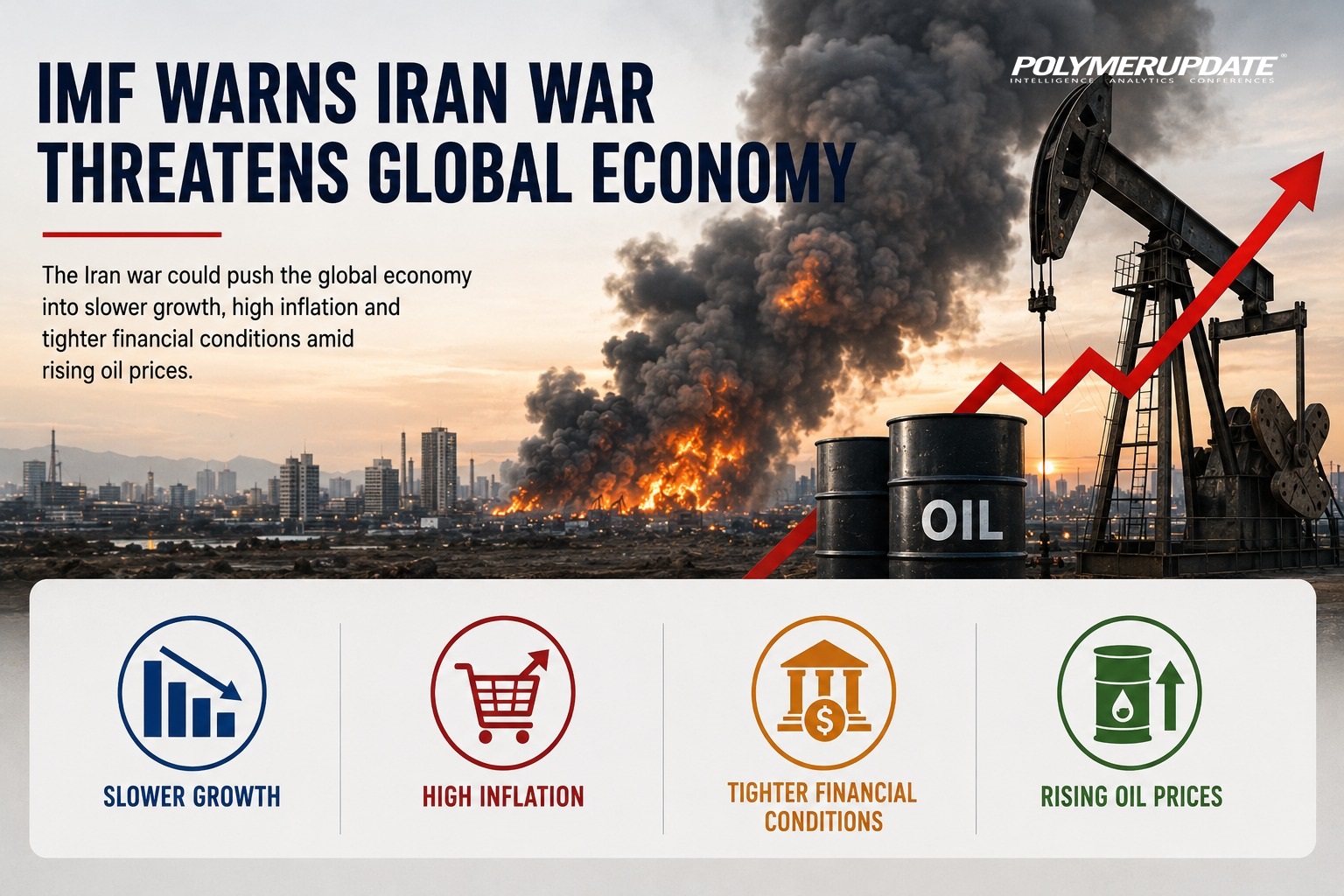
The ongoing conflict involving Israel, the United States and Iran, broadly referred to as the Iran war, has pushed the global economy closer to an “adverse” scenario marked by slower growth, elevated inflation and tighter financial conditions, the International Monetary Fund (IMF) said last week. The remarks were made by IMF Director of Communications Julie Kozack during a regular press briefing while responding to questions from journalists on the economic impact of the escalating tensions in the Middle East and their spillover effects on the global economy.
Addressing mediapersons, Kozack said short-term inflation expectations have risen in line with the recent increase in actual inflation levels. However, she noted that medium-term inflation expectations in major economies remain relatively well anchored despite the current volatility. “The financial conditions remain quite accommodative. Overall, we are moving into the adverse scenario, but inflation expectations are still reasonably well anchored, and financial conditions still remain accommodative,” Kozack said, indicating that policymakers continue to closely monitor inflationary and financial market risks arising from the conflict.
 The conflict
The ongoing military conflict involving the United States, Israel and Iran has intensified concerns over a prolonged disruption to global trade and energy supplies, particularly after the effective closure of the Strait of Hormuz — one of the world’s most critical oil transit routes. The narrow waterway handles nearly a quarter of global crude oil shipments and a significant portion of liquefied natural gas exports, making any disruption a major threat to the world economy. The conflict has already pushed crude oil prices above the US$ 100-a-barrel mark, sharply increasing transportation, manufacturing and energy costs across both developed and emerging economies.
IMF has warned that a prolonged closure of the Strait of Hormuz and sustained geopolitical tensions could drag the global economy into an “adverse” scenario marked by slower growth, persistently high inflation and tighter financial conditions. Energy-importing economies in Asia, Europe and Africa are expected to face the biggest pressure from rising import bills, weakening currencies and supply-chain disruptions. Financial markets have also turned increasingly volatile as investors fear deeper disruptions to oil flows, shipping routes and global trade networks. Economists caution that if the conflict widens further or oil prices remain elevated for a longer period, the world economy could face stagflation-like conditions with weaker growth and rising inflation simultaneously.
Economic growth forecastIn its latest edition of the World Economic Outlook (WEO) published in April, the IMF projected global economic growth to slow to 3.1 percent, down from its earlier forecast of 3.3 percent made in January. After withstanding higher trade barriers and elevated uncertainty last year, global economic activity now faces a major test from the outbreak of war in the Middle East.
Assuming that the conflict remains limited in duration and scope, global growth is projected to slow to 3.1 percent in 2026 and 3.2 percent in 2027. Global headline inflation is projected to rise modestly in 2026 before resuming its decline in 2027. The slowdown in growth and the increase in inflation are expected to be particularly pronounced in emerging market and developing economies.
A longer or broader conflict, worsening geopolitical fragmentation, a reassessment of expectations surrounding artificial intelligence-driven productivity, or renewed trade tensions could significantly weaken growth and destabilize financial markets. Elevated public debt and eroding institutional credibility further heighten vulnerabilities. At the same time, economic activity could receive support if productivity gains from AI materialize more rapidly or if trade tensions ease on a sustained basis.
Fostering adaptability, maintaining credible policy frameworks, and reinforcing international cooperation are essential to navigating the current shock while preparing for future disruptions in an increasingly uncertain global environment. Increased defense spending prompted by rising geopolitical tensions could boost economic activity in the short term, but it could also fuel inflationary pressures, weaken fiscal and external sustainability, and risk crowding out social spending, which in turn could trigger public discontent and social unrest.
Moving towards 2.5%The fund, however, did not rule out a further slowdown in global economic growth to 2.5 percent if the war continues for a prolonged period and crude oil prices remain elevated above the US$ 100-a-barrel mark. According to the fund, such a scenario could unfold if global financial conditions continue to tighten sharply and inflation remains persistently high across major economies. Rising energy costs, coupled with elevated borrowing costs and weaker consumer demand, could significantly weigh on economic activity and investment sentiment worldwide.
In a more severe downside scenario, the fund warned that global economic growth could slip further to 2 percent if average global inflation remains stuck around 6 percent for a longer-than-expected period. Sustained high inflation would likely force central banks to maintain aggressive monetary tightening, increasing the risk of recessionary conditions in several advanced and emerging economies. The prolonged combination of expensive energy, tighter liquidity and slowing trade flows could further intensify pressure on global growth prospects.
Fund demandThe International Monetary Fund (IMF) revealed that several countries have approached the institution seeking policy support on how to respond to the ongoing global economic shock, with the required measures expected to depend largely on the capacity and adaptability of individual economies. The IMF noted that governments are looking for guidance on managing rising inflation, tighter financial conditions and the impact of elevated energy prices, particularly as geopolitical tensions continue to disrupt global markets and trade flows.
According to the IMF, at least 12 countries are currently expected to require financing support ranging between US$ 20 billion and US$ 50 billion. IMF spokesperson Julie Kozack said discussions with individual countries remain ongoing as part of the fund’s broader engagement process. “We don't yet have any specifics or details to share with you on specific countries, but of course, as those discussions continue, we will be able to share that information with you. And that applies also to Iraq,” Kozack added, indicating that negotiations and policy consultations are still underway.
Separately, the IMF is seeking board approval for the disbursement of US$ 1 billion to Argentina after acknowledging a sharp improvement in the country’s economic policy framework. For Ukraine, the IMF approved a new four-year programme worth US$ 8.1 billion in February to support economic stability and reconstruction efforts amid the ongoing conflict. The fund said the Ukrainian authorities have agreed to pursue a comprehensive reform agenda, including measures related to taxation and broader structural reforms aimed at strengthening the country’s long-term economic resilience.
DILIP KUMAR JHA
Editor
dilip.jha@polymerupdate.com



