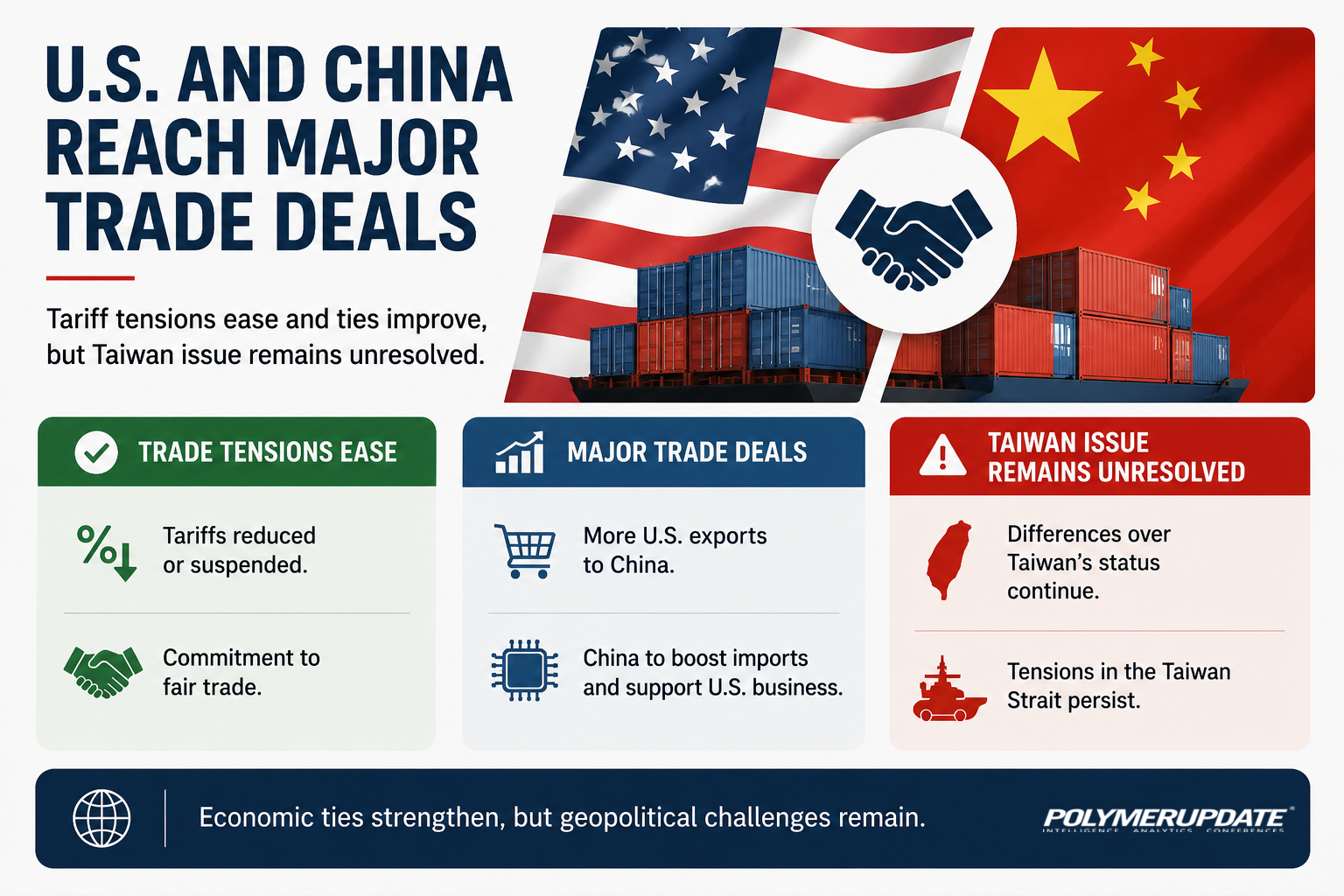
U.S. President Donald Trump's "landmark" meeting with his Chinese counterpart Xi Jinping concluded with multi-billion-dollar deals, with both sides agreeing to smoothen bilateral trade ties and support economic growth. The agreements signed between the world's largest economy, the United States, and the second-largest economy, China, pave the way for a new phase in bilateral relations, although tensions over Taiwan remain unresolved.
While hosting Trump at Zhongnanhai, the secretive headquarters of the ruling Communist Party and residence of China's top leadership, Xi said, "This is a historic and landmark visit by U.S. President Donald Trump. Thus far, we have established a new bilateral relationship — a constructive, strategic, and stable relationship — which constitutes a milestone event. We have achieved many cooperative outcomes."
 Important consensus
The United States and China reportedly reached an "important consensus" on maintaining stable economic and trade relations while expanding bilateral cooperation across multiple sectors, according to a statement released on Friday by China's official Xinhua News Agency shortly before U.S. President Donald Trump departed Beijing aboard Air Force One. While both sides acknowledged progress in discussions, neither Washington nor Beijing disclosed specific details regarding potential commercial agreements, raising expectations that announcements on trade or investment deals could emerge in the coming days.
The high-level meeting followed a day marked by elaborate state ceremonies and carefully choreographed diplomatic engagements in the Chinese capital. During nearly two-and-a-half hours of talks on Thursday, President Trump and Chinese President Xi Jinping adopted a notably positive tone on the future of U.S.-China relations, even as they addressed several contentious geopolitical and economic issues. Discussions reportedly covered trade disputes, tensions surrounding Taiwan, and the ongoing conflict involving Iran, underscoring the broad and sensitive agenda confronting both nations.
The leaders met at Zhongnanhai, the heavily guarded leadership compound located adjacent to Beijing's Forbidden City, a venue widely regarded as one of China's most prestigious political settings and a symbol of exceptional diplomatic hospitality. Historically, only a limited number of U.S. presidents have been granted access to the compound. Former President Richard Nixon met Chairman Mao Zedong there during his landmark 1972 visit that reshaped U.S.-China relations, while George W. Bush visited Zhongnanhai in both 2002 and 2008. Former President Barack Obama was also received at the compound during his 2014 trip to China, placing Trump among a select group of American leaders accorded the symbolic honour.
Symbolic admirationChinese President Xi Jinping and U.S. President Donald Trump were seen walking together through the landscaped grounds of Zhongnanhai, pausing occasionally to admire the compound's greenery and manicured gardens during their diplomatic engagement in Beijing. Xi, speaking through a translator, shared details about the history and symbolism of the leadership compound and reportedly offered to send rose seeds to the United States after Trump expressed admiration for the flowers on display. "These are the most beautiful roses anyone has ever seen," Trump remarked during the stroll, reflecting the cordial atmosphere surrounding the visit.
Despite the warmth and symbolism projected during the meeting, underlying tensions between the world's two largest economies remain significant. The United States and China continue to face deep divisions across a range of sensitive geopolitical and economic issues, including trade disputes, technology restrictions, military competition in the Indo-Pacific, and broader strategic rivalry. While both leaders publicly emphasized cooperation and stability, analysts noted that the carefully choreographed diplomacy masked persistent disagreements that continue to shape the bilateral relationship.
During their initial meeting a day earlier, Xi reportedly delivered one of his strongest warnings yet to an American president on the issue of Taiwan. According to officials familiar with the discussions, the Chinese leader cautioned that any mishandling of the Taiwan issue could potentially lead to "clashes" between the two superpowers. The remarks underscored Beijing's increasingly firm stance on Taiwan, which China considers a core national interest, and highlighted the issue's central role in shaping future U.S.-China relations.
Bilateral dealsU.S. President Donald Trump said in a recent interview that Chinese President Xi Jinping had offered assistance on the Iran issue during their discussions in Beijing, although Chinese authorities have not publicly confirmed the claim. According to a White House readout of the meeting, both leaders agreed on the importance of keeping the Strait of Hormuz open to ensure the uninterrupted flow of global energy supplies, underscoring growing international concerns over maritime security and stability in the Gulf region.
Trump also stated that China had agreed to purchase 200 aircraft from Boeing as part of broader commercial discussions between the two nations. While significant, the figure fell short of earlier market expectations that Chinese airlines could commit to acquiring as many as 500 Boeing 737 Max aircraft along with additional wide-body jets under a potentially landmark aviation agreement. Nevertheless, the announcement was viewed as a positive signal for Boeing and a potential step toward easing trade tensions between Washington and Beijing.
Meanwhile, the United States and China are also exploring mechanisms to accelerate approvals for certain Chinese investment deals in the U.S., according to Scott Bessent, the US Treasury Secretary. Bessent indicated that both sides were additionally discussing tariff reductions on a range of non-critical goods as part of ongoing economic negotiations. The talks suggest a broader effort by both governments to stabilise bilateral trade relations and rebuild economic cooperation amid years of tariff disputes and strategic rivalry.
Trade tensionsTrade tensions between the United States and China escalated sharply in April 2025 after Washington imposed 20 percent which was later raised gradually to 145 percent on a broad range of Chinese goods, citing concerns over trade imbalances, supply chain security, and unfair industrial practices, and China retaliated with a similar tariff on the American goods. The tariff hikes affected billions of dollars worth of products, including electronics, machinery, electric vehicles, batteries, and critical technology components.
In response, China announced retaliatory duties on several American exports, targeting sectors such as agriculture, energy, automobiles, and industrial goods. The tit-for-tat measures intensified concerns over a prolonged trade war between the world's two largest economies and weighed heavily on global trade sentiment and manufacturing activity.
However, after months of negotiations and growing pressure from businesses and global markets, both countries gradually moved toward easing trade restrictions and restoring economic stability. Washington and Beijing later agreed to reduce tariffs on selected categories of goods while reopening channels for broader commercial and investment cooperation. The rollback of some duties was viewed as an important confidence-building measure aimed at stabilising supply chains, lowering costs for manufacturers and consumers, and improving bilateral relations. Although several strategic and technology-related restrictions remained in place, the tariff reductions signalled a willingness on both sides to prevent further deterioration in economic ties and revive trade momentum.
DILIP KUMAR JHA
Editor
dilip.jha@polymerupdate.com



