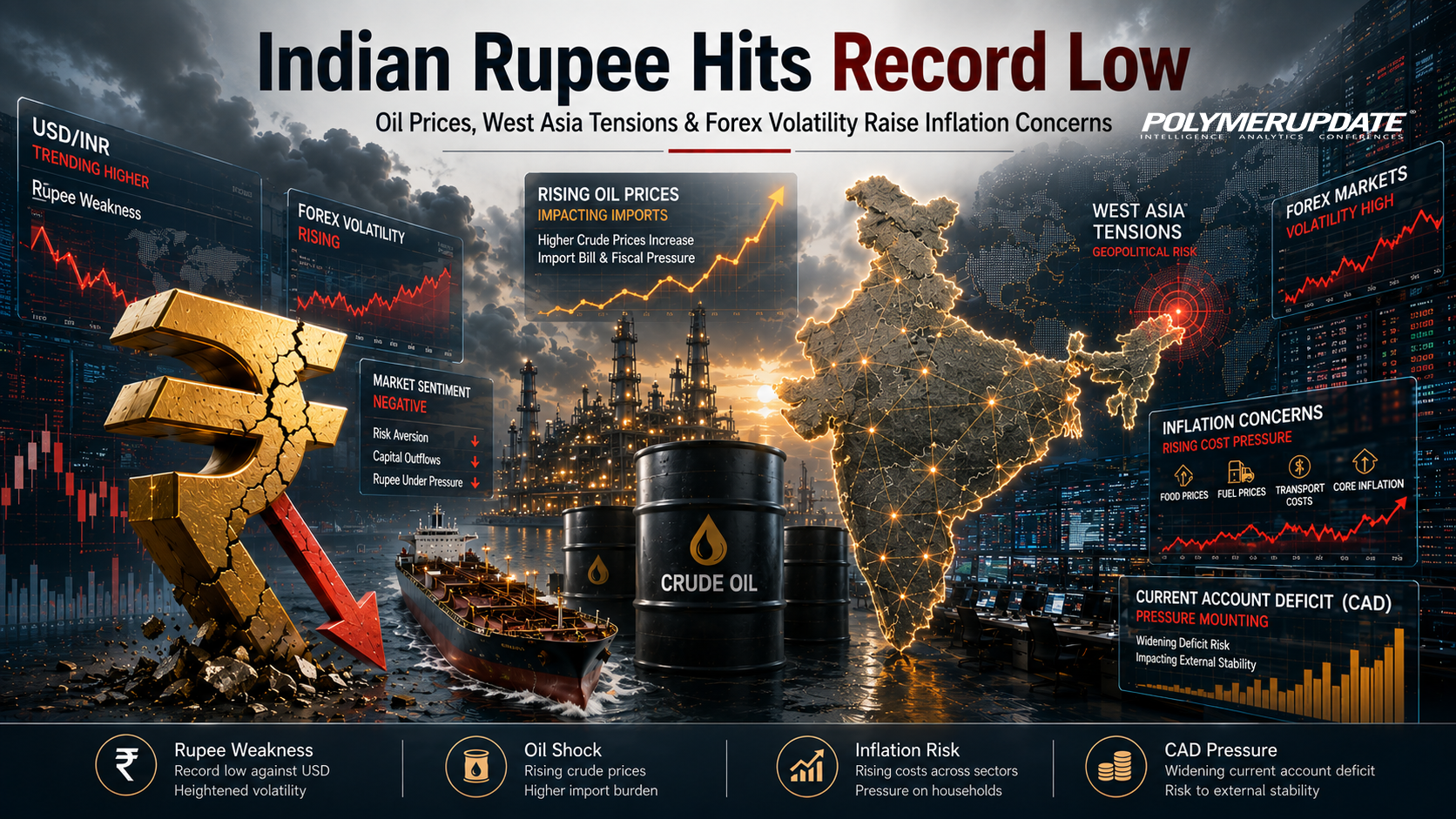
The Indian rupee opened steady on Wednesday after depreciating to touch an all-time low of 95.62 against the United States dollar on Tuesday, breaching its previous record low of 95.43 against the greenback touched last week. The depreciation marked the Indian rupee’s over 5 percent correction since the ongoing geopolitical conflict began following the joint strikes by the United States and Israel on Iran on February 28, which led to the killing of the then Iranian Supreme Leader Ayatollah Ali Khamenei.
In the beginning, US President Donald Trump claimed that Iranian defences would not sustain for even a few days against the US and Israeli militaries, and therefore the war with Tehran would end quickly. However, the Iranian military not only withstood strikes from the world’s most powerful military forces equipped with advanced weaponry and warfare techniques, but also retaliated strategically, creating hardships for US defence personnel by targeting military installations and energy infrastructure in Gulf countries.
Consequently, the rupee has emerged as one of the fastest depreciating currencies in the world since the US-Iran deadlock began, largely due to India’s increasing dependence on imports of crude oil, gold, and other strategically important commodities, whose prices have appreciated significantly during the past 10 weeks of conflict. The key challenge before the Indian government now is to keep the Current Account Deficit (CAD) under control without creating inflationary pressure on citizens. Maintaining a strong foreign exchange (forex) reserve also remains a major priority for the government. Prime Minister Narendra Modi’s scheduled visit to the Arab world, followed by Europe later this week, is being seen as a step in that direction.
S C Ralhan, President of the Federation of Indian Export Organisations (FIEO), said, “Prime Minister Narendra Modi’s upcoming official visit to the United Arab Emirates (UAE), the Netherlands, Sweden, Norway, and Italy from May 15–20, 2026, will significantly strengthen India’s strategic economic engagement with key global partners and provide fresh momentum to trade, investment, and technology collaborations during such challenging times. The visit comes at a crucial juncture when India is deepening its economic integration with Europe and the Gulf region through enhanced trade partnerships, resilient supply chains, and investment-led growth.”
 India’s forex volatility
Amid the ongoing West Asia crisis, India’s foreign exchange markets have experienced heightened volatility, driven largely by rising energy prices and moderating capital flows. The RBI has responded proactively by taking measures to curb speculative activity and ensure orderly movements in the exchange rate. This report takes a deeper look at the current episode of volatility and the key reasons behind the rupee’s weakness. It further examines past episodes of sharp rupee depreciation and the policy measures adopted to contain the currency’s decline. The report also analyses the relatively stronger macroeconomic preparedness of the Indian economy to manage the current episode of foreign exchange volatility compared to previous instances.
Since the onset of the West Asia conflict, most currencies have depreciated against the US dollar, with a few exceptions such as the Brazilian Real (BRL), Chinese Yuan (CNY), and British Pound Sterling (GBP). Depreciation has been particularly severe for currencies such as the Philippine Peso, Indian Rupee, South African Rand, Thai Baht, Korean Won, and Indonesian Rupiah, as these economies are highly dependent on West Asia for energy imports. Given their exposure to the West Asia crisis, Asian currencies have taken a bigger hit compared to their global peers.
While such depreciation is largely expected amid rising energy prices and capital flows shifting toward safe-haven assets such as the US dollar, the weakness in the Indian rupee has remained a more persistent concern over the past year, even before the conflict. Weak capital flows during the past year have been a major factor behind the downward pressure on the rupee. The recent escalation in tensions in West Asia has only intensified these pressures. The persistent weakness in the rupee is evident from its nearly 11 percent depreciation over the past year, of which 4.7 percent has occurred since the war began.
Major headwindsIndia’s Chief Economic Advisor V. Anantha Nageswaran said on Tuesday that the top priority for Indian policymakers would be managing the current account deficit and preventing further rupee depreciation this fiscal year amid escalating disruptions arising from the West Asia crisis. Nageswaran was speaking at a session titled ‘Fractured Global Economy, Shifting Faultlines: Geopolitics, Geoeconomics and Emerging Economy Imperative’ at the Confederation of Indian Industry (CII) Annual Business Summit 2026.
He said the West Asia crisis was no longer merely a geopolitical issue affecting economic planning at the margins, but a direct macroeconomic stress test for India, with implications for inflation, exchange rates, and the external sector. He further added, “The West Asia crisis is not a foreign policy concern that occasionally bleeds into economic planning, but a live balance-of-payments stress test with direct consequences for inflation, CAD, and the exchange rate.”
Prime Minister’s appealNarendra Modi on Monday appealed to Indian citizens to avoid purchasing gold for one year, use public transport, reduce the use of cooking oil, and return to organic farming, which could eventually reduce the use of chemical fertilizers, among other key behavioural changes aimed at conserving foreign exchange reserves and maintaining the Current Account Deficit (CAD) under control. India’s Prime Minister also encouraged work from home (WFH), a concept that could reduce fuel consumption in transportation, as India depends on imports for nearly 85 percent of its crude oil requirements.
The Prime Minister also urged citizens to avoid unnecessary international travel, which contributes significantly to foreign exchange outflows through spending on aviation fuel, hotels, tourism, and overseas consumption. During periods of external economic stress, reducing non-essential foreign travel can help conserve valuable foreign currency reserves. A temporary appeal encouraging citizens and corporates to postpone discretionary overseas trips for one year could support India’s external balance while simultaneously boosting domestic tourism, hospitality, and regional economies. Increased domestic travel spending would help circulate capital within the country rather than allowing consumption expenditure to flow overseas.
Bullion import duty hikeTo curb forex outflow, India on Wednesday increased import duties sharply on gold and silver to 15 percent from the earlier 6 percent. The revised structure includes a 10 percent basic customs duty along with a 5 percent Agriculture Infrastructure and Development Cess (AIDC), marking a return to aggressive tariff-led demand management as policymakers confront a widening trade deficit and growing global economic uncertainty. For India, the world’s second-largest gold consumer, the move effectively ends the short-lived phase of lower import duties introduced in mid-2024.
The timing of the duty hike reflects mounting concerns over the pressure of bullion imports on India’s foreign exchange reserves and current account deficit (CAD). With volatile energy prices and slowing export demand from Western markets weighing on the external sector, policymakers appear keen to curb excessive gold imports, historically one of India’s largest import components after crude oil. By raising the landed cost of bullion, the government hopes to moderate physical demand and encourage investors to shift toward financial alternatives such as paper gold and other market-linked assets.
OutlookThe depreciation of the Indian rupee is expected to have significant macroeconomic implications, particularly on the current account deficit (CAD) and inflation trajectory. A weaker rupee raises the cost of imports, especially crude oil, fertilizers, edible oils, and other essential commodities, thereby widening India’s import bill and exerting pressure on the CAD. At the same time, imported inflation is likely to intensify as higher landed costs of fuel and raw materials gradually transmit into transportation, manufacturing, and consumer prices.
While a weaker currency may offer some support to exports by improving price competitiveness, the benefits could be partially offset by elevated global uncertainty and softer external demand. Going forward, the Reserve Bank of India and policymakers are likely to remain vigilant in balancing currency stability, inflation management, and external sector risks amid heightened global volatility.
DILIP KUMAR JHA
Editor
dilip.jha@polymerupdate.com



