India’s manufacturing Purchasing Managers’ Index (PMI) has come under severe pressure since the war in the Middle East began seven weeks ago, when Israel launched strikes on Iran on February 28, 2026, killing then Iranian Supreme Leader Ayatollah Ali Khamenei along with key advisors at his residence. The United States also joined the strikes on Iran, further intensifying the conflict, with Tehran retaliating against over a dozen countries in the region by targeting critical infrastructure, energy installations, and US defence bases, among others.
However, India’s manufacturing sector reported a mild recovery in April after hitting a five-month low in March, supported by sustained government efforts to minimise the impact of the ongoing geopolitical conflict in the Middle East, which has involved much of the region and reverberated globally. Iran responded with further retaliatory actions, including drone and missile strikes on Gulf countries, disrupting regional economic activity and severely impacting oilfields, tankers, and other energy transport systems. The Iran war caused severe disruptions to crude oil supplies from the Middle East due to damage to production facilities from Iranian drone and missile strikes, as well as the closure of the Strait of Hormuz.
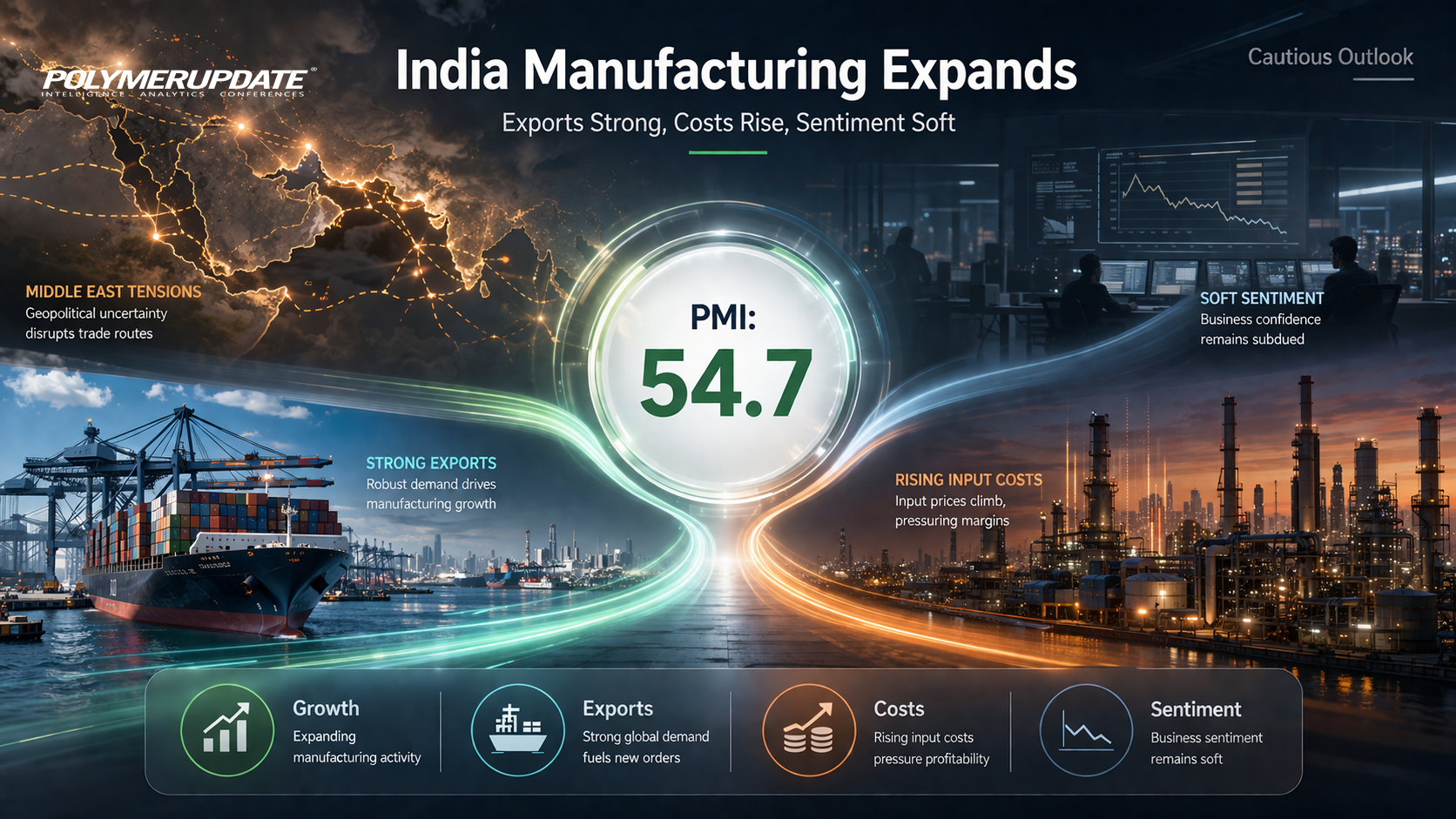 HSBC manufacturing PMI
A recently released HSBC India Manufacturing Purchasing Managers’ Index (PMI) survey showed an increase from 53.9 in March to 54.7 in April, signalling the second-slowest improvement in overall operating conditions in approximately four years. Notably, the HSBC India PMI is a gauge of overall business conditions derived from measures of new orders, output, employment, supplier delivery times, and stocks of purchases. A reading above 50 indicates expansion, while a score below this threshold denotes contraction.
Reports indicated that the two largest sub-components of the PMI—new orders and output—advanced from March levels but remained below readings seen over at least the past three-and-a-half years. Speaking on the release of the April report, Pranjul Bhandari, Chief India Economist at HSBC, said, “India’s manufacturing PMI rose to 54.7 in April, up from 53.9 in March, but still marked the second-slowest improvement in operating conditions in nearly four years.”
Survey participants indicated that advertising efforts and resilient demand supported sales and production; however, growth was constrained by competitive pressures, the war in the Middle East, and client reluctance to approve pending quotes. Bhandari added, “Spillovers from the Middle East conflict are becoming more evident, particularly through inflation, with input costs increasing at the fastest pace since August 2022 and output prices rising at the quickest rate in six months. Meanwhile, output, new orders (including exports), and employment all grew moderately, pointing to continued resilience in India’s manufacturing sector.”
New orders riseNew export orders gathered strong momentum at the start of the fiscal year’s first quarter, with growth accelerating to a seven-month high. Firms reported improved demand conditions across a broad set of markets, including Australia, France, Japan, Kenya, China, Saudi Arabia, the United Arab Emirates, and the United Kingdom. The breadth of this expansion suggests that external demand remains a key pillar supporting India’s manufacturing activity, even as global uncertainties persist.
However, the price environment turned increasingly challenging, with companies widely reporting that the Middle East conflict continued to exert upward pressure on inflation. Input costs rose at the fastest pace in 44 months, while output prices increased at a six-month high, indicating a clear pass-through of cost pressures to end consumers. This reflects tightening supply conditions and elevated risk premiums across global commodity markets.
A range of inputs—including aluminium, chemicals, electrical components, fuel, leather, petroleum products, and rubber—witnessed notable price increases during the month. Survey participants frequently linked these cost escalations to disruptions stemming from the Middle East conflict, which has affected supply chains, energy flows, and transportation routes. As a result, average cost burdens rose further in April, pushing overall inflation to its highest level since August 2022.
In response, manufacturers raised selling prices at the steepest rate in six months, signalling an attempt to protect margins amid rising input costs. While the ability to pass on higher costs indicates relatively resilient demand conditions, sustained inflationary pressures could eventually weigh on competitiveness and consumption. The interplay between strong export demand and rising cost pressures will therefore be critical in shaping the near-term outlook for India’s manufacturing sector.
Employment upIndia’s manufacturing sector recorded a notable uptick in hiring at the start of the first fiscal quarter, even as the increase in outstanding business volumes remained only marginal. Firms continued to add to their workforce, with the pace of job creation emerging as the strongest in ten months. This suggests that manufacturers are positioning themselves for anticipated demand, rather than reacting solely to current order backlogs.
The hiring momentum points to underlying confidence in the sector’s near-term trajectory, supported by steady domestic demand and improving export prospects. Companies appear willing to absorb higher labour costs in the expectation that production requirements will firm up in the coming months. This forward-looking approach to employment also reflects efforts to enhance capacity readiness and avoid potential bottlenecks as activity strengthens.
That said, overall business sentiment moderated compared to March, indicating a degree of caution amid persistent global uncertainties. While manufacturers remain broadly optimistic about growth prospects, confidence is increasingly tied to the success of marketing initiatives and the conversion of pending projects into firm orders. The slight softening in sentiment underscores the delicate balance between resilience in demand and risks stemming from geopolitical tensions and cost pressures.
DILIP KUMAR JHA
Editor
dilip.jha@polymerupdate.com



