
Click the icon to add a specified price to your Dashboard list. This makes it easy to keep track on the prices that matter most to you.

By Professor Dr Sajjid Mitha
CEO & Founder, Polymerupdate · Polymerupdate Academy · RACE Expos and Conferences
In three decades of tracking energy markets — through the Gulf War’s price shocks, the shale revolution, the COVID collapse, and the extraordinary turbulence of the Iran war — I have learned to distinguish signal from noise. The United Arab Emirates’ formal withdrawal from OPEC and the OPEC+ alliance, effective today, May 1, 2026, is not noise. It is, without exaggeration, the single most consequential structural shift in producer-side energy diplomacy since the formation of OPEC+ in 2016. And for India — the world’s second-largest crude oil importer, consuming roughly 4.8 to 5 million barrels per day with over 85 percent of its crude sourced from abroad — it is a development whose medium- and long-term dividends may prove transformational.
Let me be precise about what has happened and why it matters.
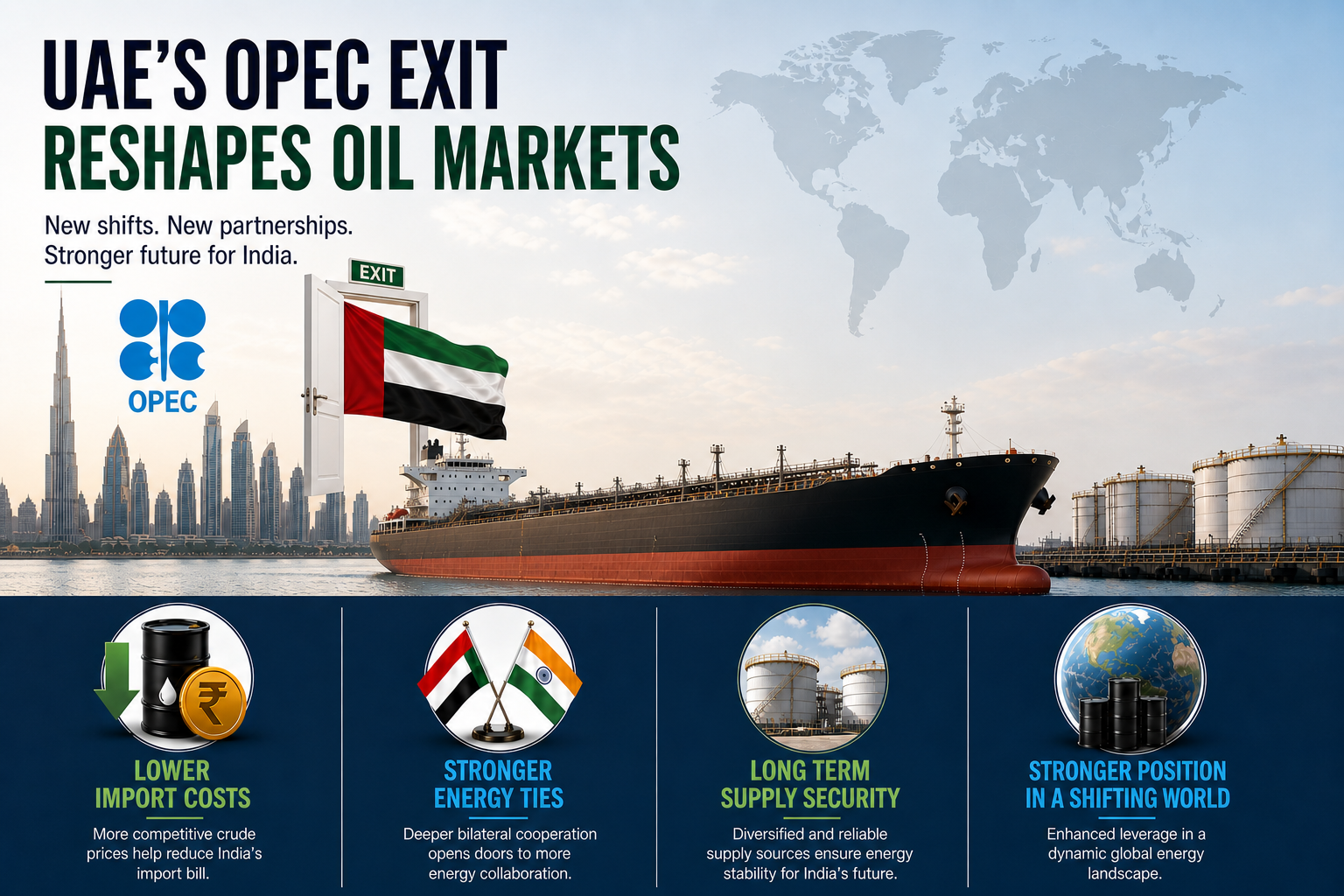
The Weight of What Just Occurred
The UAE is not Qatar. It is not Angola. When Qatar walked out in January 2019 after nearly six decades of membership, it was a country whose oil output barely exceeded 600,000 barrels per day — a rounding error in global supply terms. When Angola departed in January 2024, the markets registered a faint tremor. The UAE is a categorically different proposition. With a current production capacity estimated at approximately 4.85 million barrels per day — already constrained to around 3.2 to 3.3 million barrels per day under its OPEC quota — the UAE’s exit represents the largest single defection in OPEC’s sixty-five-year history by orders of magnitude.
Abu Dhabi joined the organisation in 1967, four years before the UAE federation was even formed. Over more than half a century, it has been not merely a member but one of OPEC’s foundational pillars. The decision, announced Tuesday by UAE Energy Minister Suhail Mohamed Al-Mazrouei, was characterised as a “policy-driven evolution” in Abu Dhabi’s approach — deliberately measured language that nonetheless cannot obscure the seismic shift it represents.
The catalyst, as anyone with knowledge of intra-OPEC dynamics will recognise, is an accumulation of years of frustration. ADNOC, the Abu Dhabi National Oil Company, has committed $150 billion in capital expenditure from 2023 to 2027 with an explicit target of reaching 5 million barrels per day of production capacity by 2027 — a target already advanced from the original 2030 timeline. At the same time, OPEC quotas have kept Abu Dhabi producing at roughly 3.2 million barrels per day. Baker Institute researchers estimated in 2023 that unconstrained production could generate the UAE upward of $50 billion in additional annual revenues. That is not a rounding error. That is the strategic rationale for departure, stated in the plainest financial terms.
“The frustration has been visible for years to anyone paying attention. The UAE has been running a world-class capital programme and then watching quota discipline erode its returns. When a major producer has invested at the scale ADNOC has and is producing at sixty percent of capacity, membership becomes an exercise in subsidising your competitors. That is not sustainable, and it never was.”
— A former senior adviser to a Gulf national oil company
A Fragmented Cartel: The Architecture of Opportunity
To understand what the UAE’s exit means for India, one must first understand what OPEC itself has become. In its 1970s heyday, the organisation commanded more than half of global crude production and wielded price-setting power that bent the trajectory of entire national economies. Today, even before this week’s events, OPEC’s share of global crude supply had fallen to approximately 33 percent, recovering somewhat through the OPEC+ framework — which incorporated Russia and eleven other non-member producers in 2016 — to nearly 44 to 50 percent of global supply by the market’s estimation. That number is now substantially diminished.
The loss of the UAE — the third-largest producer within OPEC and one of the few members with meaningful spare capacity — does not kill OPEC. But it accelerates the transition from a disciplined cartel into something closer to a Saudi-centric club with increasingly nominal influence over global price formation. Saudi Arabia’s power to set the oil market’s floor price depends on its ability to credibly threaten both production cuts and production surges. That credibility requires coalition discipline. Each departure erodes it.
“OPEC without the UAE is a structurally diminished instrument. Saudi Arabia retains formidable individual leverage as the world’s largest exporter, but the collective bargaining power of the cartel — what economists call the effective ‘OPEC tax’ baked into managed markets — has just been significantly discounted. For price-sensitive importers like India, that discount is real money.”
— A retired commodity strategy director at a European investment bank
For India, this matters at the most basic macroeconomic level. Crude oil imports remain among the country’s largest external liabilities, directly influencing the current account deficit, the rupee’s exchange rate stability, and the domestic inflation trajectory. A structural softening of prices — even a sustained $5 to $7 per barrel reduction in the effective cost of procurement — generates compounding fiscal dividends: lower transport costs feeding through to retail inflation; reduced petroleum import bills freeing current account headroom; and budgetary space that can be redirected toward infrastructure and the energy transition. These are not marginal effects. At India’s import volumes, each dollar per barrel of sustained price reduction represents approximately $1.7 billion in annualised savings.
The Abu Dhabi–Delhi Corridor: From Transactional to Structural
India currently sources approximately 8 to 10 percent of its crude oil from the UAE — the fifth-largest supplier by volume behind Russia, Iraq, Saudi Arabia, and periodically the United States. In absolute dollar terms, India imported $13.45 billion worth of UAE crude in 2024 alone. The UAE’s geographic proximity to India’s western refining heartland — the coastal refineries of Gujarat and Maharashtra — means its crude arrives with lower freight costs and shorter transit times than barrels sourced from West Africa or the Americas. Those logistical advantages have always existed. What changes today is the strategic architecture of the relationship.
Freed from OPEC’s Vienna agreement constraints, the UAE transitions from being one node in a multilateral production pact into a sovereign bilateral energy partner with complete discretion over its output and pricing. This opens several channels that were structurally closed when Abu Dhabi was bound by cartel discipline.
The first is customised pricing and long-term contractual frameworks. Standard Official Selling Prices within the OPEC architecture are set against benchmark differentials — Murban crude, the UAE’s flagship grade, against its own exchange-traded benchmark — and tend to reflect cartel-wide pricing signals. A UAE operating entirely on bilateral commercial logic has both the incentive and the flexibility to negotiate bespoke, volume-based pricing arrangements with major customers. India, as one of the world’s largest and most creditworthy import markets, is precisely the counterparty Abu Dhabi will seek to anchor.
The second channel is infrastructure integration. ADNOC has already leased commercial storage capacity at India’s Mangalore Strategic Petroleum Reserve facility — holding approximately 3 million barrels of crude there under an agreement that simultaneously supports India’s strategic buffer while providing ADNOC with a pre-positioned inventory foothold in a critical demand market. This model — a foreign national oil company co-investing in Indian downstream infrastructure — is the template for a deeper partnership that could extend to refinery co-ownership, pipeline access, and integrated supply chain agreements.
“What we are watching in real time is the conversion of a buyer-seller relationship into a strategic partnership. The UAE needs a reliable, large-volume, creditworthy customer for the additional barrels it will bring to market post-quota. India needs a stable, geographically proximate, non-sanctioned supply anchor at a time when its Russian barrel dependency has attracted serious geopolitical pressure. This is a case where both parties have urgent, complementary needs. Those relationships tend to deepen very quickly.”
— A former senior official in India’s Ministry of Petroleum and Natural Gas
The Supply Arithmetic: What an Extra 1.6 Million Barrels Per Day Means
The production numbers are worth dwelling on carefully, because the figures cited in some early commentary have understated the scale of UAE supply optionality.
Before the Iran war disrupted Strait of Hormuz transit, the UAE had a stated production capacity of approximately 4.8 to 4.85 million barrels per day, and was producing approximately 3.2 to 3.3 million barrels per day under its OPEC quota. The gap — some 1.5 to 1.6 million barrels per day of unconstrained incremental supply — represents roughly 1.5 percent of total global oil supply. In practical terms, as analysts at Al Jazeera have noted, that is “enough to give [the UAE] a serious edge in the global energy market.”
The near-term realisation of this supply is, of course, conditional on the resolution of the Strait of Hormuz blockade — the defining constraint on Gulf energy exports since the onset of the US-Iran conflict. Iran’s interdiction of Hormuz transit has sharply curtailed UAE export routes, though Abu Dhabi has been partially circumventing this via the Habshan-Fujairah pipeline, which carries approximately 1.7 million barrels per day directly to the Gulf of Oman and bypasses the strait entirely. Should Hormuz reopen under any negotiated settlement, the UAE’s capacity to flood export markets with incremental barrels becomes immediate and substantial.
For India, this creates what I would characterise as a “strategic relief valve” of historic proportions. In an environment where Washington has applied sustained secondary tariff pressure on Indian imports of Russian crude — including a 50 percent tariff regime announced in August 2025 — India faces a pressing structural need to diversify its supply base. A UAE producing at full capacity and actively seeking to anchor long-term volume commitments with Asian demand centres provides precisely the non-Russian, non-sanctioned, proximate supply alternative that India’s energy security calculus urgently requires.
The Saudi-UAE Rivalry: India as the Prize
Perhaps the most underappreciated medium-term consequence of the UAE’s departure for India is what it does to competitive dynamics between Abu Dhabi and Riyadh. Within OPEC, Saudi Arabia and the UAE were nominally aligned partners, bound by a shared interest in cartel discipline even as their bilateral relationship grew increasingly complicated by regional geopolitics, the Yemen conflict, and divergent strategic visions for Gulf leadership. Outside OPEC, they are commercial competitors — and the Asian demand centre, where India represents the single most dynamic growth market for crude over the next two decades, becomes the primary theatre of competition.
The arithmetic is instructive. OPEC’s own World Oil Outlook anticipates that combined demand growth from India, other Asian economies, the Middle East, and Africa will add approximately 22.4 million barrels per day of consumption between 2024 and 2050. India alone is projected to account for 8.2 million of those additional barrels per day — the single largest national increment in global demand growth over that period. Any exporter seeking sustained market relevance in a world of gradually declining OECD demand must secure volume in India. Both Saudi Arabia and the UAE understand this perfectly.
When two major producers with spare capacity and a shared strategic imperative to capture Indian market share are no longer bound by quota coordination, the most probable outcome is price competition in the form of deepened Official Selling Price discounts, more flexible destination clauses, and enhanced terms on downstream investment. India, historically a “price taker” in closed-door OPEC-managed markets, gains genuine negotiating leverage for the first time in the modern era.
“I have been covering oil pricing negotiations between Gulf producers and Asian refiners for over two decades. The phrase I keep returning to is ‘structural leverage shift.’ India’s refiners have always known they were important customers, but within the OPEC framework, the pricing architecture was set upstream by producers acting in concert. That changes fundamentally when the cartel fragments. A buyer with India’s scale, dealing with competing producers who are no longer coordinating, negotiates from a position of genuine market power. We have not seen that combination before.”
— A veteran commodities analyst, currently advising sovereign energy funds
Caveats and Complexities: What Could Go Wrong
A practitioner’s instinct is to resist triumphalism, and several complicating factors deserve honest acknowledgment.
First, the near-term outlook is materially complicated by Hormuz. The UAE’s additional production capacity cannot reach global markets at scale until the strait reopens — a development that remains contingent on US-Iran diplomatic progress that is, at this writing, far from certain. The Fujairah bypass route provides a partial solution but cannot substitute for full strait access.
Second, the Indian government’s deepening entanglement with discounted Russian crude — a trade relationship that expanded from under 2 percent of import volumes in 2021 to approximately 36 percent of share by 2024 — creates its own path dependencies. Refinery configurations optimised for Urals-grade heavy sour crude do not seamlessly pivot to UAE’s Murban, a lighter, sweeter grade. Capital investment in refinery flexibility takes time and planning cycles measured in years.
Third, a fragmented OPEC does not guarantee lower prices in isolation. Supply discipline from remaining members, particularly Saudi Arabia, could partially offset the incremental UAE volumes. And any escalation in Hormuz tensions introduces upward price volatility that could swamp the structural pricing benefits of cartel fragmentation.
The Strategic Dividend: India’s Generational Opportunity
With those caveats entered and registered, the trajectory is clear. The UAE’s exit from OPEC is not a transitional market event to be traded on six-month futures contracts. It is a structural reordering of the energy architecture that India faces as a chronic, large-scale importer in a world of increasingly competing exporters.
The convergence of factors is remarkable: ADNOC is building toward 5 million barrels per day of capacity and needs volume commitments to justify its $150 billion capital programme; India is under geopolitical pressure to diversify away from Russian crude; bilateral relations between Abu Dhabi and Delhi have been elevated by the Abraham Accords’ ripple effects, by Sheikh Mohamed bin Zayed Al Nahyan’s engagements with Indian leadership in early 2026, and by existing institutional infrastructure including the ADNOC-ISPRL storage partnership; and the broader OPEC cartel is fragmenting in ways that shift market power toward large buyers.
India has spent fifty years as a passive recipient of producer-side decisions made in closed-door meetings in Vienna and Riyadh. The structural conditions have finally aligned for that to change. The opportunity now is not merely to buy cheaper barrels — though that matters enormously — but to constitute itself as the indispensable anchor customer that shapes the UAE’s commercial strategy, just as China shaped Russia’s after 2022.
Whether New Delhi’s Ministry of Petroleum and its state refining companies move with sufficient speed and strategic coherence to capture this moment is the pivotal question. The geography is favourable, the diplomatic foundation exists, and — for the first time in a generation — the market structure is aligned with India’s interests as a buyer. Abu Dhabi’s independence day may, in retrospect, prove to be India’s energy coming-of-age moment.
Professor Dr Sajjid Mitha is CEO and Founder of Polymerupdate, Polymerupdate Academy, and RACE Expos and Conferences. He brings three decades of experience in energy economics, commodity markets, and industry intelligence across the Gulf, South Asia, and Southeast Asia.


