
Click the icon to add a specified price to your Dashboard list. This makes it easy to keep track on the prices that matter most to you.

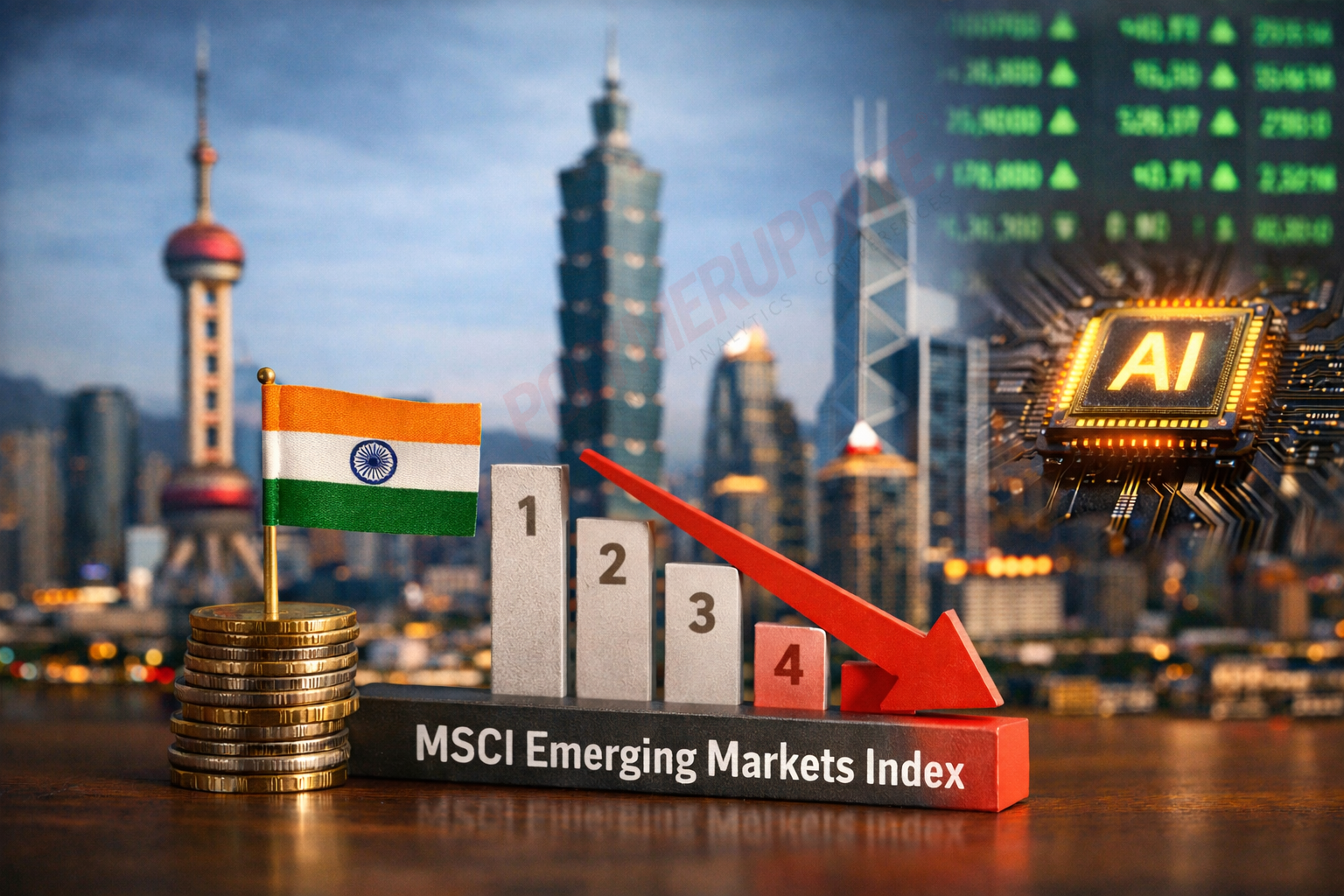
India's slide from silver medalist to fourth place in the MSCI Emerging Markets Index is not a verdict on its economic foundations. It is the consequence of a global capital cycle now dominated by the sovereign AI arms race — and it should be read as a cyclical dislocation, not a structural retreat.
| BY Professor Dr. Sajjid Mitha CEO & Founder, Polymerupdate |
India's positioning within the MSCI Emerging Markets Index has long functioned as much as a barometer of institutional sentiment as a measure of price action. Over the past eighteen months, that narrative has undergone a subtle yet seismic shift. After peaking as the index's second-largest constituent, India has transitioned to fourth position. This compression of its weighting, however, is not a by-product of domestic structural frailty. It is, rather, the direct consequence of an immense gravitational force exerted by a global investment landscape now singularly absorbed in what analysts have begun to call the "Sovereign AI" arms race.
| 9% India weight · 2020 Baseline | 21% Peak · Sept 2024 High-water mark | 12.5% Current · Early 2026 Rebalancing phase |
At its zenith in September 2024, India's index weight approached 21 per cent — a high-water mark that appeared to canonise a decade-long thesis: that India's demographic dividend and reform-oriented fiscal architecture would command an ever-increasing share of the global capital pool. By early 2026, that figure had moderated to approximately 12.5 per cent. While the delta appears jarring in isolation, a longitudinal reading reveals a far more nuanced reality. India stood at a mere 9 per cent in 2020. The current adjustment, viewed with rigour, reflects a rebalancing of relative strengths — not a fundamental withdrawal of confidence in the India story.
The Tyranny of the Cap-Weight
The MSCI Emerging Markets Index is not a referendum on sovereign economic virtue. It is a cold, market-capitalisation-weighted instrument, ruthlessly responsive to the velocity of capital flows. That velocity has recently favoured the high-moat technology corridors of North Asia with disproportionate intensity — concentrated in China's burgeoning AI ecosystem, Taiwan's unrivalled semiconductor foundry dominance, and South Korea's advanced logic-chip complex.
"The index does not reward five-year growth stories when the market is pricing a five-month hardware supercycle. India is being penalised not for what it is, but for what it is not — a short-cycle AI hardware play."
Senior fund manager, speaking on condition of anonymity
This shift has been further compounded by an evolving geopolitical risk framework. As the "China-plus-one" strategy matures, global capital is bifurcating with increasing clarity: strategic manufacturing capacity continues to anchor itself in India, while speculative hyper-growth capital chases the immediate hardware requirements of the Silicon Valley-led AI revolution. These are, by design, two distinct pools of capital responding to two fundamentally different investment horizons.
India's Structural Story Remains Intact
There is a persistent tendency, in the short-term noise of index reweightings, to mistake relative underperformance for strategic irrelevance. That conflation would be a serious analytical error in India's case. The macroeconomic architecture underpinning the India growth story — demographic scale, a rapidly formalising digital economy, a manufacturing base ascending the value chain, and a government whose fiscal ambition is matched by institutional depth — has not been impaired by a single basis point of MSCI rebalancing.
"The emerging market investor who reduces India on the back of a mechanical index reweighting, rather than any deterioration in fundamentals, risks selling the compounding story of the next decade at a cyclically depressed entry point."
International institutional investor, private correspondence
India's capital markets infrastructure has, if anything, improved structurally over the period in question — the depth of domestic institutional participation, the breadth of its listed corporate universe, and the progressive opening of its sovereign bond market to global index inclusion have each advanced materially. The Unified Payments Interface now processes transactions that, in aggregate, rival the annual payment volumes of several developed economies. These are not the data points of a retreating nation.
The AI Cycle Will Rotate
The current dominance of North Asian AI-adjacent plays within the EM index is a function of a specific phase within the AI investment cycle: infrastructure build-out. Hardware, foundries and high-bandwidth memory are the primary beneficiaries of the present moment. As the technology cycle matures toward application deployment and enterprise integration, the competitive landscape will shift decisively. India's extraordinary concentration of AI-capable engineering talent, its established global technology services footprint, and its rapidly expanding domestic digital consumption market represent precisely the asset class that the next phase of the cycle rewards.
Investors with a genuine emerging-market horizon would do well to recall that index weights are a lagging indicator of economic reality. India's weight in the MSCI EM Index was negligible at the very moment the nation was laying the foundations of what is now recognised as one of the most consequential growth stories of the modern era. The current dislocation may prove no different.
"India is not losing a race. It is running a different race — one measured in decades, not data-centre delivery schedules."
Professor Dr. Sajjid Mitha (CEO & Founder - Polymerupdate)
For the long-duration institutional investor, the relevant question is not why India's index weight has compressed from 21 to 12.5 per cent, but whether the underlying economy that generated that rise remains on trajectory. On every durable metric — productivity growth, capital formation, institutional strengthening and consumer market expansion — the answer is unambiguously affirmative. The India story is not over. It is, if anything, entering its most consequential chapter yet.
| Professor Dr. Sajjid Mitha is CEO and Founder of Polymerupdate. The views expressed are the author's own and do not represent investment advice. Polymerupdate Intelligence · April 2026 |


