
Click the icon to add a specified price to your Dashboard list. This makes it easy to keep track on the prices that matter most to you.

BY PROFESSOR DR. SAJJID MITHA | CEO & FOUNDER, POLYMERUPDATE | MUMBAI, INDIA
From tankers idled in contested waters to fertilizer shortfalls threatening next season's harvests, the world is confronting the limits of interconnected fragility and an urgent imperative for stability.
The crisis gripping the Strait of Hormuz has evolved from a regional security flashpoint into something more consequential and more difficult to contain: a systemic stress test for the global economy's underlying architecture. What began as a military standoff is now exposing, with uncomfortable precision, the structural vulnerabilities that decades of just-in time optimisation have quietly accumulated beneath the surface of modern commerce.
Even a ceasefire—however swiftly negotiated—would leave damage that lingers not for weeks, but for quarters. Supply chains, once disrupted, do not snap back. Confidence, once broken, prices in differently. The world's financial and diplomatic institutions must reckon with an uncomfortable truth: this is not a crisis that ends when the warships stand down.
| MARKET INDICATORS AT A GLANCE — AS OF MONDAY OPEN | |
|---|---|
| Brent Crude (intraday peak) | +7.9% |
| S&P 500 Futures | ▼ Retreating |
| USD (vs. safe-haven basket) | Softening |
| War-Risk Insurance Premiums | Sharply Elevated |
| Developing Asia Growth Forecast (2026) | −1.0%+ pts |
THE CHOKEPOINT
One Narrow Artery, Civilisation's Dependence
Through the Strait of Hormuz—a navigational corridor barely 33 kilometres wide at its narrowest— flows approximately one-fifth of the world's seaborne oil and liquefied natural gas. On ordinary days, it is the vascular system of global industrialisation: reliable, unremarkable, taken for granted. Today, it is none of those things.
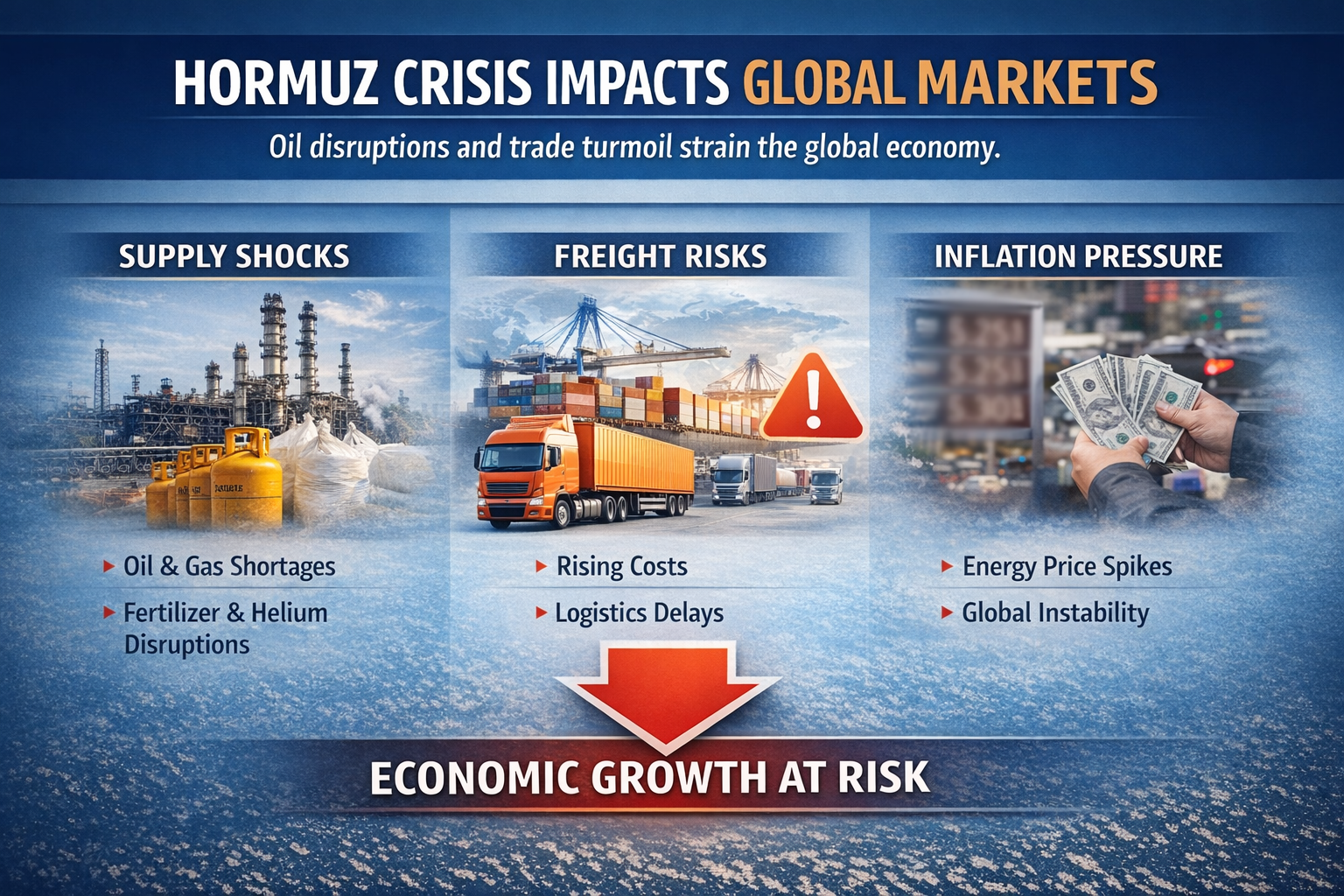
Tankers are idling. Insurers are recalculating. Port operators across South and Southeast Asia are managing queue backlogs that compound by the day. The disruption is not theoretical. It is measurable in delayed shipments, surging freight rates, and the quiet accumulation of shortages that will manifest in factory lines and grocery shelves weeks or months from now.
"We haven't lost access to the Strait yet. What we've lost is the certainty that access will be there tomorrow. And in commodity markets, that distinction doesn't matter—uncertainty prices like disruption."
— SENIOR COMMODITY STRATEGIST, GLOBAL INVESTMENT BANK (SPEAKING ON CONDITION OF ANONYMITY)
The critical analytical point, one that markets are only beginning to absorb, is that Hormuz is not merely an oil corridor. It is a logistics chokepoint of extraordinary breadth. Helium, essential for semiconductor fabrication and MRI diagnostics, transits here. Sulphur—a feedstock for fertilisers, batteries, and pharmaceuticals —moves through these waters. Methanol, petrochemical plastics, textiles: the full catalogue of modern industrial inputs is, to varying degrees, hostage to the strait's stability.
ECONOMIC TOLL
A Supply Shock Without a Playbook
International bodies now project a sharp deceleration across developing Asia, with growth forecasts for 2026 potentially reduced by more than a percentage point. That is not merely a statistical revision. It translates, at scale, into millions of households pushed back below meaningful economic thresholds— back toward poverty, food insecurity, and the political instability that follows both.
Energy price spikes have driven inflation measurably higher. The mechanism is familiar from 2022, but the context is compounding: governments already stretched by post-pandemic fiscal expansions have limited room to absorb the shock through subsidies. Those that try will borrow. Those that don't will face unrest. Neither outcome is benign for debt sustainability.
The fertiliser dimension deserves particular attention. Disruptions to sulphur and nitrogen supply chains are arriving precisely as the northern hemisphere's planting season demands reliable input flows. A shortfall at this juncture does not produce consequences in April. It produces them in harvest data released in October, and in food price indices that follow thereafter.
"A shortfall in fertiliser inputs now will not show up in economic data for months. But when it does, it will be impossible to distinguish from pure negligence."
— SENIOR AGRICULTURAL ECONOMIST, MULTILATERAL DEVELOPMENT INSTITUTION
Helium scarcity adds a dimension that financial models seldom capture cleanly. The semiconductor industry, already navigating post-pandemic capacity tightening and trade restriction headwinds, is acutely sensitive to helium supply continuity. Disruption here does not merely slow chip production. It cascades —into automotive manufacturing, medical device output, and the defence procurement pipelines that several governments are simultaneously trying to accelerate.
The Border Argument
Why the World Cannot Afford to Wait
EDITORIAL POSITION
This is not an abstract policy question. Stability in the Strait of Hormuz is not a regional preference—it is a precondition for economic recovery across the developing world. Every day of uncertainty compounds damage that will take years, not months, to repair.
The global economy entered 2026 in a condition of managed fragility. Post-pandemic demand normalisation had yet to fully resolve. Inflation, though declining in many markets, remained above pre-2020 baselines. Sovereign debt loads, particularly across the Global South, had risen to levels that leave little buffer against exogenous shock. Into this context, the Hormuz crisis has arrived not as an isolated event, but as a second major supply shock within the span of three years.
The question that should concentrate minds in every finance ministry and central bank is not whether the world can absorb this shock—it manifestly can, in the short term. The question is whether it can absorb it without structural damage that permanently impairs the recovery trajectory of the most vulnerable economies.
The answer, almost certainly, depends on how quickly stability is restored. Not managed. Not negotiated incrementally. Restored— to a condition in which commercial shipping transits without war risk premiums, in which insurers price Hormuz passage at pre crisis rates, and in which supply chain managers can once again plan with a twelve-month horizon rather than a twelve-day one.
"Every week this drags on, the calculus shifts. Companies will begin making permanent decisions—about routing, about sourcing, about where to hold inventory—that will outlast any ceasefire by years. The economic geography of this region is being rewritten in real time."
— DIRECTOR OF GLOBAL SUPPLY CHAIN RISK, EUROPEAN LOGISTICS GROUP (SPEAKING ON CONDITION OF ANONYMITY)
Geopolitically, the crisis is already accelerating a structural pivot toward alternative corridors—overland routes through Central Asia, expanded capacity through the Suez Canal's competing arteries, and renewed interest in pipeline infrastructure that has languished for a decade under the assumption that Hormuz would remain open. These pivots are rational. They are also expensive, slow, and ultimately inadequate substitutes for a maritime artery that has no true parallel in terms of throughput capacity.
THE RECKONING
Just-in-Time Meets Its Limits
For three decades, the just-in-time model has functioned as the operating system of global commerce: minimal inventory, maximum efficiency, supply chains stretched thin in the confidence that disruption would remain local and brief. The pandemic subjected that model to its first serious stress test. The Hormuz crisis is administering a second—and in some respects, a more revealing one, because it is geopolitical in origin and therefore less amenable to the technical solutions that helped navigate the first.
The implications for corporate strategy are significant. Firms that had begun rebuilding inventory buffers after 2022 will accelerate that process. Regional sourcing, near-shoring, and supplier diversification—already trends, now imperatives—will draw capital and strategic attention. The result, over time, will be a global supply chain that is more resilient and considerably more expensive to operate.
That adjustment will be unevenly distributed. For wealthy, diversified economies with strong Gscal positions, it will be a costly but manageable reconfiguration. For import-dependent developing economies, already navigating food inflation, currency pressure, and debt service obligations, it represents a compounding burden that risks becoming self-reinforcing.
There is, in this dynamic, a moral as well as an economic argument for urgency. The nations least responsible for the conditions that produced this crisis—the geopolitical posturing, the strategic miscalculation, the failure of deterrence—will bear its consequences most severely. That asymmetry demands that those with leverage toward resolution exercise it, and that they do so before the structural damage compounds beyond the reach of conventional stabilisation measures.
The world has weathered supply shocks before. It has not yet confronted one of this magnitude without the institutional architecture—open diplomacy, multilateral frameworks, credible mediation—that historically contained them. Whether that architecture can be reconstructed quickly enough to matter is, ultimately, the question on which economic recovery now turns.
| KEY DISRUPTIONS |
| Crude & LNG: ~20% of global seaborne supply in transit |
| Helium: Critical for chip fab and MRI machines |
| Sulphur: Fertiliser, battery, and pharma feedstock |
| Methanol: Resins, fuel, and chemical precursors |
| Petrochemical plastics: Across consumer and industrial sectors |
| Textiles: Manufacturing inputs from Gulf-routed suppliers |
| Medical supplies: Routing delays in time-sensitive cargo |
| ~20% OF GLOBAL SEABORNE OIL & LNG TRANSITS THE STRAIT OF HORMUZ |
| +1 PP PROJECTED GDP REDUCTION FOR DEVELOPING ASIA IN 2026 |
| 7.9% BRENT CRUDE INTRADAY SURGE, MONDAY OPEN |
ANALYST WATCH
Insurance markets are pricing Hormuz passage risk at multi-year highs. War-risk premium surges are rendering certain routes commercially unviable for thinner margin operators and smaller carriers—concentrating volumes among major players and reducing market elasticity.
The fiscal pressure on subsidy-dependent governments is acute. Nations importing energy and food commodities on leveraged sovereign balance sheets face a structural constraint: absorb the shock through spending, or allow it to pass through to consumers.
GEOPOLITICAL CALENDAR
Islamabad Talks
STATUS: UNCERTAIN
Iranian state media has signalled limited appetite for engagement under current conditions. Participation remains unconfirmed.
Planting Season Deadline
NORTHERN HEMISPHERE
Fertiliser input window narrowing. Disruptions now will affect harvest data reported Q3–Q4 2026.
BY PROFESSOR DR. SAJJID MITHA
CEO & FOUNDER - POLYMERUPDATE
Dr. Mitha is the CEO and Founder of Polymerupdate, headquartered in Mumbai, India. He advises institutional clients across the Gulf, South Asia, and European markets on energy markets, petrochemical supply chains, and geopolitical risk.


