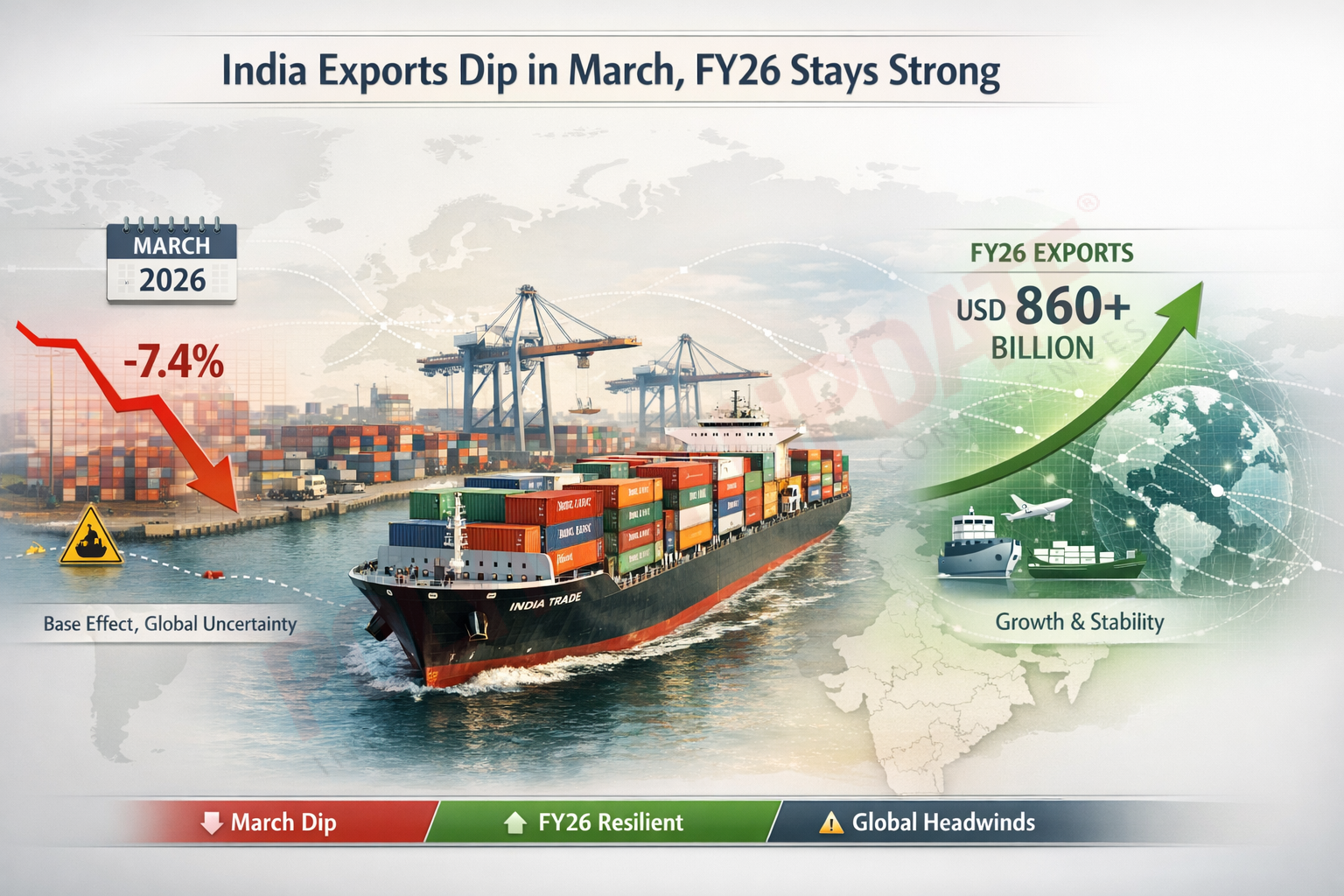
India’s goods exports contracted 7.4 percent year-on-year (YoY) in March 2026 due to a high base effect, driven by the frontloading of exports last year in anticipation of tariff hikes by the United States. According to data compiled by the Ministry of Statistics and Programme Implementation (MoSPI), India’s total merchandise exports stood at US$ 38.9 billion in March, compared with an average growth of 0.3 percent in the three months ended February. The impact of the West Asia conflict was also clearly visible in the March trade data.
The decline in exports was led by a 29.3 percent drop in gems and jewellery shipments. Notably, the United Arab Emirates (UAE) has recently become India’s top destination for gems and jewellery exports, surpassing the United States. Core exports (i.e., goods excluding oil and gems & jewellery) declined 7.5 percent year-on-year, reflecting broad-based pressure.
Dharmakirti Joshi, Chief Economist, Crisil Ltd, commented, “The sharp contraction in oil imports, along with growth in petroleum exports, led to India’s oil trade deficit halving to US$ 7 billion in March from US$ 14.1 billion a year ago. Sequentially, the oil trade deficit was also lower compared with US$ 9.5 billion in February. According to the latest available data, India’s exports to Saudi Arabia and the UAE contracted sharply by 45.7 percent and 61.9 percent year-on-year, respectively, in March.”
 Product-wise performance
Petroleum exports, however, remained buoyant, registering 5.7 percent year-on-year growth. This was partly a reflection of the significant rise in crude oil prices (Brent at US$ 95.6 a barrel in March versus US$ 70.7 a barrel a year earlier and US$ 68 a barrel in February) and also a likely diversion of some petroleum exports to other Asian markets.
For instance, India’s exports to Singapore—the country’s largest petroleum export destination after the Netherlands and the UAE—surged 158.6 percent year-on-year in March, following consistent contraction over several preceding months. Exports to Malaysia also recorded strong growth of 84.5 percent. Preliminary estimates show that India’s services exports recorded a mild contraction (-1.2 percent year-on-year) in March. However, a sharper contraction in imports (-3.0 percent) meant that the services trade surplus still increased (to US$ 18.2 billion from US$ 18.1 billion in March 2025 and US$ 17.8 billion in February 2026).
Impact on importsThe impact of the West Asia conflict was also visible in India’s imports, which contracted 6.5 percent year-on-year to US$ 59.6 billion in March, following an average double-digit growth of 18.4 percent in the previous three months. This decline was led by a 35.9 percent drop in crude oil imports and a 17.8 percent fall in gems and jewellery imports (pearls, precious and semiprecious stones declined 13.1 percent, while gold imports fell 31.6 percent).
India’s fertiliser imports—of which West Asia is a key supplier—were also affected, with growth slowing to just 2.2 percent year-on-year in March, compared with an average growth of 26.1 percent in the previous three months. Country-wise, India’s imports from Qatar, Saudi Arabia, and the UAE contracted by 47.9 percent, 37.3 percent, and 66.3 percent year-on-year, respectively, in March. However, despite the impact on imports from West Asia, India’s imports from other regions remained buoyant, as reflected in the 10.2 percent year-on-year growth in core imports in March, compared with 14 percent in February.
Outside West Asia, India’s exports to the United States improved sequentially in March (US$ 8 billion versus US$ 6.6 billion in February), reflecting some positive impact from progress on the trade deal between the two countries, under which U.S. tariffs on India were reduced from 50 percent to 18 percent and subsequently to 10 percent. That said, uncertainties around the trade deal persist, and the future trajectory of India’s exports to the United States remains an area to monitor.
Full year tradeCumulatively, in fiscal 2026, India’s goods exports rose a marginal 0.9 percent year-on-year to US$ 441.8 billion. However, imports grew 7.4 percent to US$ 774.9 billion. Overall imports for FY 2025–26 were recorded at US$ 979.40 billion, indicating strong domestic demand and industrial activity. Meanwhile, imports face significant upside risks from sustained higher energy and commodity prices if the conflict is prolonged. Together, these factors may weigh on the goods trade deficit this fiscal.
As a result, the trade deficit widened to US$ 333.1 billion from US$ 282.8 billion in fiscal 2025. India’s foreign trade performance in FY 2025–26 (April–March) remained robust, with total exports (merchandise and services) crossing a significant milestone of US$ 860.09 billion, reflecting the resilience and competitiveness of the export sector.
Commenting on the performance, S C Ralhan, President, Federation of Indian Export Organisations (FIEO), said, “Crossing US$ 860 billion in exports is a notable achievement, particularly amid global uncertainties, supply chain disruptions, and fluctuating demand. It highlights the adaptability and strength of Indian exporters. Export growth was driven by a diversified basket, including engineering goods, petroleum products, electronics, pharmaceuticals, chemicals, textiles, gems & jewellery, rice, and marine products, strengthening India’s position in global value chains.”
Joshi added, “In the base case, under the assumption that exports benefit from U.S. tariff relaxations and crude prices average US$ 75–80 a barrel, we expect the current account deficit (CAD) to widen to 1.5 percent of GDP in fiscal 2027 versus a projected 0.8 percent in fiscal 2026. If oil prices rise to US$ 82–87 a barrel, which is our alternate case and now appears plausible, the CAD could increase to 2.0 percent of GDP. A healthy services trade surplus should limit the upside to the CAD. The ongoing West Asia conflict, along with its duration and scale, will be critical to monitor. Elevated uncertainties and subdued global growth—in the event of supply shocks—could weigh on exports despite some expected tailwinds from reduced U.S. tariffs.”
Market diversificationThe United States, the UAE, China, the Netherlands, and the UK remained key export destinations. There is a need to further diversify markets and effectively leverage free trade agreements to expand India’s global footprint. Improving logistics efficiency, reducing transaction costs, and ensuring access to affordable credit—especially for MSMEs—will be critical to sustaining export momentum.
“With continued policy support and trade facilitation, India is well poised to enhance its share in global trade and move towards becoming a leading export powerhouse under the vision of Viksit Bharat,” S C Ralhan added.
DILIP KUMAR JHA
Editor
dilip.jha@polymerupdate.com



