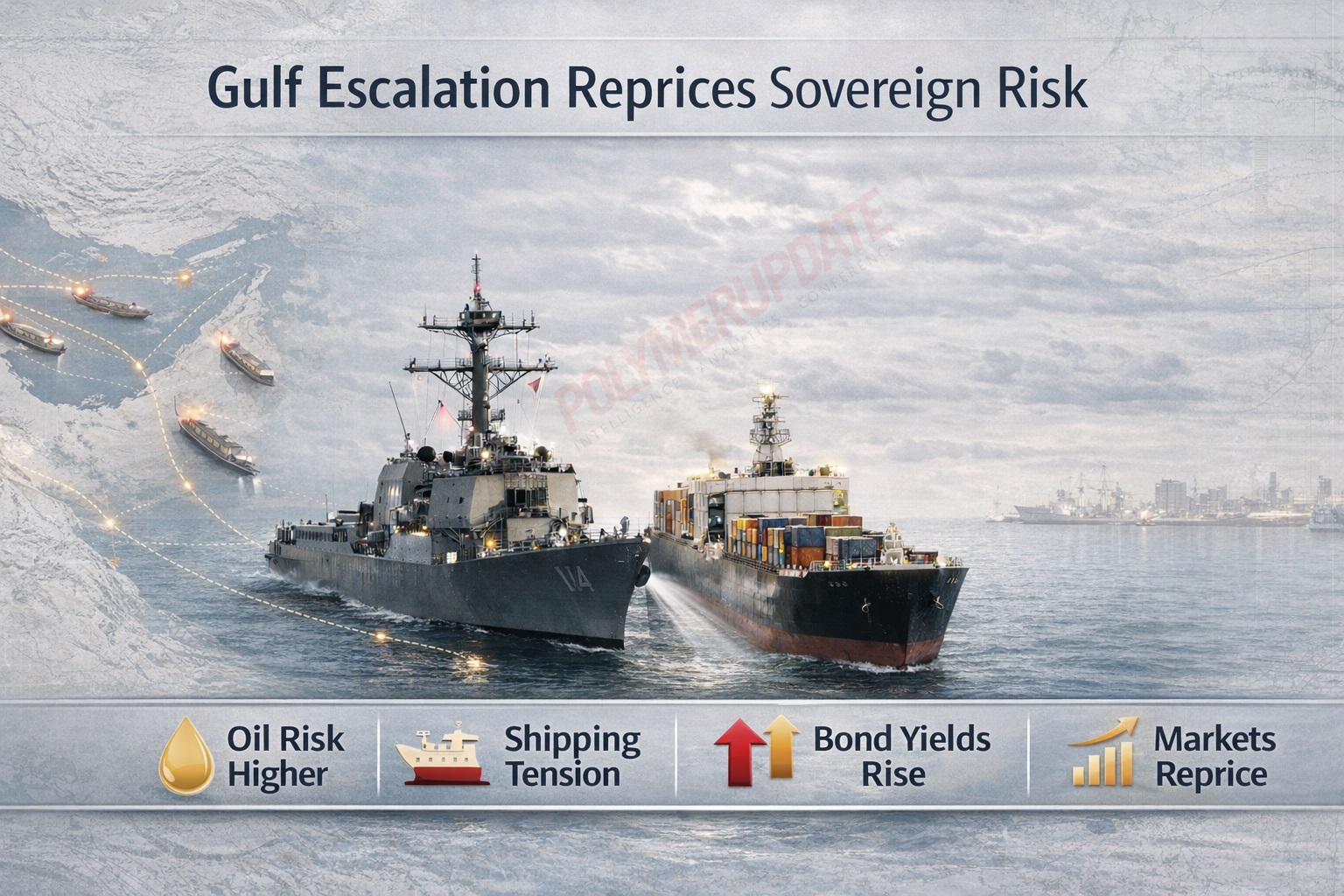
By Professor Dr Sajjid Mitha - Polymerupdate The strategic outlook underpinning Gulf stability shifted materially on Monday as President Trump announced that US Naval forces had engaged and taken custody of an Iranian-flagged cargo vessel in the Gulf of Oman. The intervention arrives at a structurally fragile moment: a ceasefire consensus that markets had partially discounted is now subject to acute revision, with implications cascading across energy, sovereign risk, and the broader geopolitical architecture of the Middle East.
The announcement follows a weekend of sharp Iranian escalation. Tehran moved to reassert interdiction authority over the Strait of Hormuz—the 21-mile chokepoint through which approximately 20% of global oil supply transits—while separately targeting commercial shipping in what analysts characterized as a coordinated pressure campaign. The operational effect was immediate: tanker operators invoked force majeure provisions, war-risk insurance premiums spiked, and the administration's stated confidence in an imminent diplomatic resolution came under direct stress.
Market Implications: Risk Repriced, Not ResolvedMonday's asset price moves offer a clean read of how institutional investors are marking the situation:
Energy: Brent crude rallied as much as 7.9% intraday—a move of sufficient magnitude to register as a supply-shock signal rather than speculative noise. With Hormuz throughput at risk, forward curve dynamics are now pricing a non-trivial probability of sustained disruption.
Equities: US equity futures retreated from Friday's S&P 500 record, reflecting a rapid rotation out of risk assets. The reversal suggests the prior session's rally had inadequately discounted tail risk in the Gulf.
FX: Dollar softness against safe-haven alternatives points to a more complex read than simple flight-to-quality. When the dollar weakens into a geopolitical shock, it typically signals that investors are pricing US policy uncertainty as a distinct risk variable—not merely a consequence of external events.
The composite signal: risk has been repriced. It has not been resolved.
Diplomatic Framework: Structural FragilityThe White House confirmed that multilateral negotiations remain scheduled for Tuesday in Islamabad. The credibility of that framework is, however, materially in question. Iranian state media signaled that Tehran does not currently view participation as strategically advantageous—a posture consistent with a party that believes escalation strengthens its negotiating leverage.
From a game-theoretic standpoint, this is a structurally unstable equilibrium. Iran's apparent calculation—that non-participation in talks, combined with Hormuz pressure, extracts greater concessions than direct negotiation—may hold in the short term. But it increases the probability of miscalculation by US naval assets operating under expanded rules of engagement. The risk of an inadvertent escalation pathway is now meaningfully elevated.
"The standoff threatens to deepen a global energy crisis and undermines the administration's narrative of a stabilized Middle East," one senior analyst noted—a formulation that, within institutional risk frameworks, functions as a high-severity flag.
 Political Economy: The Inflation Constraint
For the administration, the episode surfaces a politically consequential dual constraint. Having committed publicly to a rapid diplomatic resolution, the White House now faces simultaneous exposure on two fronts: the kinetic risk of renewed open conflict, and the diffuse but electorally potent pressure of energy-driven inflation feeding through to consumer prices.
Historically, sustained crude price spikes above the $90–$100/bbl threshold have demonstrably eroded presidential approval ratings, particularly among lower-income cohorts with inelastic energy demand. With the Federal Reserve already navigating a narrow path between restrictive policy and growth preservation, an exogenous oil shock introduces a constraint the FOMC has limited tools to address without accepting growth sacrifice.
The political calculus is therefore not simply about the Gulf. It is about whether an administration that has staked credibility on both deal-making capacity and price stability can sustain both narratives under simultaneous pressure.
OutlookThe terminal scenario distribution has widened. At one end: a return to the negotiating table, partial de-escalation, and a crude price correction as supply-disruption risk is discounted. At the other: protracted Hormuz disruption, secondary sanctions enforcement failures, and a sustained energy shock that reshapes both the monetary policy environment and the political landscape ahead of the next electoral cycle.
For now, the key variables to monitor are Iranian naval posture in the Strait, the Islamabad talks attendance, and whether US rules of engagement for naval assets in the Gulf of Oman are formally revised. Each carries significant signal value for where the risk distribution ultimately settles.
Warships are in contested waters. Positions are being marked. And the confidence that made Friday's equity rally possible is being tested against a map that is changing faster than models can update.



