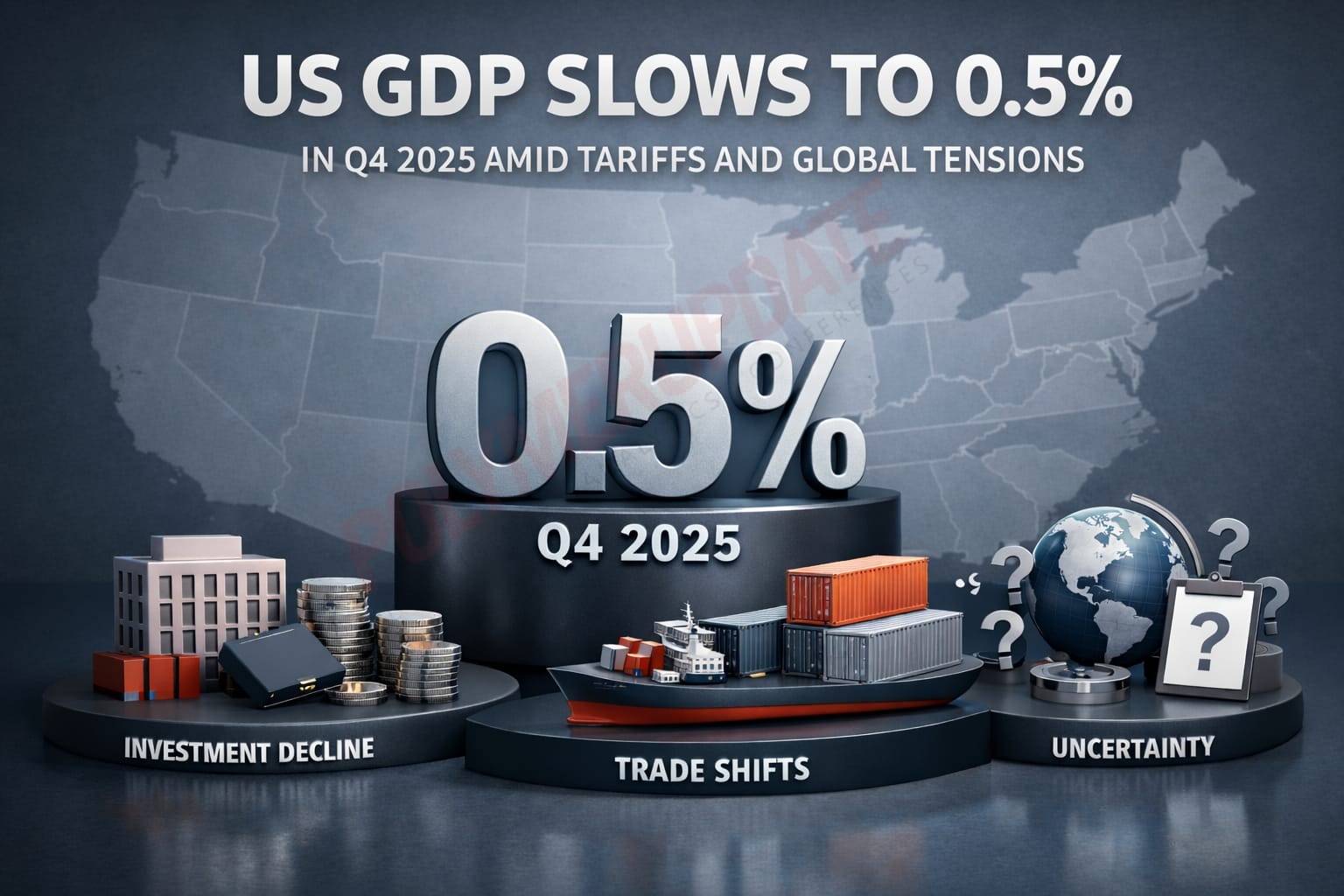
The United States economy slowed more than expected, registering real gross domestic product (GDP) growth of 0.5 percent in the October–December 2025 quarter, amid months of tariff-related uncertainty under President Donald Trump. The slowdown was also influenced by the ongoing Russia–Ukraine war, now in its fourth year, which has kept the world divided over the conflict between the two neighbours. Sanctions and reduced energy supplies from Moscow, particularly to the European Union, have hindered the region's trade activity.
In its latest assessment released on Thursday, the United States Bureau of Economic Analysis (BEA), in its third estimate, projected US growth at 0.5 percent for the fourth quarter of 2025 (October–December), down from its earlier estimate of 0.7 percent. In the third quarter of 2025, real GDP had increased by 4.4 percent. The fourth-quarter GDP was revised down by 0.2 percentage points from the second estimate, primarily reflecting a downward revision to investment. Growth in the fourth quarter was driven by increases in consumer spending and investment, partly offset by declines in government spending and exports. Imports, which are subtracted in the calculation of GDP, also decreased.
 Growth drivers
The contributors to the increase in real GDP in the fourth quarter were higher consumer spending and investment. These gains were partly offset by declines in government spending and exports. Imports, which are subtracted in the calculation of GDP, also decreased. At the state level, real GDP ranged from a 3.8 percent increase in North Dakota to an 8.3 percent decline in the District of Columbia, the BEA said.
From an industry perspective, the increase in real GDP reflected a 2.3 percent rise in real value added by private services-producing industries, partly offset by declines of 7.8 percent in government and 1.8 percent in private goods-producing industries. The leading industry contributors to growth were wholesale trade, information, and health care and social assistance.
Domestic purchasesReal final sales to private domestic purchasers—the sum of consumer spending and gross private fixed investment—increased 1.8 percent in the fourth quarter, revised down by 0.1 percentage point from the previous estimate. Real gross output decreased 0.5 percent in the fourth quarter, reflecting declines of 3.2 percent in private goods-producing industries and 4.7 percent in government, partly offset by a 1.1 percent increase in private services-producing industries.
Real gross domestic income (GDI) increased 2.6 percent in the fourth quarter, compared with a 3.5 percent increase in the third quarter. The average of real GDP and real GDI rose 1.5 percent in the fourth quarter, compared with 4.0 percent in the third quarter. Profits from current production (corporate profits with inventory valuation and capital consumption adjustments) increased by US$246.9 billion in the fourth quarter, compared with an increase of US$175.6 billion in the third quarter.
The price index for gross domestic purchases increased 3.7 percent in the fourth quarter, revised down by 0.1 percentage point from the previous estimate. The personal consumption expenditures (PCE) price index rose 2.9 percent, while the PCE price index excluding food and energy increased 2.7 percent, both unchanged from previous estimates.
Annual figuresReal GDP increased 2.1 percent in 2025 (from the 2024 annual level to the 2025 annual level), the same as previously estimated. The growth in real GDP primarily reflected increases in consumer spending and investment. From an industry perspective, real value added for private services-producing industries rose 1.2 percent, while government increased by less than 0.1 percent. From a regional perspective, real GDP increased in all 50 states and the District of Columbia, with growth ranging from 3.1 percent in South Carolina and Florida to 0.3 percent in North Dakota.
The price index for gross domestic purchases increased 2.6 percent in 2025, unchanged from previous estimates. The PCE price index rose 2.6 percent, while the PCE price index excluding food and energy increased 2.8 percent, both in line with earlier estimates. Real gross domestic income (GDI) increased 2.4 percent in 2025, compared with a 3.0 percent increase in 2024. The average of real GDP and real GDI rose 2.3 percent in 2025, compared with 2.9 percent in 2024. Profits from current production increased by US$275.7 billion in 2025, compared with a rise of US$184.4 billion in 2024. Current-dollar personal income increased 4.9 percent in 2025.
Tariff shocksThe rollout of new US tariffs in 2025 triggered months of uncertainty and market volatility. One year on, their impact is becoming clearer. Although the tariff hike was historic, its direct effect on the European economy proved more muted than initially feared. This reflected exemptions, tariff front-loading, and strong US demand for pharmaceutical imports (especially from Ireland), as well as the fact that US tariffs on many competing suppliers also rose sharply in 2025, temporarily preserving Europe's competitive position in the US market. Still, higher tariffs, a stronger euro, and heightened uncertainty have visibly weighed on EU–US trade.
Ruben Dewitte, Economist at ING Economics, commented, "The US tariff shock of 2025 was historic, but its impact on Europe was partly cushioned as tariffs on rival suppliers rose, keeping Europe's US market position broadly intact. Even so, exports fell amid higher tariffs and uncertainty. With tariffs converging to 15 percent in 2026 for most partners, Europe's competitiveness is set to deteriorate."
Meanwhile, the drivers of EU–US trade are shifting. The deal locks in a 15 percent tariff rate for EU exports, while tariffs on competing countries are also set to converge towards 15 percent in 2026. Countries such as China (31.1 percent effective tariff rate in 2025), India (20.5 percent), and Indonesia (20.8 percent) therefore face substantially lower tariff rates than in 2025, eroding the EU's relative position in the US market. As a result, the drag on EU exports is likely to persist, driven less by uncertainty and tariff asymmetries and more by a deterioration in relative competitiveness.
Effective tariff hikesUS tariffs increased sharply in 2025. The effective tariff rate rose by 8.1 percentage points (ppt), a historic jump, but one that ultimately proved less severe than the most adverse scenarios had anticipated. This more benign outcome partly reflected tariff stacking rules and sector-specific exemptions, as well as the ability of exporters to adapt by rerouting trade flows or adjusting the composition of shipments to the US market.
For the EU, the effective tariff rate climbed to 8.5 percent in 2025, up by 7.2 ppt compared with 2024. Despite the EU's common external tariff, effective tariff levels varied across countries due to differences in export structures and access to exemptions. As a result, France, Belgium, and the Netherlands faced roughly half the effective tariff burden of countries such as Germany, Italy, or Spain.
ConclusionOverall, the tariff shock may have been less dramatic than initially feared based on headline numbers, but its economic impact is already evident and is likely to extend into 2026. Diversifying trade towards partners such as Mercosur and India is both a necessary and welcome policy response, but these markets still fall short of the depth of the US market. This reinforces the importance of strengthening the EU's internal market as a key policy priority going forward.
DILIP KUMAR JHA
Editor
dilip.jha@polymerupdate.com



