
Click the icon to add a specified price to your Dashboard list. This makes it easy to keep track on the prices that matter most to you.

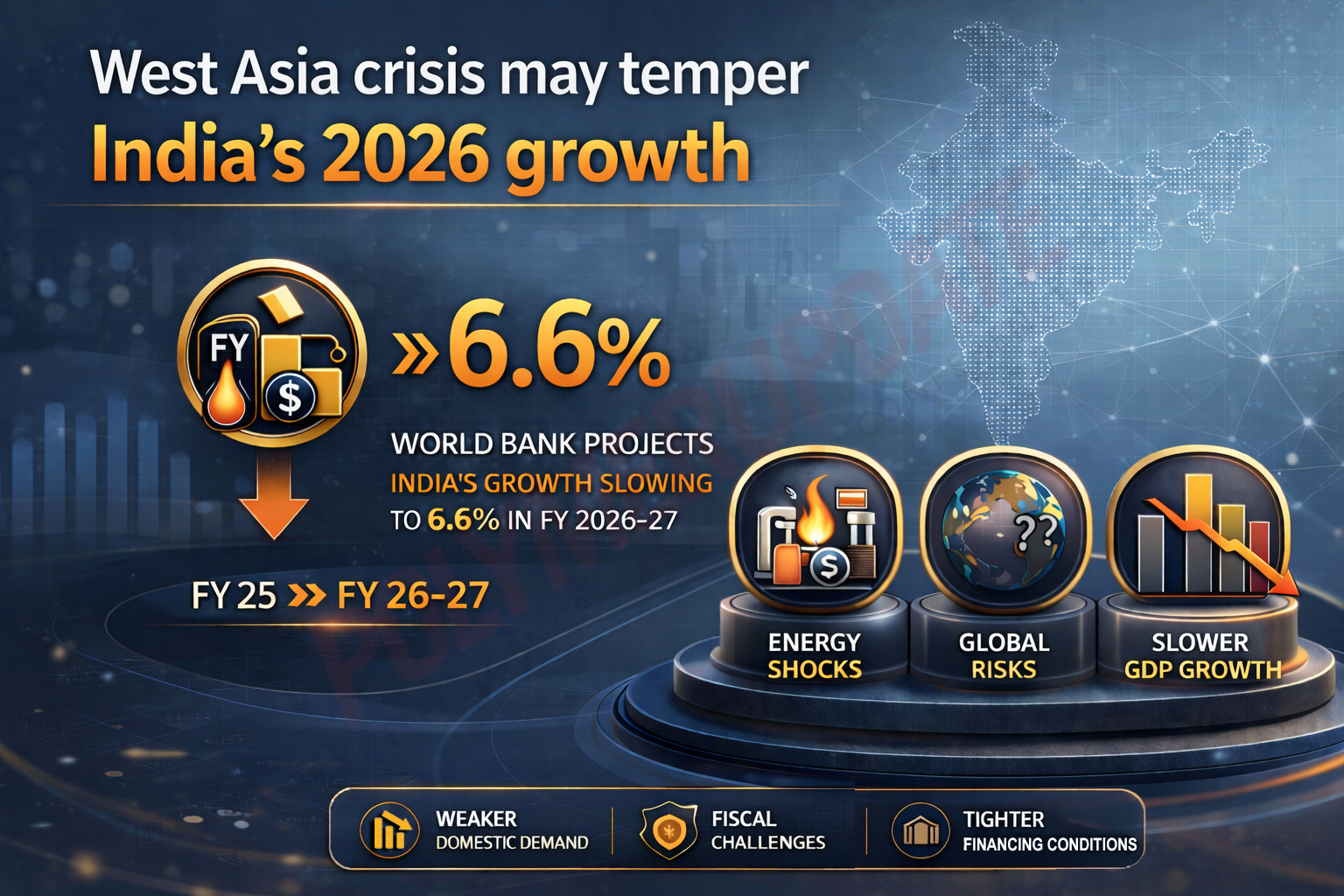
India’s economic growth is projected to slow to 6.6 percent in the financial year (FY) 2026–27 (April–March), down from an estimated 7.6 percent in FY 2025–26, due to higher energy prices stemming from the Middle East conflict and supply chain disruptions weighing on economic activity. Despite the slowdown, India is expected to remain among the fastest-growing economies, even as growth moderates amid the conflict. The outlook remains vulnerable to risks and uncertainties, the World Bank said in its latest report.
Released on Wednesday, the report titled India Development Update states that despite significant downside risks arising from the conflict, the economy’s strong macroeconomic fundamentals and policy buffers provide some insulation. Substantial foreign exchange reserves, low inflation, predominantly rupee-denominated public debt, a healthy financial sector, and trade diversification efforts play a major role in enhancing resilience against external headwinds.
Paul Procee, World Bank Acting Director for India, commented, “Boosting private sector-led growth will be critical to strengthening economic resilience and supporting more young people to enter the workforce. To achieve Viksit Bharat (developed India), a predictable, business-enabling environment will help unlock investment and create jobs at scale in priority sectors such as energy and infrastructure, manufacturing, tourism, healthcare, and agribusiness.”
Slowdown in South Asia
South Asia’s economic growth is expected to slow to 6.3 percent in 2026 amid dislocations in global energy markets. The region will remain the fastest-growing among emerging market and developing economies (EMDEs), supported by the strength of India’s economy. The rest of the region is expected to grow at a pace comparable to other EMDEs. Despite the slowdown, South Asia will continue to outpace other emerging markets and developing economies, with growth projected to recover to 6.9 percent in 2027.
South Asia’s growth prospects could be dampened by more persistent dislocations in global energy markets, or by a bout of global financial turbulence transmitted to the region and amplified by domestic weaknesses; adverse spillovers from the adoption of artificial intelligence in major export markets; and delays in reforms.
Accelerating growth and job creation remain major challenges for South Asian policymakers. Carefully designed industrial policy can help turn cities into powerful growth engines or promote tourism to broaden growth, especially when combined with broad-based reforms that support firm expansion. Governments worldwide are increasingly deploying industrial policy, and in South Asia such policies are implemented at roughly twice the rate seen in other emerging economies. However, these measures have yielded mixed results in the region.
Global economy under threat
Conflict in the Middle East is threatening activity around the Strait of Hormuz, a critical chokepoint for energy shipping. Roughly 20 percent of global petroleum production and a similar share of liquefied natural gas (LNG) transit through the Strait. This flow has been disrupted as ships have been attacked, insurance coverage withdrawn, and regional production facilities damaged. Energy prices have surged. This will increasingly affect inflation and growth if disruptions persist.
The global economy is also undergoing major shifts in the trading system. The United States increased its effective tariff rate from 2.4 percent to 16 percent in 2025 through a series of country-specific measures, before shifting to an across-the-board 10 percent increase in February 2026. Uncertainty around U.S. tariffs remains elevated, as the administration has indicated its intention to raise global tariffs to 15 percent in the future using alternative legal authorities. Tariff volatility and policy uncertainty have weighed on some sectors, but this has been partly offset by strong investment in technologies such as artificial intelligence.
Impact of high energy price on inflation
The impact of higher energy prices and tariffs is not yet evident in global inflation. As of February, global inflation was gradually trending down toward central bank targets, driven by softening demand and the low energy prices prevailing at the beginning of 2026. However, there were several exceptions to this overall trend. Inflation in the United States remains closer to 3 percent than its 2 percent target, with goods prices pushed up by tariffs. Prices in China have remained largely flat, restrained by a continued decline in house prices.
As of early March, World Bank’s consensus forecasts for growth in major economies had been trending upward. Global surveys also indicated steady momentum in both manufacturing and services prior to the recent disruptions in global energy markets. Headline global merchandise trade growth remained resilient to tariffs and uncertainty in 2025, supported by strong demand for products related to artificial intelligence and the frontloading of shipments ahead of tariff implementation. On an annual basis, the slowdown in merchandise trade has been gradual.
DILIP KUMAR JHA
Editor
dilip.jha@polymerupdate.com


