
Click the icon to add a specified price to your Dashboard list. This makes it easy to keep track on the prices that matter most to you.

India’s economy, as measured by gross domestic product (GDP), is estimated to grow by 7.4 percent in the financial year 2025–26 (FY26), driven by the twin engines of consumption and investment. The strong growth estimate reaffirms India’s status as the fastest-growing major economy for the fourth consecutive year. This was a key highlight of the Economic Survey 2025–26, tabled in Parliament today by the Union Minister for Finance and Corporate Affairs, Smt. Nirmala Sitharaman. The Survey also estimates real GDP growth for FY27 at 6.8–7.2 percent.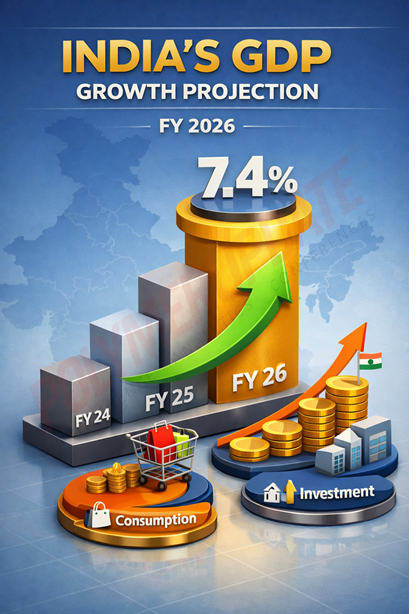 The Survey notes that domestic demand continues to underpin economic growth in FY26. According to the First Advance Estimate, the share of final private consumption expenditure (PFCE) in GDP rose to 61.5 percent in FY26. This strength in consumption reflects a supportive macroeconomic environment characterised by low inflation, stable employment conditions, and rising real purchasing power. Moreover, steady rural consumption, bolstered by strong agricultural performance, along with a gradual improvement in urban consumption, aided by the rationalisation of direct and indirect taxes, suggests that the momentum in consumption demand is broad-based.
Alongside consumption, investment has continued to anchor growth in FY26, with the share of gross fixed capital formation (GFCF) estimated at 30 percent. Investment activity strengthened in the first half of the year, with GFCF expanding by 7.6 percent, exceeding the pace recorded in the corresponding period last year and remaining above the pre-pandemic average of 7.1 percent.
S C Ralhan, President, Federation of Indian Export Organisations (FIEO), stated, “The document powerfully reinforces India’s emergence as a trusted, resilient and indispensable global trading partner, even as the world economy continues to face volatility, fragmentation and uncertainty. India’s record-breaking exports, stellar performance in services, a comfortable current account position and robust foreign exchange reserves clearly reflect the success of the government’s sustained policy reforms and the rising competitiveness of Indian exporters and service providers.”
Agriculture and allied sector
The Survey highlights that agriculture and allied activities are estimated to grow by 3.1 percent in FY26. Agricultural activity in the first half of FY26 was supported by a favourable monsoon. Agricultural gross value added (GVA) grew by 3.6 percent, higher than the 2.7 percent growth recorded in the first half of FY25, but remained below the long-term average of 4.5 percent.
Allied activities, particularly livestock and fisheries, have grown at relatively stable rates of around 5–6 percent. As their share in agricultural GVA has increased, overall agricultural growth has increasingly reflected a weighted outcome of volatile crop performance and relatively stable expansion in allied sectors.
Industrial sector
The Economic Survey notes that the industrial sector is showing signs of strength, with manufacturing growing by 8.4 percent in the first half of FY26, surpassing the FY26 estimate of 7 percent. In addition, the construction sector has remained resilient, underpinned by sustained public capital expenditure and continued momentum in infrastructure projects. The manufacturing sector’s share has remained steady at around 17–18 percent in real (constant price) terms.
Manufacturing’s gross value of output (GVO) has remained broadly stable at around 38 percent, comparable with services, indicating sustained output levels. Moreover, the industrial sector is expected to gain momentum in FY26, growing at 6.2 percent, up from 5.9 percent in FY25. High-frequency indicators for the October–December 2025 quarter of FY26—including the Purchasing Managers’ Index (PMI) for manufacturing, IIP manufacturing, and e-way bill generation—signal a strengthening of manufacturing activity, underpinned by robust demand.
Construction indicators such as steel consumption and cement production have recorded steady growth. Looking ahead, momentum in industrial activity is expected to remain buoyant, supported by GST rationalisation and a favourable demand outlook.
Supply vs demand
On the supply side, services remain the main driver of growth. In the first half of FY26 (April–September 2025), gross value added (GVA) in services increased by 9.3 percent, with growth for the full fiscal year estimated at 9.1 percent. This trend points to a broad-based expansion across the sector. Within services, all sub-segments recorded growth of over 9 percent, except the heavily Covid-impacted “trade, hospitality, transport, communication and related services” segment, which remains around 50 basis points below its pre-pandemic average.
Demand-led growth in the economy has also coincided with a marked easing of inflation, improving real purchasing power and supporting consumption. Domestic inflation dynamics in FY26 (April–December) reflect a broad-based moderation in price pressures, led by sharp disinflation in food prices. Headline CPI inflation declined to 1.7 percent, driven primarily by corrections in vegetable and pulse prices, supported by favourable farm conditions, supply-side interventions, and a strong base effect.
Inflation dynamics
While core inflation has shown persistence, this has been largely influenced by price spikes in precious metals. Adjusting for these effects, underlying inflation pressures appear materially softer, indicating limited demand-side overheating. Looking ahead, the inflation outlook remains benign, supported by favourable supply-side conditions and the gradual pass-through of GST rate rationalisation.
The momentum in domestic demand and capital formation observed in FY26 has been underpinned by a prudent fiscal policy strategy, characterised by steady revenue mobilisation and calibrated expenditure rationalisation. Gross tax revenue collection has remained resilient during the year, with direct tax collections reaching nearly 53 percent of the budgeted annual target as of November 2025.
Indirect tax collections also remained robust despite lower inflation and import volatility, with gross GST collections in absolute terms recording multiple all-time highs during the year. Recent tax policy reforms, including the restructuring of personal income tax and the rationalisation of GST rates, have supported consumption demand while sustaining revenues in absolute terms. On the expenditure side, capital outlays recorded a strong year-on-year increase, reaching nearly 60 percent of the budgeted allocation by November 2025. Meanwhile, growth in revenue expenditure remained contained, reinforcing the quality of public spending.
Policy rate cut
Alongside the fiscal stimulus provided by higher public capital expenditure and tax reductions, monetary support was delivered through a cumulative reduction of 125 basis points in the policy repo rate since February 2025, as inflationary pressures moderated. This was complemented by an injection of durable liquidity through cash reserve ratio cuts (₹2.5 lakh crore), open market operations (₹6.95 lakh crore), and a forex swap of around US$25 billion. These measures have been effectively transmitted through the banking system.
The weighted average lending rate (WALR) on fresh rupee loans by scheduled commercial banks declined by 59 basis points (bps), while the WALR on outstanding rupee loans fell by 69 bps between February and November 2025. Concurrently, the banking sector has further strengthened its balance sheet, with gross non-performing asset (NPA) ratios declining to multi-decade lows of 2.2 percent, the half-yearly slippage ratio remaining stable at 0.7 percent, and profitability improving, supported by higher profit after tax and robust net interest margins.
External shocks
Against a backdrop of global trade uncertainty, India’s total exports (merchandise and services) reached a record US$825.3 billion in FY25, with momentum continuing into FY26. Despite heightened tariffs imposed by the United States, merchandise exports grew by 2.4 percent during April–December 2025, while services exports increased by 6.5 percent. Merchandise imports rose by 5.9 percent during April–December 2025, the Economic Survey noted.
In line with trends in previous years, the widening merchandise trade deficit has been offset by an increase in the services trade surplus, while growth in remittances has further supported the external balance. In most years, remittances have exceeded gross foreign direct investment (FDI) inflows, underscoring their importance as a key source of external financing. As a result, the current account deficit remained moderate at 0.8 percent of GDP in April–September 2025.
DILIP KUMAR JHA
Editor
dilip.jha@polymerupdate.com


