
Click the icon to add a specified price to your Dashboard list. This makes it easy to keep track on the prices that matter most to you.

The Gujarat High Court has restrained the Indian government from passing any final order (i.e., levying any anti-dumping duty or ADD) on Polyvinyl Chloride (PVC) Resin used for Chlorinated PVC manufacturing, for four weeks due to the pendency of the case. The next hearing is scheduled for April 30, 2025.
A two-judge bench comprising Justice Bhargav D. Karia and Justice D. N. Ray heard the case filed by India’s leading CPVC Resin manufacturer, Epigral Ltd. (formerly Meghmani Finechem Ltd). The court observed, “It appears from the record that the respondent, i.e., the Central Government, has not implemented the provisional order passed by the Adjudicating Authority in view of the pendency of this petition. Also, the Central Government has not exercised its discretion in extending the period. We are, therefore, left with no option but to restrain the respondents from passing the final order on the subject matter for four weeks from today.”
The court noted that the concerned party is facing prejudice, while the respondent authority has failed to exercise its discretion to extend the period of one year by six months, despite having the power to do so. Furthermore, the court opined that if the respondent authorities issue a final order, the entire petition would become infructuous, as the hearing of the petition was already concluded on March 13, 2025.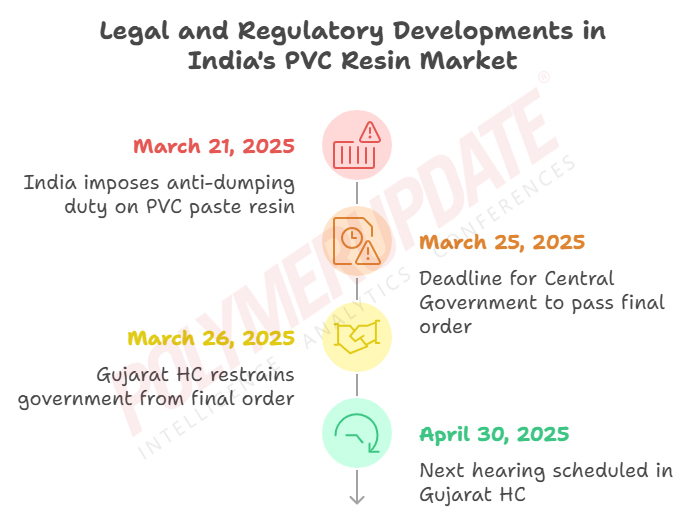 Prayers and arguments
The applicant, Epigral Ltd. (formerly Meghmani Finechem Ltd.), prayed that the Central Government or any other relevant authorities be restrained from taking any steps pursuant to the Disclosure Statement until the petition is disposed of. Additionally, the applicant sought ex-parte ad interim relief in this petition, along with any other and further relief deemed necessary in the interest of justice.
Advocate Mihir Joshi, appearing on behalf of the applicant, submitted that the Special Civil Application has already been heard and is awaiting judgment. He argued that under the provisions of the Customs Tariff (Identification, Assessment, and Collection of Anti-Dumping Duty on Dumped Articles and for Determination of Injury) Rules, 1995, the respondent authority is required to pass an order within a period of 12 months, which expires today, March 25, 2025. Joshi emphasized that if a final order is passed by the respondent authority, the entire Special Civil Application and the subsequent decision by this Court would become infructuous, leading to a multiplicity of proceedings.
Advocate Ankit Shah, representing the government authorities, opposed Joshi’s argument. Shah contended that the respondents have not been restrained from proceeding with the hearing and are, therefore, bound to pass an order today, given that the 12-month period expires on March 25, 2025, as the case was initiated on March 26, 2024.
In his arguments, Advocate Pragyan Pradeep Sharma, appearing on behalf of the Central Government, submitted that significant prejudice would be caused if the government is restrained from passing the final order. He further pointed out that no such levy has been imposed during the pendency of the petition before this Court.
Triggers
The relevant authorities under the Ministry of Commerce & Industry, i.e., the Directorate General of Trade Remedies (DGTR), initiated an investigation about a year ago into the possible dumping of certain grades of PVC resin, which is used in the manufacturing of Chlorinated Polyvinyl Chloride (CPVC). According to industry sources, such grades are not manufactured domestically, and India is entirely reliant on imports from various countries to meet its domestic demand. While the investigation is ongoing, the authorities have not disclosed any final findings yet.
“The imposition of anti-dumping duty (ADD) will increase raw material costs, potentially leading to the replacement of certain goods within the plastics industry. Eventually, the ADD will make downstream products costlier as well, given that India is entirely reliant on imports. India will continue to face a supply deficit due to rising demand until players such as Reliance Industries Ltd. (RIL) and Adani begin commercial production. Until then, raw materials should remain affordable to keep Indian products competitive in the export market. Hence, the ADD on PVC Paste resin may prove counterproductive,” said a senior industry official.
Levied on PVC Paste resin
India has imposed an anti-dumping duty (ADD) of up to US$ 707 per tonne on imports of polyvinyl chloride (PVC) paste resin from China and five other countries, including Korea, Malaysia, Norway, Taiwan, and Thailand. This measure aims to protect the interests of domestic producers and prevent the use of substandard plastic raw materials in downstream industries. The ADD, initially levied for five years unless revoked earlier, is intended to shield domestic manufacturers from injury as identified by investigating authorities and claimed by local producers.
A notification from India’s Ministry of Finance, dated March 21, 2025, states, “The Central Government has imposed provisional anti-dumping duty on Polyvinyl Chloride Paste Resin falling under the relevant tariff items of the Customs Tariff Act, originating in or exported from China PR, Korea RP, Malaysia, Norway, Taiwan, and Thailand, and imported into India. The designated authority confirmed that PVC paste resin exported to India from these countries is being dumped at below-market prices, causing material injury to the domestic industry.”
According to the notification, PVC paste resin originating from China and manufactured by any producer other than Shenyang Chemical Co. Ltd., and exported from anywhere, will attract the highest ADD of US$ 707 per tonne. However, PVC paste resin manufactured by Shenyang Chemical Co. Ltd. will be subject to an ADD of US$ 248 per tonne. Similarly, goods produced in any other country, originating from anywhere other than China, Korea, Malaysia, Taiwan, Thailand, and Norway, and exported from China, will also attract an ADD of US$ 707 per tonne.
PVC paste resin exported from Malaysia, whether produced by local manufacturers or any other producer globally, will attract an ADD of US$ 516 per tonne. Imported goods from Korea have been subjected to an ADD of US$ 89 per tonne, while imports from Taiwan fall within the range of US$ 247–373 per tonne. Imports from Thailand will face an ADD between US$ 343–421 per tonne, and producers or exporters from Norway will need to pay an ADD of US$ 495 per tonne for their PVC paste resin exports to India.
DILIP KUMAR JHA
Editor
dilip.jha@polymerupdate.com


