Crude oil prices ended the past week with a decline of around 5 percent, touching the lowest level in eight months due to an extended period of global economic recession, which may paralyze energy demand from households and factories in the future. The United States and China, the largest and second-biggest economies in the world, are still facing exorbitant interest rates, high inflation, and elevated levels of unemployment - three important indicators that signify economic challenges in these countries and spill over to other developed and developing nations with a lag. The escalating tensions in the Middle East, coupled with massive output cuts by the Organisation of Petroleum Exporting Countries (OPEC) and its allies (OPEC+), failed to make any significant impact with supply fears.
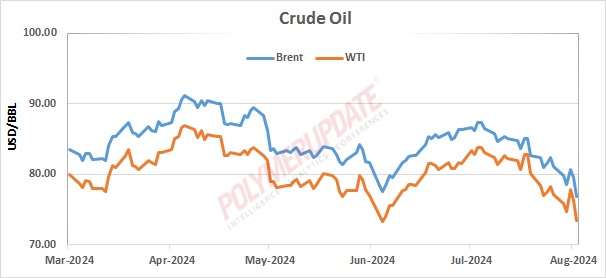
Data compiled by Polymerupdate Research showed the benchmark Brent crude futures for near-month delivery on the Chicago Mercantile Exchange (CME) declined steadily by 5.32 percent in the previous week to touch US$76.81 a barrel, compared to US$81.13 a barrel registered at the close of the previous week. This level of Brent crude futures was earlier seen in the first week of December 2023. Since then, Brent crude futures remained elevated as the OPEC+ cartel announced a cumulative output cut of 5.86 million barrels per day (bpd).
Following the trend, the Western Texas Intermediate (WTI) futures for near-month delivery on the New York Mercantile Exchange (Nymex) plunged gradually by 4.72 percent last week to US$73.52 a barrel from US$77.16 a barrel in the previous week. The downward sentiment across crude oil futures was supported by a handful OPEC+ members who failed to abide by the approved volume of production cut amid fears of a harmful impact on their economies. Oil dependent countries such as Saudi Arabia experienced a counterblast of the proposed crude oil production cut, with a contraction in their economic growth.
 Recession fears
The weak demand trend can be attributed to the negative sentiment across the United States and China. The US gross domestic product (GDP) growth moderated to 2.1 percent in the first half (January –June) of the year, down from 3.1 percent last year. Private domestic final purchases (PDFP), which excludes inventory investment, government spending, and net exports and usually sends a clearer signal on underlying demand, grew at a 2.6 percent pace over that same period in the first half, due to moderation in job gains and rising unemployment rate, despite easing retail inflation towards the target threshold of 2 percent.
Considering moderation in job gains and rising unemployment rate despite easing retail inflation towards the target threshold of 2 percent, the United States Federal Reserve (US Fed) kept the key interest rates unchanged for the eighth meeting in a row at 5.25-5.5 percent, the highest level in 23 years. The decision was taken unanimously after two days of deliberations of the United States Federal Open Market Committee (FOMC) concluded on July 31, 2024. However, the US Fed hinted at a possible cut in its September meeting. The US economy is also undergoing a Presidential Election test. Goldman Sachs has increasing probability of economic recession in the US to 25 percent from 15 percent earlier.
Apparently, the US economy has made considerable progress toward both goals over the past two years. The labour market has come into better balance, and the unemployment rate remains low. Inflation has eased substantially from a peak of 7 percent to 2.5 percent. Economists are confident in returning inflation to the US Fed’s 2 percent goal in support of a strong economy. Investment in equipment and intangibles has picked up from its anaemic pace last year. In the housing sector, investment stalled in the second quarter after a strong rise in the first. Improving supply conditions have supported resilient demand and the strong performance of the United States economy over the past year.
Meanwhile, China’s official agency National Bureau of Statistics (NBS) reported faster industrial growth at 3.6 percent in June compared to 0.7 percent gain registered in May. For the January-June 2024 industrial growth remained stable at 3.5 percent compared to 3.4 percent registered during the January-May 2024 period. However, the recovering growth in the industrial output was contrasted by a slowing economy across other sectors.
The April-June 2024 quarter growth forecast of the consumer sector indicates weakness amid job market woes and a protracted housing downturn. Alarmingly, roughly half of more than 10 mainland-listed beverage firms in China had released forecasts for January-June 2024 earnings forecasts with a loss-making period. China, the world’s second-biggest economy, is trying to provide heavier monetary stimulus to prop up its fragile economy, surpassing markets for a second time by conducting an unscheduled lending operation at steeply lower rates.
Rahul Kalantri, VP Commodities of Mehta Equities Ltd, stated, “Crude oil exhibited significant price volatility, marking its fourth consecutive week of decline following disappointing US job data. Friday's US Nonfarm Payrolls figures fell short of investor expectations, compounded by a dismal ISM Manufacturing PMI report, which heightened concerns about the health of the US economy. The Japanese Yen demonstrated a strong gain against the US dollar, exerting additional pressure on oil prices. Concerns over Chinese demand and fears of a US recession continue to weigh on global oil prices.”
Heaps of missiles in the Middle EastThe Middle East conflicts have escalated in recent days with the assassination of Ismail Haniyeh, the leader of the Palestinian Islamist group Hamas, in Tehran on Wednesday, a day after an Israeli strike in Beirut killed Fuad Shukr, a senior military commander from Hezbollah. With these incidents, Israel is facing multi-front Missile attacks from Iran and other neighbouring countries. According to reports, both militant groups are supported by Iran. Responding to these missile attacks, the United States has announced to deploy additional military forces to the Middle East as a defensive measure aimed at de-escalating regional tensions, and dispatched warships to take position in case of any eventuality to Israel.
Meanwhile, OPEC+, cumulatively accounting for nearly a third of global supply, has decided to pause the proposed gradual unwinding of the voluntary output cut from October due to unfavourable market conditions including weak global demand, and increasing supply from non-OPEC+ countries such as the United States. OPEC+ countries exerted pressure on participating members to conform the voluntary production cuts as decided in the previous ministerial meetings. The OPEC+ is currently exercising an output cut of a total of 5.86 million barrels per day (bpd), or about 5.7 percent of global demand.
DILIP KUMAR JHA
Editor
dilip.jha@polymerupdate.com



