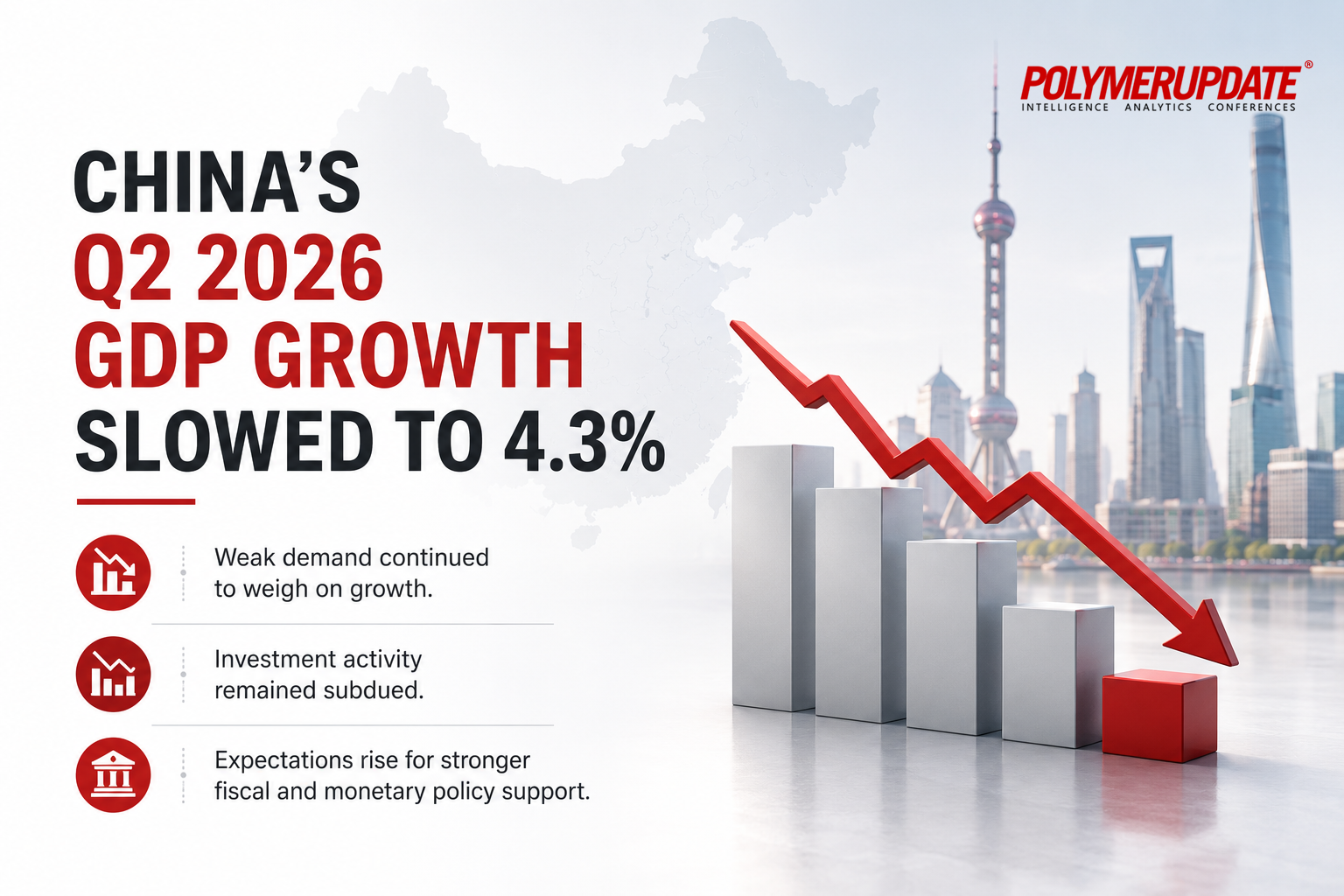
China's economic recovery lost significant momentum in the second quarter of 2026 as slowing domestic demand, weak consumer spending and a worsening investment downturn pulled growth to its slowest pace since the pandemic. The slower-than-expected growth momentum strengthens expectations that Beijing will introduce additional policy support in the months ahead.
Official data showed China's Gross Domestic Product (GDP) expanded 4.3 percent year-on-year in the April-June quarter (Q2), slowing from 5.0 percent growth in the first quarter and falling short of market expectations of 4.5 percent. The reading marked the weakest quarterly performance since the lockdown-hit fourth quarter of 2022, highlighting that underlying economic weakness has become increasingly difficult to ignore.
Despite the slowdown, China's economy expanded 4.7 percent in the first half of 2026, keeping growth broadly within the government's full-year target range of 4.5-5 percent. However, economists believe the latest data point to mounting pressure on policymakers to step up fiscal and monetary stimulus to prevent further deceleration during the second half of the year.
Lynn Song, Chief Economist, Greater China, ING Economics, commented, “China's growth slowed to 4.3 percent year-on-year in the second quarter, the slowest quarterly pace since the pandemic. Though June saw better industrial production and retail sales, the investment slump worsened. Weak domestic demand also weighed on overall momentum. Growth remains within the target range, but pressure for policy support may be increasing.”
 Deteriorating high-frequency indicators
The weaker GDP figures were accompanied by deteriorating high-frequency indicators that painted a bleak picture of domestic activity. Fixed asset investment slipped deeper into contraction, retail spending remained subdued despite a modest recovery in June, while exports continued to face pressure from an increasingly uncertain global environment.
The services sector remained the economy's brightest spot. China's tertiary industry expanded 5.2 percent year-on-year in the second quarter, comfortably outpacing the 3.9 percent growth in the secondary sector and 3.7 percent in primary industries. The stronger services performance reflected Beijing's continued emphasis on developing higher-quality service industries even as manufacturing and construction lost momentum.
Stabilising consumer spendingConsumer spending showed tentative signs of stabilisation in June, although demand remained far from robust. Retail sales returned to positive territory with 1.0 percent year-on-year growth, rebounding from a 0.6 percent contraction in May and exceeding market expectations for a marginal decline.
Even so, retail sales grew only 1.3 percent during the first half of the year, underscoring persistent weakness in household spending. In contrast, services consumption remained relatively resilient, rising 5.4 percent year-on-year during the same period, indicating that Chinese consumers continue to shift spending from goods towards services.
Several structural factors weighed heavily on retail sales. Automobile sales plunged 16.1 percent year-on-year, reflecting weaker replacement demand following years of stimulus-driven purchases and the ongoing transition towards electric vehicles. Petroleum product sales also declined 5.1 percent, mirroring the rapid adoption of EVs.
Song further stated, “The larger backdrops to the weak consumption story are dumb consumer confidence and the impact of China's trade-in policy shifting from tailwind to headwind after front-loading demand in previous years. We are now dealing with the blowback, with beneficiary categories such as autos, household appliances, and furniture particularly hit hard. We're looking for consumption to be a primary policy target in the second half of the year. This could take the form of another wave of trade-in policy expansion, which may have diminishing returns, or policy support to boost services consumption.”
Property market weaknessThe prolonged property downturn continued to hurt demand for household-related products. Sales of household appliances fell 8.7 percent, furniture declined 6.6 percent, while building and decoration materials dropped 10.5 percent, highlighting the continued weakness in China's housing market.
Gold and jewellery sales also contracted 3.4 percent following a sharp decline in gold prices.
Nevertheless, pockets of consumer strength remained evident. Sales of communication devices surged 16.5 percent, while cultural and office supplies rose 12.7 percent, cosmetics increased 12.6 percent, and alcohol and tobacco sales advanced 12.2 percent, suggesting discretionary spending has not completely disappeared.
Industrial production upIndustrial production, meanwhile, provided one of the few positive surprises. Factory output accelerated to 5.3 percent year-on-year in June, up from 4.5 percent in May and comfortably ahead of expectations. Industrial production expanded 5.4 percent during the first half of the year, making it one of China's strongest-performing economic indicators.
Manufacturing output increased 6 percent, supported by continued strength in high-technology industries. High-tech manufacturing expanded 14.1 percent, while semiconductor production jumped 25.4 percent, the fastest pace in 17 months, reflecting sustained investment in strategic technologies and strong global demand for advanced electronics.
Export-oriented industries continued to outperform the broader economy. Production in railways, ships and aerospace rose 18.2 percent, computer and electronic equipment manufacturing grew 15.7 percent, while automobile production increased 8.7 percent, despite weak domestic vehicle sales.
Lack of private investmentPrivate sector investment fell to (-)8.5 percent year-on-year year-to-date (ytd), worsening from a (-)7.1 percent decline over the first five months. State-owned investment also fell further into contractionary territory, down to (-)2.3 percent yoy ytd from (-)0.4 percent in the first five months. This sends a clear signal that public sector investment is no longer acting as a stabilising force after a decent start to the year. Against a backdrop of elevated global uncertainty, both private and state-owned enterprises appear to be postponing capital expenditure plans, adding to an already weak investment environment.
By industry, the divergence remains extreme. Sectors related to external demand and industrial upgrading continued to attract investment, including rail, ships, and aerospace (24.7 percent), textiles (9.4 percent), and computer and electronics manufacturing (6.5 percent). High-tech investment continued to grow at 4.6 percent yoy ytd.
However, these bright spots were the exception. Manufacturing investment overall was soft at -1.2 percent yoy ytd, and would've looked even worse if not for strong investment in rail, ships, and aerospace at 24.7 percent yoy ytd. Infrastructure investment fell into negative territory, down to -2.4 percent yoy ytd, after managing positive growth over the first five months of the year. Many other categories, especially in the tertiary sector, saw double-digit year-on-year declines in investment.
The persistent lack of investment appetite continues to feed through to subdued credit demand, driving banks to park yet more funds in government bonds. Accelerating project approvals, special local government bonds, and more fiscal transfers look increasingly necessary to help stabilise the sharp deceleration of investment. The FAI data has been increasingly out of sync with the gross fixed capital formation data and overall GDP. It’s worth watching to see if this is again the case when the detailed data is released in the coming days.
OutlookOverall, ING Economics expects China to be able to hit its full-year growth target of 4.5-5 percent. As things stand, risks to its 4.7 percent yoy full-year GDP forecast look balanced to the downside. It’s uncertain how long it will take to announce and roll out policy support to arrest the downward momentum. Without support, China’s economy is likely to see growth continue to grind lower. However, as China is in the first year of the 15th Five-Year period, it's likely that policymakers would prefer not to come in at the low end of this band, thereby raising the stakes for the upcoming Politburo meeting.
DILIP KUMAR JHA
Editor
dilip.jha@polymerupdate.com



