India has taken a significant step towards improving the measurement of its services-driven economy with the launch of the Index of Services Production (ISP), a new high-frequency indicator developed by the Ministry of Statistics and Programme Implementation (MoSPI). The index is expected to fill a long-standing gap in tracking the performance of the country's largest economic sector, which contributes more than half of India's Gross Value Added (GVA) and employs nearly one-third of the workforce.
The services sector has emerged as the principal engine of India's economic growth over the past two decades, driven by robust domestic consumption, rapid digitalisation, expanding financial services, and rising exports of information technology and business services. Despite its dominant contribution to the economy, policymakers and analysts have lacked a comprehensive, high-frequency indicator to monitor short-term movements in services output.
 Current practice
Until now, assessments of the sector relied largely on fragmented indicators such as railway and air passenger traffic, cargo movement, banking activity and the Purchasing Managers' Index (PMI) Services. While the PMI provides valuable insights into business sentiment and expansion or contraction in services activity, it is not designed to measure the actual size or growth of the sector.
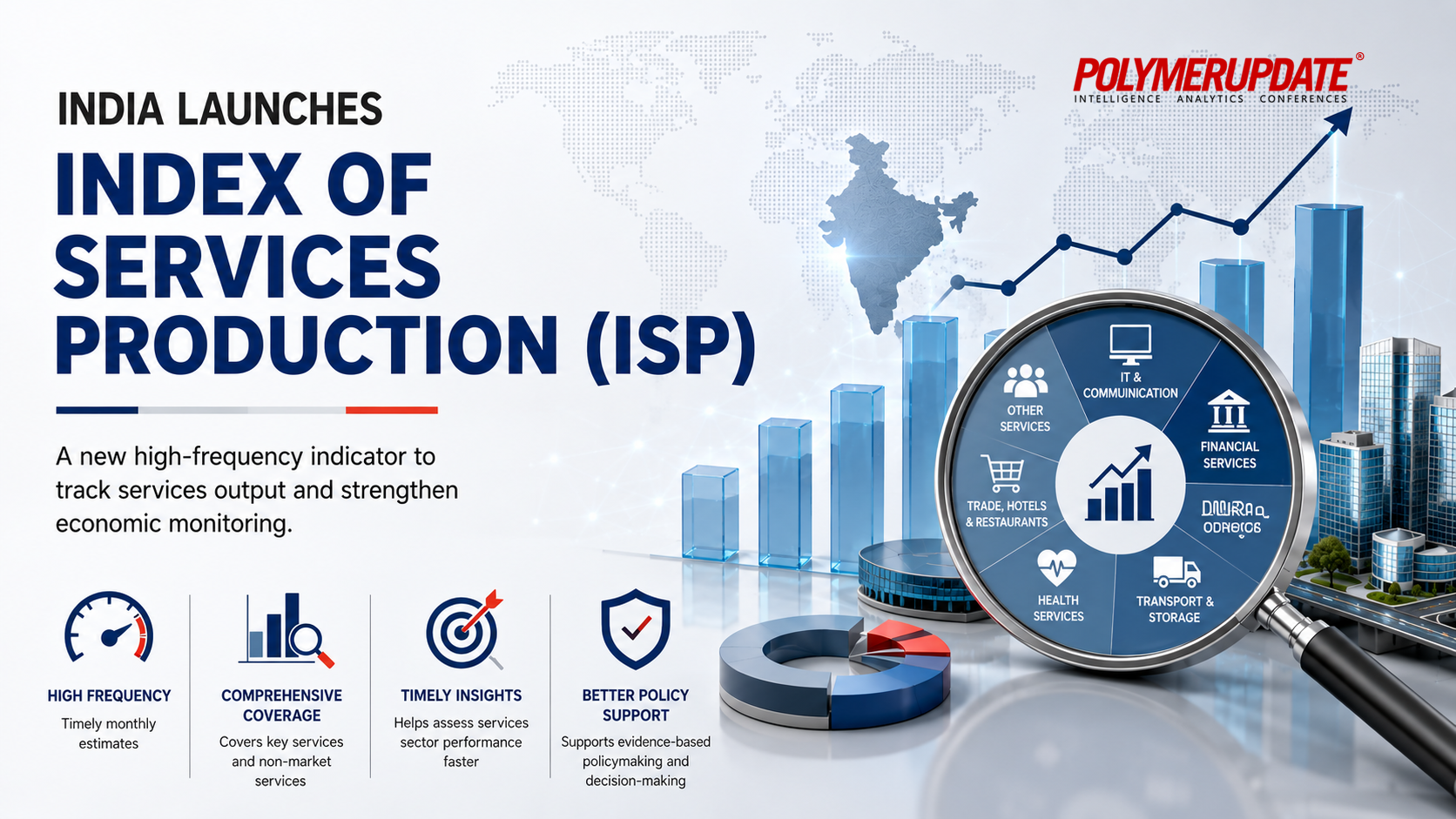
The newly introduced ISP seeks to address this limitation by providing a systematic, timely and internationally aligned measure of changes in service sector output. The index has been designed to improve consistency and comparability across time while providing policymakers, businesses and investors with a more reliable gauge of India's services economy.
Base year changesFor its inaugural release, the ISP adopts 2024-25 as the base year, chosen as a recent and structurally stable reference period that is broadly aligned with the revised Consumer Price Index (CPI) series. The index currently covers 19 service sub-sectors, representing around 60 percent of India's services GVA.
The coverage spans a wide range of formal economic activities, including wholesale and retail trade, transport, warehousing, accommodation and food services, postal and courier services, telecommunications, real estate, information technology, professional and technical services, arts and entertainment, among others. A notable feature of the new index is its extensive use of administrative and digital data sources. Output estimates for 15 sub-sectors are derived primarily from Goods and Services Tax (GST) data, reflecting the growing role of digital tax records in economic statistics.
Agency-driven approachFor sectors where administrative information offers better coverage, the ISP draws upon data from specialised agencies. Railway services are measured using Railway Board statistics, air transport activity is sourced from the Directorate General of Civil Aviation (DGCA), banking data is obtained from the Reserve Bank of India (RBI), while insurance sector estimates are based on information from the Insurance Regulatory and Development Authority of India (IRDAI).
Unlike traditional sample-based surveys, the ISP employs a universe approach, covering the entire formal services sector rather than a representative sample of enterprises. This methodology enables the index to automatically capture the entry and exit of firms, making it more responsive to structural changes in the economy. MoSPI has clarified that the current weights assigned to individual sub-sectors are provisional, based on the recommendations of the Technical Advisory Committee, and are likely to be revised as the database expands and methodology evolves.
First set of dataThe first set of data points to broad-based strength in India's formal services economy. In April 2026, 14 of the 19 covered sub-sectors recorded double-digit year-on-year growth, while nearly every sub-sector registered positive expansion. One notable exception was air transport services, which contracted 13.9 percent year-on-year, reversing the 4.5 percent growth recorded in April 2025. The decline is widely attributed to geopolitical tensions and disruptions to international air travel, which adversely affected passenger traffic during the month.
Despite weakness in aviation, overall services activity remained supported by resilient domestic demand and healthy growth in India's services exports, reinforcing the sector's role as a stabilising force for the broader economy. The present version of the ISP, however, does not capture the entire services economy. Several important activities remain outside its scope because of data limitations or separate statistical treatment.
A third among excluded sectorsExcluded sectors account for nearly 33 percent of services GVA and include public administration and defence, central banking and certain financial services such as pension and money market funds. Several GST-exempt or largely informal activities—including social work, gambling and betting, membership organisations, personal services, private household services and extraterritorial organisations—are also excluded from the current framework.
Another limitation is that the ISP focuses exclusively on the formal sector, as both GST records and the Annual Survey of Incorporated Service Sector Enterprises (ASISSE) primarily capture GST-registered and company-registered businesses. Consequently, a substantial portion of informal service activities remains outside the index.
Potential future expansionMoSPI has indicated that future expansions will include health and residential care, education and ownership of dwellings, increasing the coverage of the index over time. The ministry has also suggested that data from the Annual Survey of Unincorporated Sector Enterprises (ASUSE) could eventually support the development of a separate quarterly Gross Value Added-based measure for the informal services sector.
The methodology also incorporates price adjustments to estimate real output. Wholesale Price Index (WPI) data are currently used as the deflator for wholesale trade, while sector-specific Consumer Price Index (CPI) series—or appropriate proxy indices—are used for other services. General CPI serves as the deflator for banking, insurance, repair and maintenance services, whereas CPI-Services is applied in sectors lacking dedicated price indices.
A significant milestoneRajani Sinha, Chief Economist, Care Ratings Ltd believes that the introduction of the ISP represents an important milestone in India's statistical system. As the economy becomes increasingly services-led, a robust and timely indicator of services output will strengthen economic analysis, improve policy formulation and enhance the monitoring of growth trends.
While the current index covers only about three-fifths of the sector, its gradual expansion towards the government's target of approximately 80 percent services GVA coverage will make it an increasingly comprehensive barometer of India's largest and fastest-evolving economic engine.
DILIP KUMAR JHA
Editor
dilip.jha@polymerupdate.com



