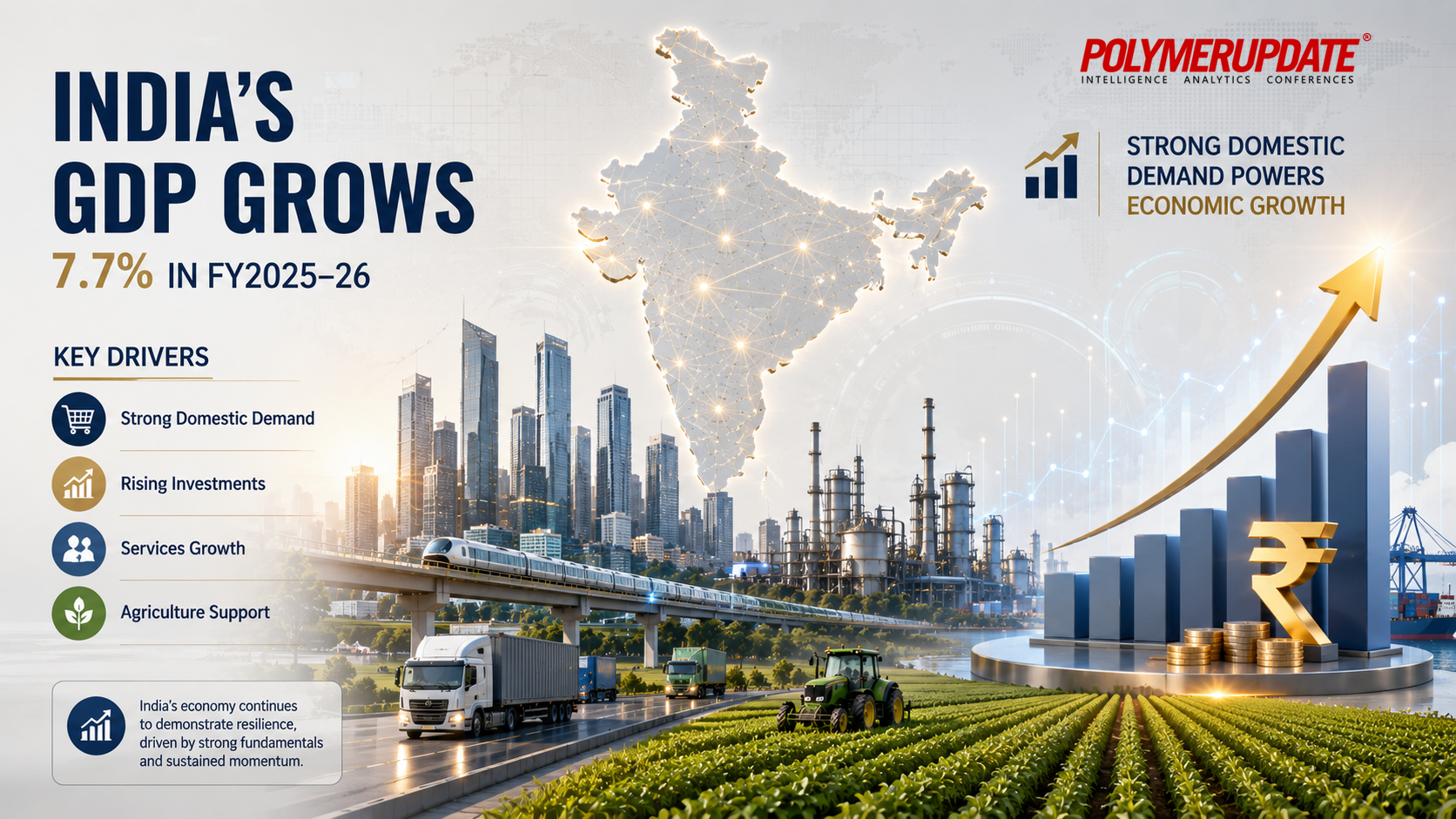
India’s economy closed FY2025-26 (April-March) on a stronger-than-expected note, with provisional estimates indicating gross domestic product (GDP) growth of 7.7 percent, marginally higher than the second advance estimates of 7.6 percent, underscoring the resilience of domestic demand, robust investment activity, and a broad-based recovery across key sectors, the Ministry of Statistics & Programme Implementation (MoSPI) said in a statement released on Friday. Nominal GDP growth for the fiscal year has also been revised slightly upward to 8.9 percent, taking the size of the economy to approximately Rs 345 lakh crore (Rs 345 trillion).
The latest numbers reflect buoyancy in agriculture, services, finance, and construction, while manufacturing growth moderated slightly due to revisions based on updated corporate data. The upward revision in overall GDP growth was aided by an improvement in agricultural performance, with the sector expanding by 3 percent during FY26. Economists attributed the better-than-expected outcome largely to a stronger rabi harvest and favourable crop output during the latter half of the fiscal year.
Madan Sabnavis, Chief Economist, Bank of Baroda, commented, “The provisional estimates on growth for FY26 stands now at 7.7 percent which is marginally above the second advance estimates of 7.6 percent. Nominal GDP growth is now marginally higher at 8.9 percent with an absolute value of Rs 345 lakh crore. These numbers do indicate buoyancy for sure. However, there will be moderation in FY27 and post RBI credit policy we project growth in region of 6.4-6.6 percent for the year.”
 Sector-wise performance
Mining activity also registered a significant upward revision, growing by 5.2 percent compared to the earlier estimate of 4.1 percent. Analysts said improved mineral output and steady demand from infrastructure and industrial sectors supported the rise. Manufacturing growth, however, was revised downward to 10.7 percent from the earlier estimate of 11.5 percent. The moderation is being viewed more as a statistical adjustment rather than a sign of weakness in industrial activity. The provisional estimates incorporated actual corporate financial data, replacing earlier assumptions and projections used in advance estimates.
Construction activity remained one of the key drivers of growth during the year, expanding by 7.4 percent. Strong momentum in road construction, urban infrastructure, and sustained housing demand contributed to the sector’s healthy performance. Government-led capital expenditure and improving private sector participation also supported activity levels.
The services sector continued to demonstrate robust momentum. Trade, transport, hotels, and communication services recorded growth of 11 percent, reflecting rising mobility, increased consumer spending, and higher travel and tourism activity across the country. Improved passenger traffic, hospitality demand, and logistics activity were among the major contributors. The financial sector also witnessed stronger growth during FY26, supported by impressive expansion in both deposits and credit within the banking system. Higher lending activity across retail, housing, and industrial segments, along with strong deposit mobilisation, helped sustain momentum in financial services.
Steady investment activityInvestment activity remained steady during the fiscal year. The capital formation rate, considered a proxy for investment demand, edged up marginally to 31.9 percent. Economists believe the increase reflects broad-based investment participation from both public and private sectors, indicating continued confidence in medium-term economic prospects.
Despite the stronger FY26 performance, economists expect growth moderation in FY27 due to external uncertainties and tighter global financial conditions. Following the recent monetary policy stance adopted by the Reserve Bank of India (RBI), growth projections for FY27 are currently estimated in the range of 6.4 to 6.6 percent. Corporate earnings performance during the quarter also remained supportive, while government spending and consumption demand sustained overall growth momentum.
Analysts noted that while domestic demand remains supportive, geopolitical tensions, elevated commodity prices, and slower global trade growth may weigh on economic momentum in the coming quarters. The economy also ended FY26 with a strong fourth-quarter showing. GDP growth during the January-March quarter stood at 7.8 percent, suggesting that the impact of global geopolitical tensions and the ongoing conflict in parts of the Middle East remained relatively muted on domestic economic activity.
Farm activity and constructionAgriculture expanded by 3.6 percent in the fourth quarter, aided by the rabi harvest and improved crop output. Mining and power sectors recorded growth of 5.4 percent and 4.1 percent respectively, though analysts pointed out that coal production and electricity demand remained somewhat restrained during the period. Construction activity accelerated further to 8.4 percent in the fourth quarter as infrastructure projects and public works gathered pace toward the fiscal year-end. Project execution by both central and state governments contributed significantly to the expansion.
Services sectors including trade, transport, hotels, communication, and financial services continued to register strong double-digit growth during the quarter, highlighting the resilience of domestic consumption and the sustained momentum in services-led economic expansion. Rising travel and tourism activity, improved mobility, higher consumer spending, and robust banking sector performance contributed significantly to the growth momentum. The strong expansion across these segments also reflected improving business confidence and healthy demand conditions in the broader economy.
Public administration slowsOne area that witnessed relatively slower growth was public administration, defence, and other services, which expanded by 5.8 percent during the quarter. Economists attributed the moderation primarily to fiscal restraint exercised by both the Centre and state governments in order to adhere to fiscal deficit targets.
A particularly encouraging aspect of the fourth-quarter data was the strong rise in both consumption and investment expenditure. Private consumption expenditure grew by 9.5 percent, while capital formation expanded by 13.2 percent, indicating that government measures aimed at stimulating spending and investment during the year had yielded positive results.
The latest GDP data reinforces the view that India continues to remain among the fastest-growing major economies globally. While growth is expected to moderate somewhat in FY27, the current momentum in investment, services activity, and domestic demand provides a strong foundation for sustained economic expansion over the medium term.
DILIP KUMAR JHA
Editor
dilip.jha@polymerupdate.com



