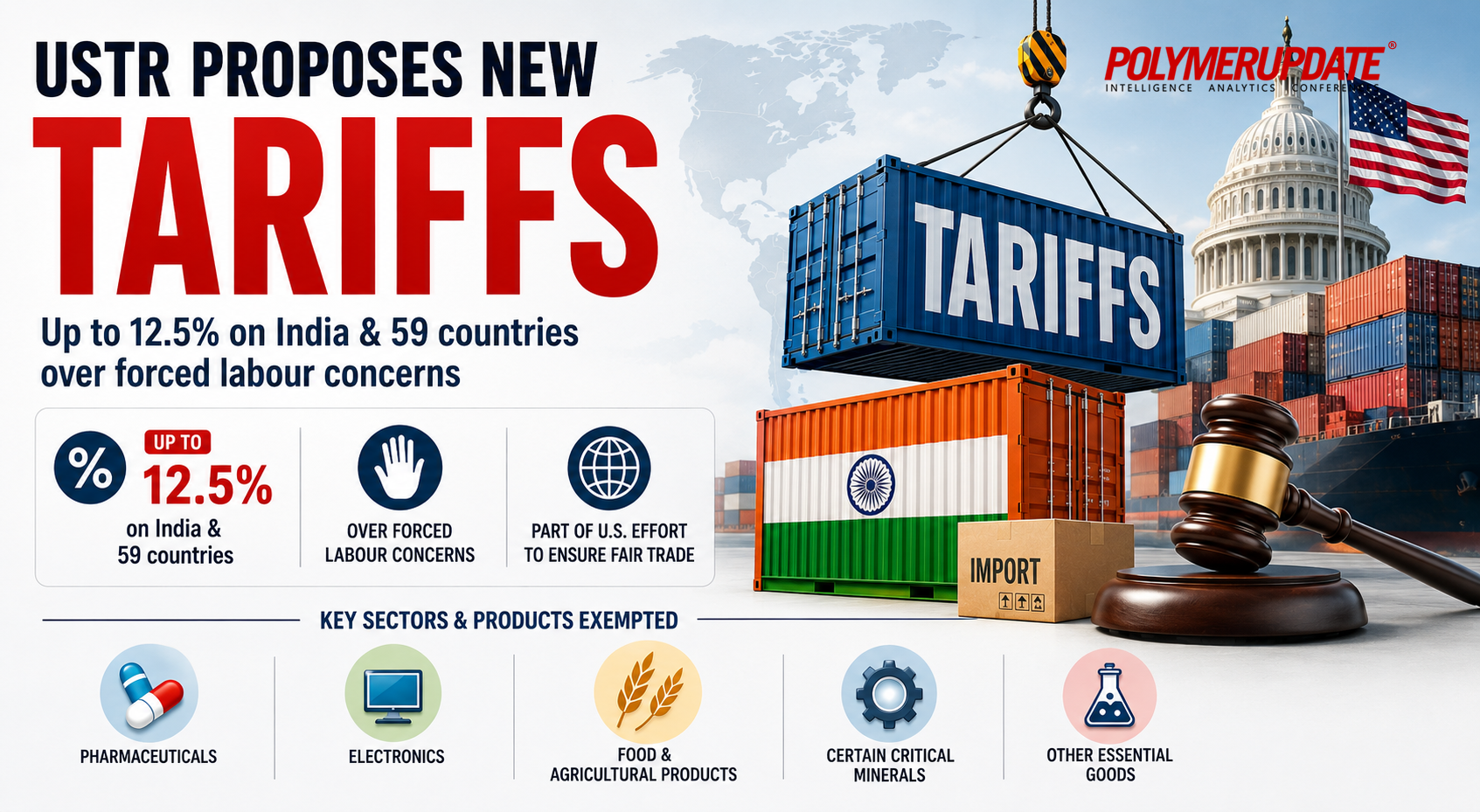
The United States Trade Representative (USTR), under the Ministry of Trade in President Donald Trump’s administration, has proposed an additional tariff of 10 percent and 12.5 percent on India and 59 other countries after finding that goods shipped to the world’s largest economy were produced using forced labour. While the European Union and the United Kingdom have been placed among 15 countries under the 10 percent additional tariff bracket, countries such as Australia, China, India, Japan, and New Zealand have been categorised under the 12.5 percent additional import duty bracket.
Issued late on Tuesday, the USTR proposal came after the completion of a Section 301 investigation into unfair trade practices and is designed to help rebuild Trump’s emergency tariffs that were struck down by the U.S. Supreme Court in February this year. The Supreme Court verdict forced the Trump administration to refund billions of U.S. dollars to exporting countries that had paid the duties while shipping goods to the United States. The emergency duties were later rationalised through bilateral trade agreements following weeks and months of intense negotiations.
 Textile mechanism
The Office of the United States Trade Representative (USTR) said it was also proposing a dedicated textile mechanism that would permit a specified volume of apparel and textile imports to enter the U.S. market at a reduced tariff rate. While the USTR did not disclose the exact duty concessions or import volumes under the proposed framework, the move is aimed at providing greater market access for textile-exporting countries while ensuring safeguards for domestic manufacturers.
The proposed mechanism is expected to benefit global apparel supply chains by improving cost competitiveness and facilitating smoother trade flows in textile products. Industry participants are likely to closely monitor further details regarding tariff thresholds, quota limits, and product coverage, as these factors will determine the extent of commercial gains for exporters and the potential impact on the U.S. textile industry.
Unilateral tariff unjustifiedWhile the USTR has scheduled a public hearing on the matter for July 7 and advised individual countries and trade associations to submit their suggestions and objections before the scheduled date, countries likely to be affected by the additional tariffs have termed the unilateral duties unjustified. Meanwhile, Trump’s new tariff proposal has been announced ahead of the July 24 expiry of the temporary 10 percent tariff imposed on February 20. The European Commission described the tariffs as unjustified, while reiterating its commitment to the trade deal signed with Washington last year that fixed tariffs at 15 percent.
Reacting to the proposed tariff measures, Beijing, which faces a 12.5 percent tariff rate, said it opposed all forms of unilateral tariffs and maintained that there was no forced labour in China. India, also subject to the same tariff rate, said it was actively engaging with Washington on the Section 301 proceedings and emphasized that the proposed duties were not yet final. Meanwhile, Taiwan said it remained “hopeful and confident” that the final outcome would reflect understandings already reached with the United States, enabling it to secure relatively preferential treatment under the proposed framework.
ExemptionsIn its forced labour-related findings, the Office of the United States Trade Representative (USTR) said several categories of products would be exempted from the proposed tariffs. These exemptions include energy products, rare earths and certain other metals, along with a range of agricultural and industrial goods such as beef, coffee, selected fruits and vegetables, pharmaceuticals, organic chemicals, and aircraft parts. The exclusions are aimed at limiting disruptions to critical supply chains and ensuring continued access to strategically important commodities and industrial inputs.
The USTR also said it would invite public comments on the proposed tariff measures and other remedies through July 6, providing stakeholders an opportunity to present their views on the potential economic and trade implications of the action. A public hearing on the proposals has been scheduled for July 7, following which the agency is expected to review submissions and determine the final course of action under the Section 301 framework.
Section 301 investigationUSTR, a Cabinet-level agency within the Executive Office of the President, launched an investigation on March 12 under Section 301(b) of the Trade Act of 1974, which deals with unfair trade practices, against 16 countries including China, Japan, and India for the potential imposition of fresh tariffs. The move follows the Supreme Court of the United States striking down President Donald Trump’s previous duty levies imposed under the International Emergency Economic Powers Act (IEEPA). Initiated on March 11, the investigation aims to pave the way for new duties to restrict imports from these countries.
Trump’s move to launch the investigation is seen as a fresh attempt to create additional pressure on these key partner nations to strike trade deals that could favour the United States under the President’s “America First” policy and “Make America Great Again (MAGA)” agenda. Although these trade partners have undergone multiple rounds of negotiations, a final agreement has yet to be signed due to what officials describe as “unfriendly” conditions, including demands prioritising duty-free access for American goods in partner nations.
Announcing the initiation of the investigation, the USTR said it will open dockets for the submission of written comments on March 17, while the Section 301 Committee will convene public hearings on May 5. Experts believe the USTR may impose fresh tariffs on these countries as part of an effort to pressure them into reaching an immediate trade agreement.
Tariff muddleThe United States, under the administration of Donald Trump, imposed a 50 percent tariff on a broad range of imports from India, effective August 27, 2025, as a punitive measure in response to India’s continued purchases of discounted crude oil from Russia. The tariff structure comprised a 25 percent “reciprocal” duty, intended to counter what Washington described as higher tariffs and market barriers imposed by India on American goods, along with an additional 25 percent penal levy aimed at discouraging New Delhi’s energy trade with Moscow. The move marked a sharp escalation in trade tensions between the two strategic partners and affected a wide range of Indian exports entering the US market.
The Trump administration imposed a 15 percent ad valorem surcharge on certain imports with effect from February 24, 2026, following the U.S. Supreme Court’s ruling that his earlier tariff measures were unconstitutional. The surcharge was initially set at 10 percent for a period of 150 days before being raised to 15 percent. According to the administration, the measure is not a direct replacement for the previous tariffs but a temporary mechanism to continue duty collection, deemed necessary to address the balance-of-payments deficit.
The Supreme Court’s decision to strike down the reciprocal IEEPA tariffs materially reshaped the trade policy landscape. In response, U.S. President Donald Trump swiftly announced the introduction of a 15 percent across-the-board tariff, following an initial 10 percent surcharge that was raised to 15 percent on February 22. Under the new structure, the surcharge applies broadly to most imports, with several key exceptions. Products already subject to Section 232 duties — such as steel, aluminium, copper, lumber, and automobiles — are excluded to the extent that existing Section 232 tariffs remain in force. Approximately 1,100 product codes are fully exempt from the surcharge.
DILIP KUMAR JHA
Editor
dilip.jha@polymerupdate.com



