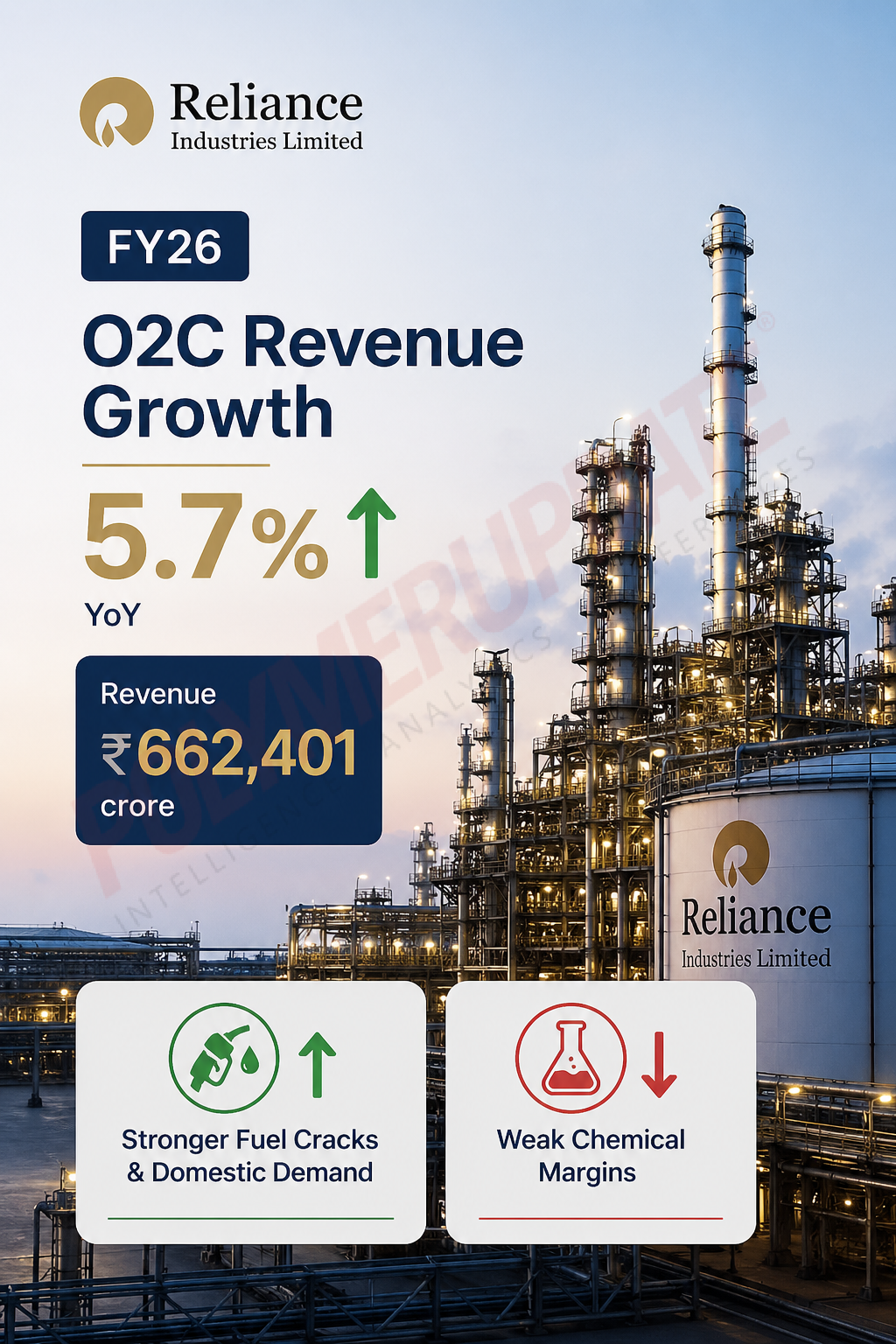
Reliance Industries Ltd (RIL), India's largest private sector conglomerate and a global leader in petrochemicals operating the world's largest refining complex in Jamnagar, Gujarat, reported 5.7 percent increase in revenue from oil-to-chemicals (O2C) business despite challenging global environment. The O2C segment revenue year-on-year rose to Rs 662,401 crore (US$ 69.9 billion), driven primarily by stronger domestic product placement and improved price realisation. The growth reflects resilient demand in the domestic market, enabling higher throughput and better monetisation across key product categories despite a mixed global backdrop.
Operational performance remained robust, with segment EBITDA increasing 10.1 percent year-on-year to Rs 60,546 crore (US$ 6.4 billion). EBITDA margins improved by 30 basis points to 9.1 percent, supported by stronger transportation fuel cracks, which enhanced refining profitability. Additional support came from efficient feedstock sourcing strategies and higher product placement through the expanding Jio-bp fuel retail network, contributing to improved realisations and operational efficiency.
However, earnings growth was partially constrained by persistent weakness in downstream chemicals margins, which continued to weigh on overall profitability. Furthermore, disruptions linked to the outbreak of conflict in the Middle East towards the end of the financial year created volatility in supply chains and pricing dynamics, limiting the full potential of margin expansion despite otherwise favourable operating conditions.
Commenting on the results, Mukesh D. Ambani, Chairman and Managing Director, Reliance Industries Limited said: “Through fiscal FY2025-26 we faced geopolitical disruptions, volatile energy prices and shifting global trade patterns. These headwinds weighed on businesses across the world. India held its economic growth course through all this, as did Reliance. The breadth of our portfolio and strong domestic orientation helped navigate volatility in the external environment. The O2C business navigated a complex global environment during the year.“
 Transportation fuel
Transportation fuel cracks strengthened sharply during the period, supported by structural tightness in the global refining system and better-than-expected demand growth across key consuming regions. Limited additions to global refining capacity, coupled with steady consumption of gasoline, diesel and aviation fuels, helped improve margins, providing a favourable environment for refiners.
However, the broader energy market remained volatile, influenced by heightened geopolitical and trade tensions. Uncertainties arising from conflicts in key regions and shifting trade dynamics led to fluctuations in crude prices and product spreads, creating an unpredictable operating landscape for the sector despite the underlying strength in fuel demand.
Ambani further added, “The war in West Asia has led to unprecedented dislocation in global supply chains. As in prior periods of disruption, Reliance has again demonstrated its commitment to ensure availability of critical energy and materials to India. Our O2C team successfully diverted streams toward scaling up LPG production, our colleagues in Jio-bp have ensured continuous availability of fuels to individuals and businesses throughout India.”
“Gas from KG-D6 Basin has been diverted towards priority sectors, in line with national energy priorities. The dedication of our teams and the agility with which they have addressed challenges facing the nation is really appreciable. Recent events have underscored the critical need of energy security. Reliance is making rapid progress in operationalizing its New Energy giga-factories,” he commented.
Price trendSingapore benchmark gasoline cracks (92 RON) averaged US$ 9.3 a barrel, marking a strong 34 percent increase over the previous period. The rise was largely driven by refinery closures in North America and Europe, which tightened global supply, along with lower gasoline exports from China that further supported margins.
Singapore 10-ppm gasoil cracks surged 63 percent to an average of US$ 23.6 a barrel, underpinned by lower inventory levels in the US and Europe and supply disruptions, including refinery outages in Russia and geopolitical tensions in the Middle East. Additionally, European Union restrictions on diesel imports derived from Russian crude contributed to the tightening supply environment, boosting cracks significantly.
Similarly, Singapore jet fuel/kerosene cracks rose sharply by 68 percent to US$ 22.8 a barrel. The increase tracked the strength in gasoil cracks and was supported by robust travel demand as well as seasonal winter heating requirements, which kept overall distillate markets firm.
Polymer market movementPolyethylene (PE) margins rose modestly by 2 percent to US$ 306 a metric tonne, supported primarily by lower naphtha prices, which helped improve spreads despite a relatively stable demand environment. In contrast, polypropylene (PP) margins declined by 5 percent to US$ 293 a metric tonne, as weak demand conditions led to a sharper fall in product prices compared to the decline in feedstock costs, exerting pressure on overall realisations.
Polyvinyl chloride (PVC) margins inched up 1 percent to US$ 363 a metric tonne, aided by a significant decline in feedstock prices, particularly ethylene dichloride (EDC), which fell around 30 percent to US$ 206 a metric tonne. Meanwhile, the polyester chain saw a marginal 1 percent decline in margins to US$ 446 a metric tonne. Polyester product deltas, especially for polyethylene terephthalate (PET), remained slightly lower due to capacity overhang, while purified terephthalic acid (PTA) margins weakened further amid continued capacity additions in China. On the other hand, paraxylene (PX) margins improved, supported by tight supply conditions and softer naphtha prices.
Q4 business performanceSegment Revenue for 4Q FY26 (January-March 2026) increased by 12.4 percent Y-o-Y to Rs 184,944 crore (US$ 19.5 billion) mainly due to sharp increase in crude oil prices by 12 percent Y-o-Y and higher volumes in domestic fuel retail. Segment EBITDA for 4Q FY26 decreased by 3.7 percent Y-o-Y to Rs 14,520 crore (US$ 1.5 billion) despite strength in transportation fuel cracks. Multiple headwinds curtailed margin capture including sharp rise in crude premiums on physical barrels, elevated freight and insurance cost and higher fuel cost.
Further, in order to protect domestic consumers, RIL diverted propane / butane to boost liquefied petroleum gas (LPG) output and KGD6 gas to priority sectors. RIL also held fuel prices at retail outlets, leading to under recoveries in fuel retailing. Reintroduction of Special Additional Excise Duty (SAED) on exports of Diesel and ATF also impacted earnings. Weak polymer deltas with sharp increase in feedstock and energy cost weighed on segment profitability.
DILIP KUMAR JHA
Editor
dilip.jha@polymerupdate.com



