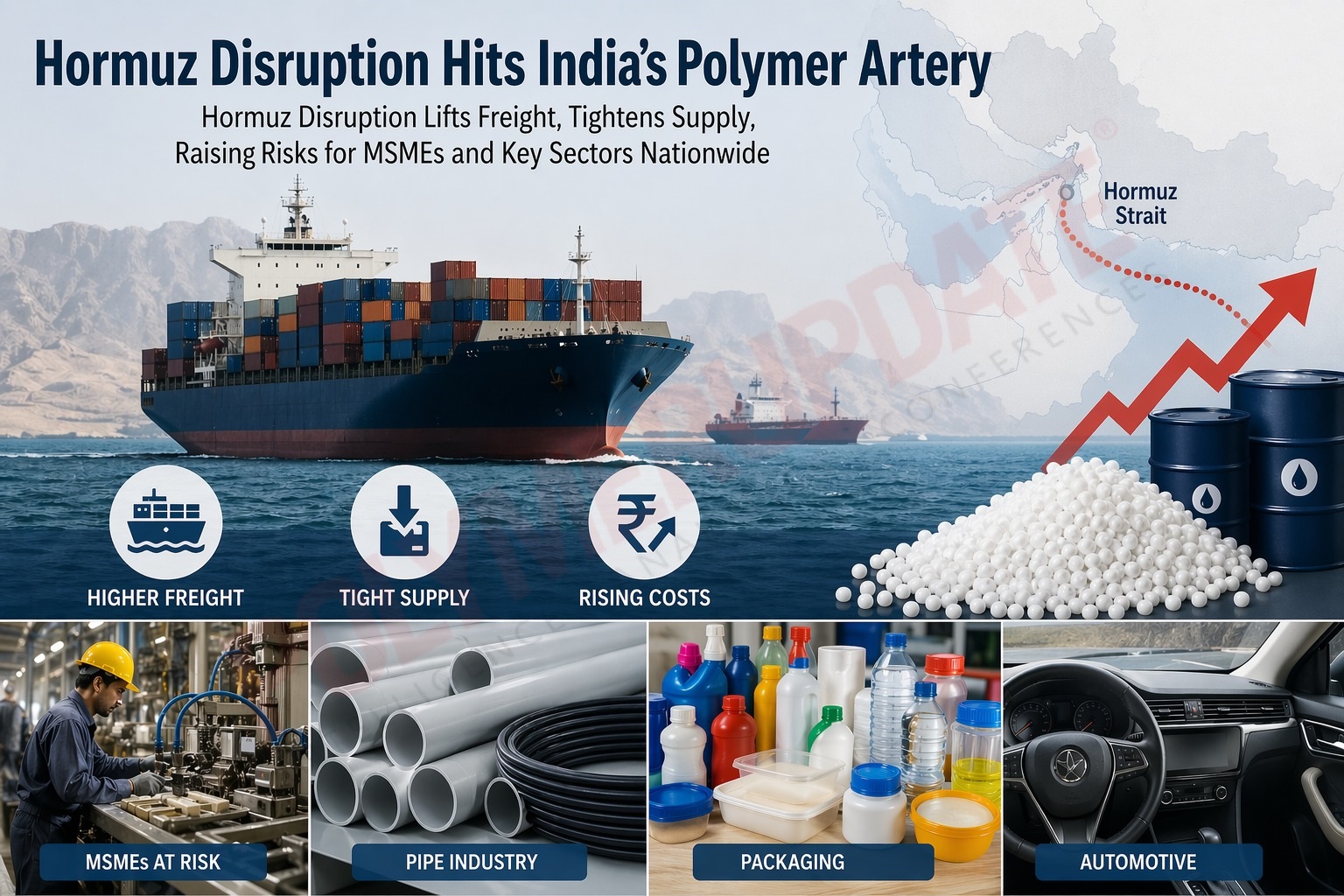
The escalating disruptions in the Strait of Hormuz have pushed India’s polymer supply outlook into a phase of prolonged uncertainty, as repeated attacks on merchant vessels and heightened geopolitical tensions continue to unsettle trade flows. With a significant share of India’s polymer and petrochemical imports routed through this narrow corridor, any sustained instability directly threatens supply continuity. The recent targeting of cargo ships, including those carrying polymer consignments destined for India, has amplified concerns among processors and traders over shipment delays, contract uncertainties, and rising transit risks.
In the longer term, the disruption is expected to reshape procurement strategies and cost structures across India’s polymer industry. Importers may be forced to diversify sourcing away from the Gulf, explore alternative logistics routes, or maintain higher inventory buffers—each of which carries cost implications. At the same time, elevated freight rates, insurance premiums, and potential supply tightness could keep domestic polymer prices volatile and biased upward. Unless tensions ease and safe passage through the Strait of Hormuz is restored, the Indian polymer market is likely to face sustained pressure, with long-term implications for manufacturing competitiveness and downstream demand.
Chintan Pushpraj Singhvi, Director, Phoenix Global Polymers Private Limited, commented, “The Indian polymer value chain is currently grappling with significant supply constraints in specific grades, with import dependence on the Middle East remaining high. India continues to import approximately 1.4 MMT of polyethylene (PE) and around 1 MMT of polypropylene (PP) from the region, underscoring its reliance on Middle Eastern suppliers for select critical grades. Since early March, there has been an acute rise in polymer prices, driven by shortages of naphtha, crude derivatives, and other key feedstocks. This has created a ripple effect across the supply chain, tightening availability and pushing costs upward. As a result, the downstream converting industry is under considerable stress, facing both elevated working capital requirements and acute material shortages, which are impacting overall business viability.”
Singhvi further added, “However, there is also a constructive shift underway. Domestic processors and downstream users are increasingly focusing on value-added and specialized products, particularly for industrial applications, to navigate these challenges. Importantly, the Indian government has demonstrated strong foresight in recognizing the long-term growth potential of the plastics and petrochemicals sector. Through proactive policy support and encouragement of large-scale petrochemical investments, it has facilitated the establishment of multiple domestic capacities, gradually reducing overdependence on imports and strengthening the resilience of the Indian polymer ecosystem.”
An industry veteran said on condition of anonymity, “The escalating disruptions in the Strait of Hormuz have pushed India’s polymer supply outlook into a phase of prolonged uncertainty, with repeated attacks on merchant vessels and rising geopolitical tensions continuing to unsettle trade flows. Given that a significant share of India’s polymer and petrochemical imports transit through this corridor, any sustained instability poses a direct threat to supply continuity and has heightened concerns over shipment delays, contract risks, and escalating transit costs.”
 The latest attack
Fresh disruptions in the Strait of Hormuz have raised fresh concerns for the polymer trade, after three cargo vessels were reportedly attacked while transiting the key maritime route linking the Middle East to India. The incidents underscore the growing vulnerability of commercial shipping in one of the world’s most critical energy and petrochemical corridors, where escalating geopolitical tensions are increasingly spilling over into trade flows.
Vessel-tracking analysis indicates that all three ships—Euphoria, MSC Francesca, and MSC Epaminondas—abruptly altered their course around the time the incidents occurred, suggesting possible distress signals or external interference. The timing and location of these deviations closely align with reported attack zones in the region, reinforcing concerns that the vessels may have come under direct threat. Such sudden navigational changes are typically associated with security risks, mechanical distress, or instructions issued in response to hostile activity.
Of particular concern to the petrochemical market, MSC Epaminondas was reportedly en route from Jebel Ali Port to Mundra Port—a major trade corridor for polymer shipments into India. Any disruption along this route could have immediate implications for polymer supply chains, potentially delaying cargo arrivals and tightening domestic availability. With India heavily reliant on imports from the Gulf, repeated incidents along this corridor risk amplifying volatility in polymer pricing and logistics in the near to medium term.
The container ship Epaminondas, which was attacked and seized by Iran's Islamic Revolutionary Guard Corps (IRGC) in the Strait of Hormuz on April 22, 2026, was carrying approximately 800 containers of polymers bound for Mundra port in India.
Surendra Sharda, a polyvinyl chloride pipe manufacturer stated, “Over the longer term, this disruption is likely to reshape procurement strategies across the Indian polymer industry, forcing importers to diversify sourcing, explore alternative routes, and maintain higher inventory buffers—all of which will increase costs. Elevated freight rates, higher insurance premiums, and the risk of supply tightness could keep domestic polymer prices volatile and skewed upward. Unless stability returns and safe passage through the Strait of Hormuz is restored, the market is expected to remain under sustained pressure, with broader implications for manufacturing competitiveness and downstream demand.”
Dangerous escalationOverall, the attacks signal a dangerous escalation in the Iran-U.S. conflict, with commercial shipping increasingly caught in the crossfire. As tensions remain high and negotiations stalled, the Strait of Hormuz is emerging not just as an energy flashpoint, but as a major disruptor of global trade flows—including critical supplies to India’s polymer industry.
The escalation is part of a broader pattern of Iranian retaliation following a U.S.-led naval blockade and earlier seizures of Iranian vessels. Tehran has increasingly used drones, missiles, and boarding operations to challenge international shipping, effectively tightening its grip over the Strait. The situation has led to a sharp drop in vessel movement, with many shipping companies either delaying transit or rerouting cargo to avoid the conflict zone.
The impact on the global chemicals and polymer markets is expected to be significant. Disruptions in Gulf-based petrochemical exports could persist for months or longer, affecting supply availability and price stability worldwide. For India, which relies heavily on imports of certain polymer grades and feedstocks from the Middle East, the risks are particularly acute. Higher insurance premiums, freight surcharges, and logistical bottlenecks are likely to add upward pressure on polymer prices in the near term.
Second round of Islamabad negotiationsPakistan has been actively attempting to broker a second round of negotiations between the United States and Iran in Islamabad, positioning itself as a key regional mediator amid escalating tensions. Following an initial round of talks that failed to yield a breakthrough, Islamabad intensified diplomatic outreach, maintaining backchannel communication with both sides and expressing readiness to host further discussions aimed at extending the fragile ceasefire and narrowing differences on critical issues such as Iran’s nuclear programme and regional security.
However, these efforts have faced a major setback, with Tehran firmly denying any plans to participate in a second round of talks in Islamabad. Iranian officials have dismissed reports of fresh negotiations as “baseless” and rejected claims that any delegation has been sent to Pakistan, citing unresolved disagreements and what it describes as unrealistic U.S. demands, as well as ongoing tensions such as the maritime blockade. This divergence highlights the deep mistrust between the two sides and underscores the challenges facing Pakistan’s mediation efforts, leaving the diplomatic process in a state of uncertainty.
Indefinite extension in US-Iran ceasefireUS President Donald Trump has announced an indefinite extension of the ceasefire, which was due to expire on April 23 after completing two-week period, signalling a strategic pause in hostilities amid ongoing tensions with Iran. The move is aimed at creating space for diplomacy while preventing further escalation in sensitive regions such as the Strait of Hormuz. By extending the ceasefire without a fixed timeline, Washington appears to be prioritizing stability and risk containment, particularly as global markets remain highly sensitive to any disruption in energy and trade flows.
The decision comes against the backdrop of fragile negotiations and intermittent flashpoints, including attacks on commercial shipping and rising geopolitical friction. While the ceasefire extension reduces the immediate risk of military confrontation, underlying tensions remain unresolved, with key disagreements persisting over security guarantees, sanctions, and regional influence. Analysts suggest that the open-ended nature of the truce reflects both caution and uncertainty, as neither side appears ready for a full-scale escalation but remains unwilling to concede on core issues.
For global markets, particularly energy and petrochemicals, the indefinite ceasefire offers temporary relief but not lasting assurance. Trade flows through critical routes like the Strait of Hormuz are likely to remain vulnerable to sporadic disruptions, keeping freight rates, insurance premiums, and commodity prices volatile. Unless sustained diplomatic progress is achieved, the extended ceasefire may serve more as a holding arrangement than a definitive step toward long-term stability.
DILIP KUMAR JHA
Editor
dilip.jha@polymerupdate.com



